

Progressive Hey
Also known as: Snowball Reel.
Bars: depends on the number of changes, often 8 bars.
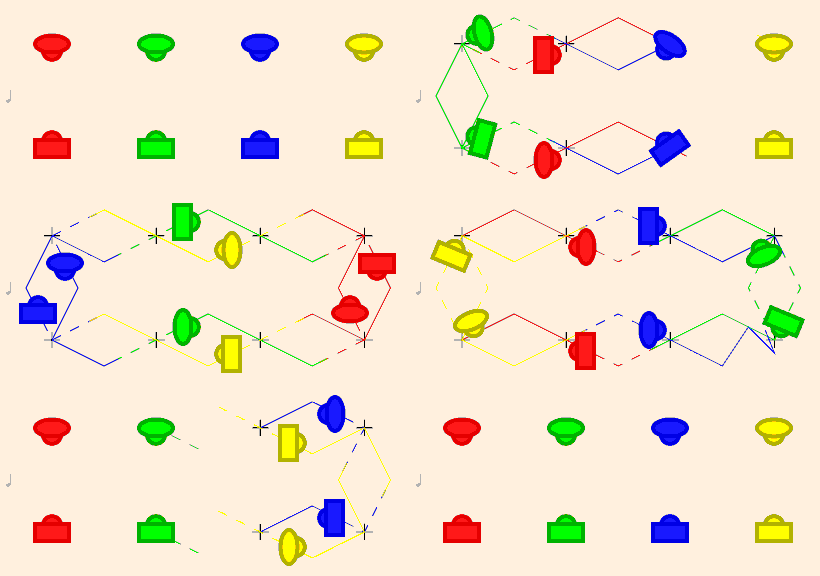 In a normal hey, everyone starts dancing at once. In a progressive hey two dancers will start, and pass each other, and then they and the dancers they face will pass by the other shoulder, and then the next dancers by the original shoulder. Each dancer waits until the one of the first pair reaches them, and then continues in their own right. The hey ends the opposite way: when the first two dancers reach their original places they stop, but the other dancers continue, only stopping when they reach their original places.
(Note that this is very similar to the old style of starting a country dance: where only the 1s and 2s were initially active, then the 1s+3s, then the 2s+3s and 1s+4s...
History
The earliest description of a hey that I've found is a progressive hey. In Thoinot Arbeau's (Jehan Tabourot) Orchésographie, 1589, a book about French dancing, he describes a dance called "Branle de la Haye" (page 90 (his numbering is unexpected, he only numbers every other page, most would call this page 180) where he gives a very clear definition.
Les danceurs seuls, & l'vn apre l'aultre, premierement dancent l'air en façon de Courante, & sur la fin s'entrelacent, & font la haye les vns parmy les aultres: ....Capriol.Ie ne leulx pas bien conprendre ce que dictes de cette haye.Arbeau.Vous l'entendrez bien facilement ansi: Posez le cas qu'ilz foient trois dáceurs (cest le moindre nombre qui y peult estre) & ymaginez qu'ils soient comme voiez ces lettres A B C.A B CE's premiers quatre pas de l'air de la haye, A & B changent de place en passant a leurs gaulches, puis és quatre secódes mesures A & C change de place, en passant a leurs main droictes, tellement qu'ils se treuueront placez ainsi que voiez icy.B C ACe fait, B & C changeront comme dessus, puis B & A, tellement qui'ils se treuueront disposez ainsi que voiez étroifiemes quatre pas de l'air de la haye.C A BE's quatre pas suyuants, C changera auec A, puis ledit C auec B, & ainsi se retreuueront comme au commencement.A B C
The dancers alone, one after another, first dance an air in the style of the Courante and, after that, interlace themselves, making a hay, each among the others....Capriol.I don't understand what you mean by this "hay".Arbeau.You will understand it easily thus: suppose that you have three dancers (that's the smallest number there can be) and imagine they are arranged as the letters A B C.A B CDuring the first four steps of the air of the hay, A & B change places by passing to their left, then the next four beats A & C change places passing by their right hands, now they are ordered thusly:B C AThis done, B & C change places as before, then B & A, and now they are disposed:C A BIn the next four steps, C changes with A, then the same C with B, and thus everyone finds themselves where they started.A B C
Playford, too, used progressive heys as early as 1651 in his dance À la Mode de France: then the 1. man take his wo. by the hand, his left hand to the 2. wo. the right to the 3. wo. and so forward, his wo. doing the like on the other side until you all meet again in your places.
Some dances which (probably) use this figure
- Dances for which I have animations
Note: This list may be incorrect or incomplete.
See Also
This website is copyright © 2021-2026 by George W. Williams V My work is licensed under a Creative Commons Attribution 4.0 International License. Most of the dances have more restrictive licensing, see my notes on copyright, the individual dance pages should mention when some rights are waived.