

Scottish Allemande
An online definition may be found here.
Bars: 8.
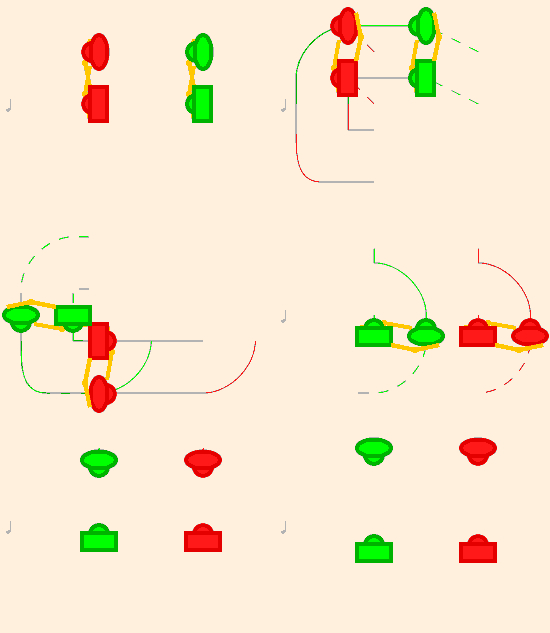 This is a figure for two couples (later extended to more) who start on the center line, beside partner, facing up, in either allemande or promenade hold. On the first bar they step out toward the woman's line and up and change from promenade to allemande hold if they need to. The first couple pivots about the man to face the men's line, and dance to it, then again pivot about the man to face down, then move down. The 2nd couple follows the first. By the end of bar 4 both couples should be facing down, the 1s in 2nd place, and the 2s in first. On bar 5 the couples pivot to face in (so now everyone is on the men's line M2 at top, W1 at bottom). On the sixth bar everyone dances in and the women move to stand across from and facing their partners, raising arms above the woman's head. Then release hands and fall back over the next two bars.
History
None of the books (I've found) printed by 19th Scottish dancing masters use the term "allemande". So I don't think there was any history of an "allemande" figure in Scotland prior to the (R)SCDS". The first use of "allemande" is in the interpretation of William Campbell's Delvine Side, interpreted in (R)SCDS Book 2 in 1925. Campbell was a London publisher, and at that time an "Allemande" probably meant the Linked Arm Allemande which took four bars, involved one couple, and was not progressive.
The (R)SCDS replaced this with something that involved at least two couples, took eight bars, and was progressive.
Murrough Landon has pointed out to me that Miss Milligan had more books of old dances than she did of old figures, and probably didn't know what an allemande was. She may have seen a description in Lowes' Ball-Conductor and Assembly Guide, ~1831, where they define a Spanish figure called allemanda:
Allemanda, (allemande,) the same figure as promenade, only the hands joined behind backs.
Which has some resemblance to the Scottish version, except that a promenade is not progressive.
(Note the Lowe's define this figure, but none of their dances actually uses it. It doesn't seem to have been a Scottish figure at that time.)
The original (R)SCDS allemande was for two couples. The first dance I know of to use a three couple version is Balmoral Strathspey, devised by John A. Charles and published in RSCDS Book 22 in 1963.
Some dances which (probably) use this figure
- Dances for which I have animations
- Dances in (R)SCDS Books
Note: This list may be incorrect or incomplete.
See Also
This website is copyright © 2021-2026 by George W. Williams V My work is licensed under a Creative Commons Attribution 4.0 International License. Most of the dances have more restrictive licensing, see my notes on copyright, the individual dance pages should mention when some rights are waived.