

Allemande
Bars: 4.
"Allemande" just means "German", and an "Allemande" thus means a figure imported from Germany... which is not very precise. From its inception the term "Allemande" has been ambiguous.
And modern interpreters have come up with various ways of expressing this:
History
 |  | 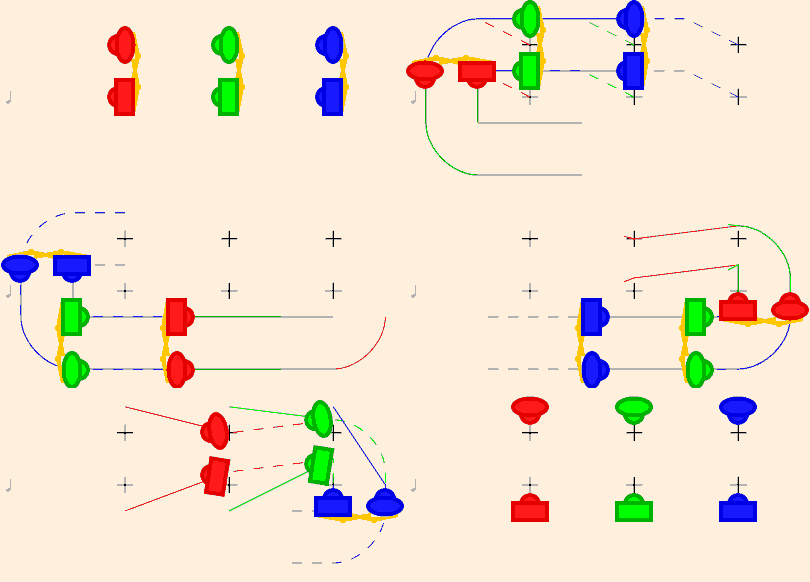 |
| Cooper's Crossed Allemande | Cooper's Pirouette Allemande | The Lowes' Promenade Allemanda |
The Regency Dance Site has a nice paper giving the history of the allemande in English dancing.
Nicholas Dukes does not define allemande in his book of Country Dance figures, published 1752.
In ~1769 in Paris in his Contredanse, Dubois appears to call for a pirouette allemande:
6. l'Hom. va en avant vis-à-vis de la f. lui fait fair l'Allemande revient à sa fem. lui fait aussi faire l'Allem. pour se remettre à leurs Place
The earliest use of "Allemande" (in English) which I have found is in Marli Water Works by Matthew Welch in perhaps ~1767 (though this date is debatable). After that Longman uses a pirouette in 1768 in a cotillion, and an unspecified allemande in 1772 in a country dance (The Herefordshire Lasses), Sancho in 1770 Thompson in 1779 (The Barley Mow), and Budd in 1781 (Miss Sayers' Allemand), etc.
In Sancho's Twelve Country Dances for the Year 1779, the dance Cutford Heath Camp uses allemande in a corner/partner, corner/partner sequence:
Allemande with the Corners with the Right hand & with your Partner with the Left hand Allemade with the opposite corners & your Partner
Across the Atlantic, in the US, Saltator, 1802 says:
ALLEMANDE, is to put one hand behind and reach the other out side-ways, turning both plams backwars matching another person's presented in like manor, and the arms interweaving with them.
There were two common styles of allemande in this period. One involved standing beside your partner right (or left) shoulder to partner's shoulder, then linking proximate arms with partner and connecting with partner's other arm behind their back. While the other allemande involved the man raising their joined arms (sometimes right, sometimes left, sometimes both) above his partner's head while she twirls beneath.
Wilson, in 1808, defines "allemande" and shows two people dancing around each other in circles, but does not say if they take hands, nor how they face. His description might be for a two hand turn, a back to back, a shoulder round, or half a dozen other possibilities and so isn't much help.
A later edition of this work, from 1815 says explicitly that people go round each other back to back.
On the other hand, his book on Quadrilles (1822) is the linked arm allemande, and points out that this is different from his country dance allemande.
The Lowes, in their Lowes' Ball-Conductor and Assembly Guide, ~1831, provide yet another version in their section on Spanish Dances and in it they define:
Allemanda, (allemande,) the same figure as promenade, only the hands joined behind backs.
The meaning of Allemande in modern Square Dancing (and Contra Dancing), and the meaning in Scottish Country Dance do not seem to match any of these
This website is copyright © 2021-2026 by George W. Williams V My work is licensed under a Creative Commons Attribution 4.0 International License. Most of the dances have more restrictive licensing, see my notes on copyright, the individual dance pages should mention when some rights are waived.