

Table of Contents
C
| Dance Title | Type | Deviser (or Editor/Publisher), Date, Interpreter | Music Performers | Formation |
|---|---|---|---|---|
| Cannock Chase |  | Charles Bolton 1991
| Dave Bartley, Ruthie Dornfeld and Terry Wergeland | 3 Couple Longways permutation: 312 |
I
| Dance Title | Type | Deviser (or Editor/Publisher), Date, Interpreter | Music Performers | Formation |
|---|---|---|---|---|
| Impropriety | | Brooke Friendly/Chris Sackett 1999
| Bare Necessities | Duple Minor |
J
| Dance Title | Type | Deviser (or Editor/Publisher), Date, Interpreter | Music Performers | Formation |
|---|---|---|---|---|
| Jack's Health ~ Bolton | | John Playford 1679 Charles Bolton ~2004 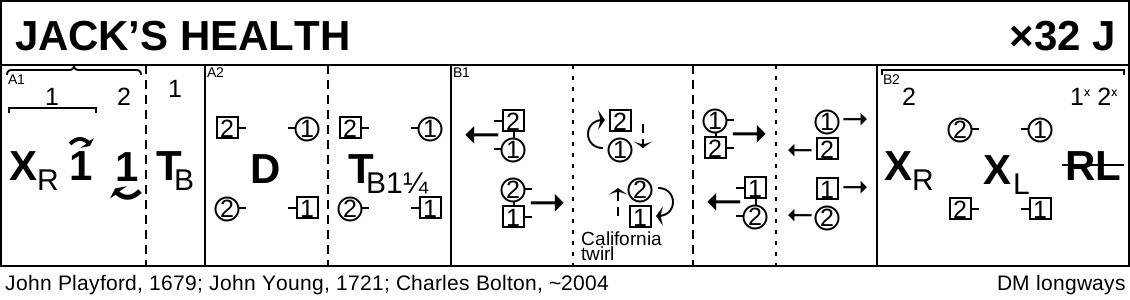
|  | Duple Minor |
S
| Dance Title | Type | Deviser (or Editor/Publisher), Date, Interpreter | Music Performers | Formation |
|---|---|---|---|---|
| Smithy Hill | | Tom Cook 1987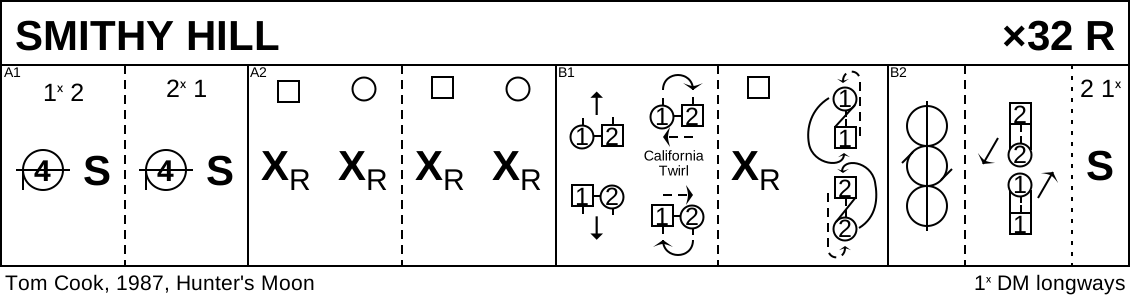
| Bare Necessities | Duple Minor |
| Number of dances | Number of versions | Number with music |
|---|---|---|
| 4 | 4 | 3 |
Warning: The figures for each dance is generated programmatically by regular expression matching and may be in error. Also, for old dances, they reflect the figures used by the interpreter which may not match those of the deviser.
California Twirl
Also known as: California Whirl, Frontier Twirl, Twirl to Swap.
An online definition may be found here.
Bars: 2.
 This figure involves a couple, standing side by side, with the woman to the right of the man and inside hands joined. They change places, and end facing the other way (with the same hands still joined. The man walks forward outside the woman in a semicircle turning right, while the woman twirls under their joined hands 180° to the left.
History
Lloyd Shaw does not mention it in his Cowboy Dances from 1939.
The first use I can find is from the report of the "Southern California Square Dance Standardization Subcommitee" which was published in the January 1951 issue of Sets in Order.
California Whirl (Turn-back or around after an arch)
Although the modern California Twirl is invariably done with the man on the left and woman on the right, this does not seem to be the case in 1951 with more examples where the man is on the right:
It's Corners California Whirl, and see-saw round with your own sweet girl"California Whirl": holding his corner's right hand in his left, the gent twirls the lady in a CW spin under his left arm while he walks a half CCW turn, ending up at arm's length, each facing in proper grand-right-and-left direction. Then passing corner girl by left shoulder, see-saw round partner, also passing left shoulderCalifornia, Here I Come by Bob Hall, published in the Nov, 1951 issue of Sets in Order
By 1953, the term "California Twirl" appears in Easy Key Handbook of Square Dance Fundamentals, Clarke Kugler. And his definition now says that the woman is on the man's right.
In a glossary printed in the May, 1957 issue of Sets in Order, both "California Twirl" and "California Whirl" appear and are mirror images of each other. In a "California Twirl" the man's right hand connects to the woman's left, while in "California Whirl" the woman's right hand connects to the man's left.
Things were different on the East Coast: in Northern Junket, Aug, 1970, page 22 there is a dance which uses the term "Frontier Twirl" (with a comment saying it's a new term for an old figure) in a context where I'd use a "California Twirl", so I suspect the two are the same. Although published in 1970, the dance itself dates to 1968.
CALLERLAB published the first standardized list of calls in 1975, and California Twirl was on that list.
Recently I have seen the term "Twirl to Swap" used to mean a non-gendered version of California Twirl, and, occasionally, "Box the Gnat", and "Star Through".
See Also
This website is copyright © 2021-2026 by George W. Williams V My work is licensed under a Creative Commons Attribution 4.0 International License. Most of the dances have more restrictive licensing, see my notes on copyright, the individual dance pages should mention when some rights are waived.