

Table of Contents
H
| Dance Title | Type | Deviser (or Editor/Publisher), Date, Interpreter | Music Performers | Formation |
|---|---|---|---|---|
| Hoffed Ap Hywel |  | Charles and Samuel Thompson 1765 Pat Shaw? ~1971 | Colin Hume | 3 Couple Longways permutation: 231 |
I
| Dance Title | Type | Deviser (or Editor/Publisher), Date, Interpreter | Music Performers | Formation |
|---|---|---|---|---|
| Impropriety | | Brooke Friendly/Chris Sackett 1999 | Bare Necessities | Duple Minor |
P
| Dance Title | Type | Deviser (or Editor/Publisher), Date, Interpreter | Music Performers | Formation |
|---|---|---|---|---|
| Powell's Fancy | | Charles and Samuel Thompson 1765 Pat Shaw? ~1971 | Colin Hume | 3 Couple Longways permutation: 231 |
| Number of dances | Number of versions | Number with music |
|---|---|---|
| 2 | 2 | 2 |
Warning: The figures for each dance is generated programmatically by regular expression matching and may be in error. Also, for old dances, they reflect the figures used by the interpreter which may not match those of the deviser.
Lead Out Through The Sides
Bars: 8.
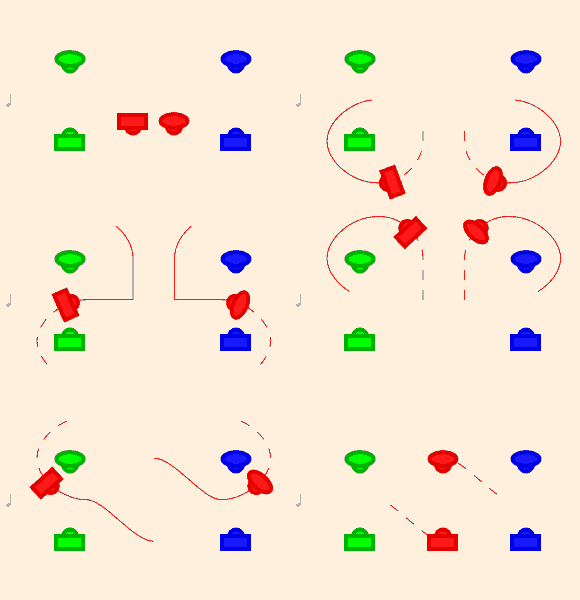 I know of too many very different meanings for "lead out sides" in modern usage.
- The first was used by Pat Shaw in Prince William, by Keller & Sweet in A Choice Selection of American Country Dances of the Revolutionary Era, and by the RSCDS in The Bonniest Lass in all the World, in it the 1s meet in the center, take hands and lead out between the women, cast away from each other, looping around the corner, meet again in center, lead out between men cast away, loop corners and return home.
John Young describes the figure, though he does not name it in Audenard Battle, and Eccles's Maggot, first published in ~1710, he uses it again in Albarony, 1726. Kynaston also describes this movement, though he also does not name it, in The Merry Salopians in 1718. And Walsh used it in a number of dances including Athol Brays in 1731.
Sometimes there is a two hand turn half in the middle so that the woman is always on the right during the leads.
Johnson in his 8th volume appears to use this meaning as he juxtaposes "Lead out sides" with "Lead out bottom & top" (which is the same thing rotated 90°).
- The second is defined by Wilson in his An Analysis of Country Dancing, page 51, in it the 1s again meet in the center, lead to between the men, turn around, lead to between the women, turn around, lead back to center, where Wilson leaves them.
- Nicholas Dukes defines "Lead out sides and turn in the middle" which seems to involve having the 1s cross to their first corners, leading them out and turning them, going back to partner, turning them, and finishing 2nd place proper. I think.
- Dukes also defines "lead out sides & in again", and, honestly I can't make head nor tail of his diagram. His description is "The two first Men & two first Wo: finish in their own places."
- The next involves having everyone face out, lead out, turn and lead back. (This seems more like a 4 bar figure rather than the 8 bars usually allocated to it). In the dance The Last New Vagaries, Playford describes these movements, though he does not give them a name.
- Tom Cook in The Fairy Prince has the 1s cross to improper sides, lead out (M1 with the two corner women, W2 with the two corner men), turn, lead back, 1s cross to proper, lead out (M1 with men, W1 with women), turn, lead back.
- The last meaning was used by Bernard Bentley in The Happy Pair where the 1s start between the women, lead out in a line of four with them, turn and lead back, the 1s two hand turn moving to the men's line, stand between them and lead out with them in a line of four with them, turn, and lead back.
History
John Young describes (but does not name) a figure that might be lead out sides in Sham Doctor, 1718: and lead through the one side, and meet and clap Hands, and lead through the other cu., or might just be lead out top and bottom.
John Young uses the turn "lead outsides" in The Whirly Gigg, in 1726 then The Register of Dances at Castle Menzies uses this term in Montgomerie's Rant in 1749, and Johnson is using it by 1758 in The First of January. What they meant by it is unclear.
Dukes, 1752, defines at least three figures which contain the words "lead out sides"
See Also
This website is copyright © 2021-2026 by George W. Williams V My work is licensed under a Creative Commons Attribution 4.0 International License. Most of the dances have more restrictive licensing, see my notes on copyright, the individual dance pages should mention when some rights are waived.