

Early Sources of RSCDS dances
None of the dances published by the RSCDS before book 13 were devised by the RSCDS, instead they were considered "traditional" dances. Many dances published in subsequent books fall into that category as well. I have tried to track down the sources of these dances and display here the earliest published versions of the dance's figure which I've been able to find.
In some cases the RSCDS mentions a source. Often I have found earlier examples of the dance. Sometimes I have been unable to find the RSCDS source and will present the earliest source I have found.
When I know the deviser, I mark the name in italics. In most cases for these old dances I only know the publisher.
When a dance source is marked with "†" it means I have been unable to verify the source of the dance, when it is marked with "‡" it means I have been unable to find any Scottish dance manual containing this dance (prior to 1924).
Hovering the mouse over a dance's devisor/publisher will (often) produce a popup containing the text of the original.By default the list below shows only traditional dances interpreted by the (R)SCDS. I believe that Book 34 (1986) was the last book to contain any traditional dances. Before Book 13 all (R)SCDS dances were traditional, but Book 13 contains The Reel of the 51st Division, the first published modern dance. No further modern dances were published until Book 22 (1963), and after that some books contained modern and some traditional dances until Books 31&34, which contains both.
At the end I have several tables of statistics.
Order by:
Include:
(R)SCDS Book Range:
Containing figure:
(R)SCDS Book 1, 1924
| Petronella | J. P. Boulogne, Glasgow, 1827 The Ball-Room, or the Juvenile Pupil's Assistant; Containing the Most Fashionable Quadrilles, with Les Lanciers of Sixteen, As Danced in the Public & Private Assemblies in Paris The first dance in the first book of the (R)SCDS is Petronella. According to that book this dance was "introduced" by Nathaniel Gow, a composer and musician of Edinburgh, in 1820. Although Gow published many tunes (including this one), I have been unable to find any choreographies by him. Book 1 also says the dance was published in a book called The Ball-Room, 1827 (no editor, or publisher, or location given), actually the book is titled The Ball-Room, or the Juvenile Pupil's Assistant; Containing the Most Fashionable Quadrilles, with Les Lanciers of Sixteen, As Danced in the Public & Private Assemblies in Paris published in Glasgow, 1827 and the author is J. P. Boulogne. This work actually contains three versions of the dance — though the last two have the same figure (all called Petronelle not Petronella), the first is an "English Quadrille", found on page 40, the second a "Spanish Dance" found on page 41, and the last is an "English Country Dance", found on page 43
Sadly Boulogne does not have a glossary where he defines what he means by his figures, so we don't know what the figure of a diamond means exactly, nor what steps are used to do it. We have a bit more luck with Down the middle and up again. This might seem quite straightforward, but it is not. In England at this time, the term was progressive, meaning that the 1s ended up in 2nd place while the 2s moved up (either the 1s went down, came all the way back and cast off, or the 1s end down and only came back to 2nd place). If we look at Meg Mirrilees (another dance on page 43) we see the Boulogne also uses Down the middle and up again as progressive. This means that Boulogne's Pousette was non-progressive, and presumably still meant the standard push-pull poussette that came to the UK from France in about 1760. In 1821, G.M.S. Chivers in The Dancer's Guide page 57, had described Spanish dances as starting improper, and I suspect this might be intended here and explain why the same figure occurs twice. I don't see that it makes much difference whether the first couple is proper or improper. The Spanish version of the dance is subtitled "Hungarian Waltz" in Boulogne (Not a part of Spain I'm familiar with). The next earliest description of the figure I've found was published by the Lowes in Lowes' Ball-Conductor and Assembly Guide. of 1831. The Lowes published in Edinburgh, and their book has three sub-categories of country dance: English, Scotch and Irish. Petronella is categorized as an "English Country Dance". They describe it thusly: First couple chassé round to the right, and set in the middle; round to the right again, and set on the sides; to the right again, and set in places; down the middle, up again, and pousette. By 1853, the Lowes had become just Joseph Lowe, and he published a somewhat different version in his Lowe's Selection of Popular Country Dances (courtesy of the National Library of Scotland):
In ~1868 H. D. Wilcock in Ball-Room Guide; A Manual of Dancing page 70, writes:
In 1868 Elias Howe in The Pianist's Matinee: A Collection of Music for the Piano-Forte, writes: First couple turn round to the right, and balance opposite to each other in the middle of the dance. (4 bars) Again round to the right, and balance on the sides of the dance. (4 bars) Again to the right, and balance in the middle. (4 bars) Again to the right, and balance in places. (4 bars) First couple down the middle and up again (8 bars) Right and left with the next couple. (8 bars) In ~1872 J. F. Wallace in The Excelsior Manual of Dancing, (Glasgow), writes:
In 1897 in D. Anderson's Ball-Room and Solo Dance Guide, (Dundee)
Note: Anderson very explicitly says the lead down and back returns to places, while fifty years earlier it had an implied cast off. That means his "pousette" must be progressive, though he does not say that explicitly. Many pages later in the book Anderson defines a "Petronella Step". He does not explicitly say it is for petronella turns, rather he says This Step may also be used for Contra Dances, Circassian Circle, etc., in setting to partners, but must never be used for Quadrilles.
In ~1898 J. Scott Skinner in The People's Ball Room Guide, (Dundee), writes:
While in the book Prompting: How To Do It by John M. Schell, published Boston, 1890. First couple balance to side (4); balance to center (4); balance to side (4); balance to center (4); first couple down centre and back, cast off (8); right and left (8). Back in Scotland, in Allan's Reference Guide to the Ball-Room, says:
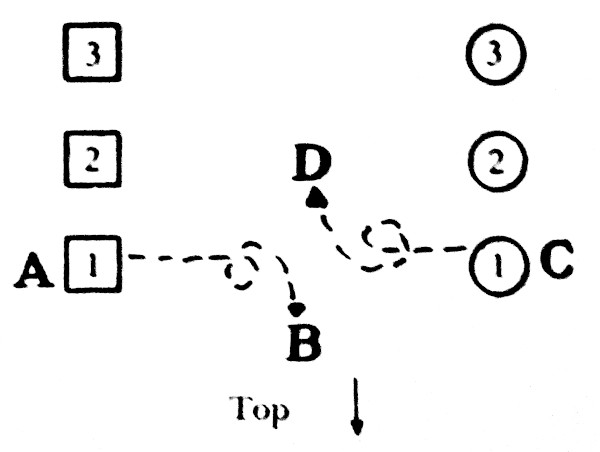
Note that in 1831 the 1s simply chassé into position with no turn, but by 1868 they are turning into the middle, then in 1924 the (R)SCDS describes the figure: 1st woman moves from A to B with two pas de basque, leading off with the right foot and making a three-quarter turn by the right, in the middle of which she has her back to her partner. The modern contra figure seems similar to that described by Wilcock in 1868. As this dance is rather boring for the 2s a number of variations have arisen. The tune was published by Nathaniel Gow in about 1820. The music was synthesized using Colin Hume's software.
|
(R)SCDS Book 2, 1925
| The Princess Royal ~ RSCDS | Joseph Lowe, Edinburgh, ~1850 Lowe's Selection of Popular Country Dances Common name for dances; Wright, Walsh, Straight, Campbell, Howe and Wilcock all have figures for it, but I have found none which seems to match this one. Lowe writes: First couple turn round to the right, and set opposite to each other in the middle of the Dance (4 Bars) Again round to the right, the Lady going between the second and third Gentlemen, and the Gentlemen between the second and third Ladies (4 Bars) Six hands round and back again (8 Bars) The Lady between the two Gentlemen, and the Gentleman between the two Ladies, advance and retire. (4 Bars) The Gentleman who commenced the Dance, then turns his partner to her own side. (2 Bars) And all clap their hands, counting 1, 2, 3, 1, 2, 3 (2 Bars) Then the three Ladies on their own side, and the three Gentlemen on theirs go three hands round. (4 Bars) Then commence the Figure again. Courtesy of National Library of Scotland, licensed under: 
|
(R)SCDS Book 5, 1929
| Dumbarton Drums ~ RSCDS | Thomas Wilson, London, 1816‡ A Companion to the Ball Room Wilson writes (on page 40): SINGLE FIGURE (Tune played straight thro') Wilson usually gives multiple figures for a tune, the (R)SCDS appears to have conflated the first figure and the last. They seem to have taken the first 8 bars from the first figure (the hey), and added the last 16 bars of the final figure, except these have been reinterpreted to take up 24 bars. The music consists of two 8 bar strains. Wilson defines most of his figures in his An Analysis of Country Dancing.
|
(R)SCDS Book 6, 1930
| The Edinburgh Volunteers ~ RSCDS | Bartholomew Cooke, Dublin, 1796‡ Cooke's Selection of the Present Favorite Country Dances for the Year 1796 Cooke writes: 1st. La. turn 2d Gent. 1st. Gent. do the same. fall in at top & bottom & at the sides 6 hands round back again & turn your Part.
|
(R)SCDS Book 9, 1934
| Cauld Kail | Anonymous, Dumfriesshire, Scotland, ~1730 Holmain MS From the Holmain MS (dated sometime between 1710 and 1750):
|
(R)SCDS Book 11, 1936
| Monymusk | Preston, London, 1786 Twenty four Country-Dances for the Year 1786 Monymusk is an estate in Aberdeenshire is Scotland. Cracking Chestnuts says the tune was written by Daniel Dow and published in Thirty Seven New Reels and Strathspeys in 1776. Francis Werner set figures to the tune in his 8 Cotillions, 6 Favorite Contry Dances and two Minuets, with their proper Figures for the Harp, Harpsichord and Violin Book xvii for the year 1785. John Preston in 1786 published a different set of figures. Hugh Thurston in Northern Junket Vol 11#9 (1974) claims: "But Monymusk is not a traditional Scottish dance. It was resurrected in 1934 (out of a book published in England in 1786) and there is no evidence that it was ever danced in Scotland before that date." In another article he says "Second, it is reconstructed wrongly". Werner Book XVIII For the Year 1785 (London, 1785) writes: Turn your partner with the right hand; quite round, and cast off one Cu. Turn with the left quite round, Set three and three top and bottom, and turn your Partner, Set three and three sideways and turn your Partner. Hands six quite round and back again Lead out sides and turn your Partner with both hands. In Preston's Twenty four Country-Dances for the Year 1786: Turn your partner with the right hand and cast off one couple Turn your partner with the left hand and cast back, the lady falling in at the top, the gentleman at the bottom set three and three and turn your partner set three and three sideways and turn your partner hands six round and back again lead through the bottom and come up one couple lead through the top The RSCDS claims their reconstruction is based on Preston, but it actually looks more like Werner's in the first 8 bars. John Griffiths in The Gentleman & Lady's Companion (Norwich, CT, 1798) has a different figure: Six hands half way round and back, first and second gentlemen balance together and turn round, the 1st and 2nd ladies do the same, down the middle, up again, cast off, right and left In A Treatise on Dancing (Boston, 1802) Saltator writes: First couple cross over, down the out side, promenade round the gentleman, fall between the second couple, the lady between the third, six dance address, first couple promenade and fall below the second, six demicircinate, right and left atop. Wilson Treasures of Terpsichore, page 80 (London, 1809)
Howe Complete Ball-room Hand Book, page 82 (Boston, 1858) First couple join right hands and swing once and a half round, go below second couple (the first lady goes below second gentleman on the outside) (first gentleman at the same time goes below and between second and third ladies) — forward and back six, first couple swing three quarters round — first gentleman goes between second couple (on the inside) first lady goes between third couple (on the indside) forward and back six, first couple swing three quarters. Burchenal American Country-dances, page 55 (New York/Boston, 1912) Swing Once and a Half Around |
RSCDS Book 17, 1953 (Coronation Book)
| Donald Bane ~ RSCDS | Thomas Wilson, London, 1816‡ A Companion to the Ball Room Donald Bane is an anglicization of Domnall Bán (Donald the Fair) and was the great-grandson of the king killed by MacBeth. Wilson writes (on page 80): SINGLE FIGURE Each strain repeated Wilson usually gives multiple figures for a tune, this is an attempt to understand the double figure he describes. The music consists of two 4 bar strains. Wilson's usual statement for double figures (which he gives on the dance above this) is Tune played twice through with repeats. So the music should probably be played AABBAABB. Wilson spells the dance "Donaldbane". Wilson defines most of his figures in his An Analysis of Country Dancing. It is not obvious to me where in this sequence Wilson expects progression to happen. Perhaps the first movement of set contrary corners has the 1s moving down and the 2s up. |
RSCDS Book 19, 1957
| None So Pretty - Wilson ~ RSCDS | Thomas Wilson, London, 1816 A Companion to the Ball Room Wilson writes: SINGLE FIGURE1st. strain repeat 2d. played straight thro & D.C. Wilson has a different figure for this tune in his earlier book Treasures of Terpsichore, 1809. Preston has yet another figure in 1796. Cahusac gives two figures in 1795. Campbell has a figure in Campbell's 9th Book of New and Favorite Country Dances & Strathspey Reels from about 1794. While Rutherford, 1756 and Johnson, 1742 give the same figure (Rutherford's compleat Collection of 200 of the most celebrated Country Dances both Old and New, Vol. 1) — but the music they give is a different tune (for one thing it is a jig, not a reel). The following is an attempt to understand Wilson's DOUBLE FIGURE which is the basis of the Scottish Country Dance. In An Analysis of Country Dancing Wilson defines some of the terms he uses. A "whole figure" is just a "full figure eight" (as you might expect, Playford uses the same phrase). Wilson does not explicitly define "whole figure contrary corners" in his first edition, but he does in his second on page 104 of the 2nd edition of the Analysis (1811). Rather awkwardly, Wilson provides two different (contradictory) directions. In the first "the 1s cross down, W1 in front of M1, W1 around M3, M1 around W3, then cross up, W1 around W2, M1 around M2, and return home". In the second the "1s cross up, W1 around M2, M1 around W2, then cross down W1 around W3, M1 around M3, and return home. Chain figure for four is also defined in the second edition, on page 76 and it is what anyone else would call rights and lefts. Wilson gives a very unclear definition of "allemande" it might be a modern gypsy, or a back to back (he defines neigther of these figures). He says the two people doing the allemande walk in circles around one another, he does not mention taking hands, he does not say how their faces are oriented. |
RSCDS Book 20, 1959
| The College Hornpipe - RSCDS | William Boag, London, 1797 A Collection of Favourite Reels and Strathspeys by the most Eminent Composers |
RSCDS Book 21, 1961
| The Lea Rig | Anonymous, date unknown† |
RSCDS Book 22, 1963
| Miss Janet Laing's Strathspey | Isobel Cramb, Aberdeen, 1963 RSCDS Book 22 |
RSCDS Book 23, 1967
| The Starry Eyed Lassie | Martin Sprague, Dorset, 1967 RSCDS Book 23 |
RSCDS Book 24, 1968
| Adieu Mon Ami | Thomas Wilson, London, 1814 Le Sylphe, An Elegant Collection of Twenty four Country Dances, for the Year 1814 |
RSCDS Book 26, 1972
| Rob Roy MacGregor ~ RSCDS | G.M.S. Chivers, London, 1821 The Dancer's Guide Wilson published several figures named Rob Roy in his L'Assemblee of 1819 but none has a figure which matches the RSCDS version. On page 73 of his The Dancers' Guide, 1821, Chivers writes: Rob Roy Macgregor... First couple lead down the middle, the second follow, half right and left back again, and half right and left swing corners right and left at top On page 69 of his The Excelsior Manual of Dancing, ~1872, J. F. Wallace writes:
|
RSCDS Book 27, 1975
| La Flora | Monro, [Unknown City], ~1790 Monro's Country Dances |
RSCDS Book 28, 1977
| The New Petronella | Anonymous, date unknown† | |
| Not I | Johnson, London, ~1754†‡ Caledonian Country Dances Vol. II |
RSCDS Book 31, 1983 (Diamond Jubilee)
| Autumn in Appin | John Drewry, Aberdeen, 1982 RSCDS Book 31 |
RSCDS Book 32, 1984
| Miss Nancy Arnott | Graeme Stevens, Kirkcaldy, 1983 RSCDS Book 32 |
RSCDS Book 34, 1986
| Glasgow Lasses - RSCDS | Walsh, London, 1748 Caledonian Country Dances Vol. II Part 1 Walsh writes: First Man foot it to the 2d Wo. and cast off into the 2d Man's Place, and the 2d Wo. cast up at the same time into the 1st Wo. Place — Then the 2d Man foot it to ye 1st Wo. (he being at Top) and cast off into his Place, and the 1st Wo. cast up into her Place then the 1st and 2d Man foot it to their Partners, the 1st Cu. cast off one Cu. take Hands with the 2d. Cu. and lead up, foot it and cast off into the 2d Cu: Place. The music is two eight bar strains, the first repeated, the second not. Walsh spells "Glasgow" as "Glascow". Davis also published this dance in 1748, and also spells "Glascow", I have no idea which published first. |
RSCDS Book 35, 1988
| Inverneill House | John Drewry, Aberdeen, 1986 RSCDS Book 35 | |
| Major Ian Stewart | John Drewry, Aberdeen, 1986 RSCDS Book 35 |
RSCDS Book 36, 1990 (Frae A' The Airts, Vol. 1)
| Gang the Same Gate | Milton Levy, [Unknown City], 1990 RSCDS Book 36 |
RSCDS Book 37, 1992 (Frae A' The Airts, Vol. 2)
| Queen City Salute | G Dale Birdsall, Cincinnati, ~1992 RSCDS Book 37 | |
| Wisp of Thistle | Pat Kent, [Unknown City], ~1992 RSCDS Book 37 |
RSCDS Book 38, 1994
| Back to the Fireside | Roy Goldring, Leeds, ~1994 RSCDS Book 38 | |
| Miss Florence Adams | John Drewry, Aberdeen, 1991 RSCDS Book 38 | |
| A Trip to the Drakensberg | Barbara J Rendle-Braime, [Unknown City], ~1994 RSCDS Book 38 |
RSCDS Book 42, 2002
| Anna Holden's Strathspey | John Drewry, Aberdeen, 1991 RSCDS Book 42 | |
| Anna Holden's Waltz | John Drewry, Aberdeen, 1991 RSCDS Book 42 |
RSCDS Book 43, 2003 (Golden Jubilee Dances)
| The Celebration Strathspey | Alan MacPherson, [Unknown City], 2002 RSCDS Book 43 | |
| The Corian Strathspey | Maurice Whitby, [Unknown City], 1995 RSCDS Book 43 |
RSCDS Book 44, 2004
| Starlight | Ed Abdill, [Unknown City], ~2004 RSCDS Book 44 |
RSCDS Book 45, 2005
| The Fairbridge Reel | John Brenchley, [Unknown City], 1989 RSCDS Book 45 |
RSCDS Book 46, 2010
| Links with St. Petersburg | Malcolm Brown, [Unknown City], 2009 RSCDS Book 46 | |
| Peggy Spouse MBE | John Wilkinson, [Unknown City], ~2010 RSCDS Book 46 |
RSCDS Book 48, 2014
| Farewell to Helensburgh | Brian Charlton, [Unknown City], 2003 RSCDS Book 48 | |
| Lady in Red | Simon Scott, [Unknown City], 2004 RSCDS Book 48 | |
| A Summer Meeting | Irene Townshend, [Unknown City], 2014 RSCDS Book 48 | |
| The Tri-Mariner | Ann Dix, [Unknown City], 1993 RSCDS Book 48 |
RSCDS Book 49, 2015
| Midsummer Common | Tom and Lindsey Ibbotson, [Unknown City], 2013 RSCDS Book 49 |
RSCDS Book 51, 2017
| Hello-Goodbye | Chris Ronald, [Unknown City], 2012 RSCDS Book 51 |
RSCDS Book 52, 2018
| Trip to Timber Ridge | Linda Henderson, [Unknown City], 2012 RSCDS Book 52 | |
| The Ullapool Ferry | Pat Houghton, [Unknown City], 2015 RSCDS Book 52 |
RSCDS Book 53, 2023
| Elspeth Gray's Reel | Tom Toriyama, [Unknown City], 2019 RSCDS Book 53 | |
| The Orchards of County Armagh | Jinty Anderson, [Unknown City], 2016 RSCDS Book 53 | |
| Pinewoods Reel | John Bowie Dickson, [Unknown City], 1970 RSCDS Book 53 | |
| Schiehallion | Hugh A Thurston, Vancouver, Ca., 1971 RSCDS Book 53 | |
| Ysobel | John Drewry, Aberdeen, 1973 RSCDS Book 53 |
RSCDS Book 54, 2025
| Dancing in Perthshire | Janet Macdonald, [Unknown City], ~2020 RSCDS Book 54 | |
| A Driving Reel | Lizzie Wratten, [Unknown City], ~2025 RSCDS Book 54 | |
| A Hundred Years Since | Peter Knapman, [Unknown City], 2023 RSCDS Book 54 | |
| Miss Lucy Clark | Valerie Farr, [Unknown City], ~2025 RSCDS Book 54 | |
| Thank You Patricia | Deb Lees, [Unknown City], ~2025 RSCDS Book 54 |
Miss Milligan's Miscellany 1, ~1977
| Brechin Lassies | Anonymous, date unknown† | |
| The Duke of Roxburgh's Reel | Thomas Skillern, London, ~1776‡ Skillern's Compleat Collection of Two Hundred & Four Reels and Country Dances |
Miss Milligan's Miscellany 2, ~1977
| The Blithest Lass that ever was Seen | Thompson, London, ~1757‡ Thompson's Compleat Collection of 200 Favourite Country Dances, Vol I Thompson writes: The 1st. Cu. foot it cast off one Cu the Man cast off the 3d. Cu. and the Wo. cast up meet in the Middle and turn hands the 1st. Cu. fall in at top and bottom and foot it all six fall in Sides and foot it all six and turn set contrary Corners and turn lead thro' sides and turn The original music consisted of two eight bar strains in jig time. | |
| Lady Susan Stewart's Strathspey | Anonymous, date unknown† | |
| The Thistle | Kate Hughes, Dundalk, Ireland, ~1867 Kate Hughes' Dancing Book Bride published a dance with this name in 1768 but it had a different figure. Longman & Broderip republished it in 1781. Kate Hughes wrote down a dance very similar to the RSCDS version:
And in his The "Excelsior" Manual of Dancing, ~1872, J. F. Wallace writes:
|
Statistics
Number of dances published by city (or region)
| [Unknown] | 30 |
| London | 11 |
| Aberdeen | 8 |
| Cincinnati | 1 |
| Dorset | 1 |
| Dublin | 1 |
| Dumfriesshire, Scotland | 1 |
| Dundalk, Ireland | 1 |
| Edinburgh | 1 |
| Glasgow | 1 |
| Kirkcaldy | 1 |
| Leeds | 1 |
| Vancouver, Ca. | 1 |
Number of dances published by semi century
| Unknown | 4 |
| 1700-1749 | 2 |
| 1750-1799 | 7 |
| 1800-1849 | 6 |
| 1850-1899 | 2 |
| 1950-1999 | 20 |
| 2000-2049 | 18 |
Number of dances by early publisher/devisor
References
| Anonymous | Holmain MS, Dumfriesshire, Scotland, about 1730 |
| William Boag | A Collection of Favourite Reels and Strathspeys by the most Eminent Composers, London, 1797. I don't know where to find it. |
| J. P. Boulogne | The Ball-Room, or the Juvenile Pupil's Assistant; Containing the Most Fashionable Quadrilles, with Les Lanciers of Sixteen, As Danced in the Public & Private Assemblies in Paris, Glasgow, 1827. Found in the RSCDS Archives. |
| G.M.S. Chivers | The Dancer's Guide, London, 1821. Found at The British Library |
| Bartholomew Cooke | Cooke's Selection of the Present Favorite Country Dances for the Year 1796, Dublin, 1796 |
| Kate Hughes | Kate Hughes' Dancing Book, Dundalk, Ireland, about 1867 |
| Johnson | Caledonian Country Dances Vol. II, London, about 1754. I don't know where to find it. |
| Joseph Lowe | Lowe's Selection of Popular Country Dances, Edinburgh, about 1850. May be found in The National Library of Scotland |
| Monro | Monro's Country Dances, about 1790. I don't know where to find it. |
| Preston | Twenty four Country-Dances for the Year 1786, London, 1786. Robert Keller's site says this may be found in the British Library |
| Thomas Skillern | Skillern's Compleat Collection of Two Hundred & Four Reels and Country Dances, London, about 1776. Robert Keller's site says this may be found in the Mitchell Library, Glasgow. |
| Thompson | Thompson's Compleat Collection of 200 Favourite Country Dances, Vol I, London, about 1757 |
| Walsh | Caledonian Country Dances Vol. II Part 1, London, 1748 |
| Thomas Wilson | Le Sylphe, An Elegant Collection of Twenty four Country Dances, for the Year 1814, London, 1814. I don't know where to find it. |
| " | A Companion to the Ball Room, London, 1816. Robert Keller's site says this may be found in the British Library |
Scans of old dance manuals are scattered about the internet. The Vaughan Williams Memorial Library, International Music Score Library Project, Scott Pfitzinger's Playford site, Richard Powers' website, Library of Congress, and The Library of Dance all provide primary sources. A number of other sites provide indeces of these sources: The Regency Dance site, The Library of Dance again, and my own site have all proven useful for finding old sources. Finally there is Robert Keller's index which does not provide sources directly but lists thousands of dances, the publications containing them, dates and a brief coded description of the figures. This last has proven invaluable for tracking down dances for which I had no complete sources.
And, of course, both the Scottish Country Dance Database and the Scottish Country Dancing Dictionary provide online descriptions of all the RSCDS books and often hint at early sources.
This website is copyright © 2021-2026 by George W. Williams V My work is licensed under a Creative Commons Attribution 4.0 International License. Most of the dances have more restrictive licensing, see my notes on copyright, the individual dance pages should mention when some rights are waived.