Petronella ~ Lowes
If youtube's captions annoy you as much as they annoy me click on the [CC] button at the top right of the video. (It doesn't show until you start playing the video).
Petronella ~ Lowes is an old Scottish Country Dance. It was published by J. P. Boulogne in 1827 in The Ball-Room, or the Juvenile Pupil's Assistant; Containing the Most Fashionable Quadrilles, with Les Lanciers of Sixteen, As Danced in the Public & Private Assemblies in Paris. It was interpreted by The Lowes in 1831 and published in Lowes' Ball-Conductor and Assembly Guide. It is a proper Duple Minor dance. The minor set lasts 32 bars.
According to the (R)SCDS (Book 1) this dance was "introduced" by Nathaniel Gow, a composer and musician of Edinburgh, in 1820. Although Gow published many tunes (including this one), I have been unable to find any choreographies by him.
The (R)SCDS gives as their source for the dance a book called The Ball-Room (full title: The Ball-Room, or the Juvenile Pupil's Assistant; Containing the Most Fashionable Quadrilles, with Les Lanciers of Sixteen, As Danced in the Public & Private Assemblies in Paris) by J. P. Boulogne, published 1827. This work actually contains three versions of the dance (all called Petronelle not Petronella), the first is an "English Quadrille", found on page 40, the second a "Spanish Dance" (that is: improper) on page 41 and the third is an "English Country Dance", found on page 43. The instructions for the last two are exactly the same, the only difference is the starting formation.
Bars 1. The first Gentleman and third Lady perform the figure of a diamond, to their right, in the centre, setting at the four corners 16 2. Double hands across and back again, 8 3. All balancez to partners, and turn them to their places, 8 The others repeat the figures.
Bars 1. The first couple perform the figure of a diamond to their right, setting at the four corners 16 2. Down the middle and up again, 8 3. Pousette, 8 Courtesy of the RSCDS archives
(and Mary Nisbet who went there for me)
Sadly Boulogne does not have a glossary where he defines what he means by his figures, so we don't know what the figure of a diamond means exactly, nor what steps are used to do it. We have a bit more luck with Down the middle and up again. This might seem quite straightforward, but it is not. In England at this time, the term was progressive, meaning that the 1s ended up in 2nd place while the 2s moved up (either the 1s went down, came all the way back and cast off, or the 1s went down and only came back to 2nd place). If we look at Meg Mirrilees (another dance on page 43) we see the Boulogne also uses Down the middle and up again as progressive. This means that Boulogne's Pousette was non-progressive, and presumably still meant the standard push-pull poussette that came to the UK from France in about 1760.
The next earliest description of the figure I've found was published by the Lowes in Lowes' Ball-Conductor and Assembly Guide. of 1831. The Lowes published in Edinburgh, and their book has three sub-categories of country dance: English, Scotch and Irish. Petronella on page 102 is categorized as an "English Country Dance". They describe it thusly:
First couple chassé round to the right, and set in the middle; round to the right again, and set on the sides; to the right again, and set in places; down the middle, up again, and pousette.
By 1853, the Lowes had become just Joseph Lowe, and he published a somewhat different version in his Lowe's Selection of Popular Country Dances (courtesy of the National Library of Scotland):
First couple turn round to the right, and set opposite to each other in the middle of the Dance (4 Bars). Again round to the right, and set on the sides of the Dance, (4 Bars) Again round to the right, and set in the middle, (4 Bars) Again to the right and set in places. (4 Bars) First couple down the middle and up again. (8 Bars) Poussette with top couple. (8 Bars)
In ~1868 H. D. Wilcock in Ball-Room Guide; A Manual of Dancing page 70, writes:
- First couple turn round to the right, and set in centre of dance (4)
- Turn to the opposite side and set (4)
- Turn to centre and set (4)
- Turn and set in places (4)
- Lead down the middle and up again (8)
- Pousette (8)
In 1868 Elias Howe in The Pianist's Matinee: A Collection of Music for the Piano-Forte, writes:
First couple turn round to the right, and balance opposite to each other in the middle of the dance. (4 bars) Again round to the right, and balance on the sides of the dance. (4 bars) Again to the right, and balance in the middle. (4 bars) Again to the right, and balance in places. (4 bars) First couple down the middle and up again (8 bars) Right and left with the next couple. (8 bars)
In ~1872 J. F. Wallace in The Excelsior Manual of Dancing, (Glasgow), writes:
- First couple turn to their right and set in centre of dance (4 bars)
- Turn into each other's place and set (4)
- Again turn to centre by right and set (4)
- Turn to places and set, (4)
- Down the centre and back, (8)
- Poussette, (8)
In ~1898 J. Scott Skinner in The People's Ball Room Guide, writes:
This is one of the very prettiest Country Dances we have.
The dancers are arranged in the usual way.
First lady and opposite gentleman advance to the centre, one, two, three, and turn with toes to right. Then they execute the first quickstop twice.
They advance to the opposite side and set.
They advance to the centre and set.
They advance and set in places, having thus, with their successive movements described the figure of a diamond.
Then down the centre, back, and pousette.
There is a tune "Petronella" for this dance. "Meg Merrilees" suits it admirably.
While in the book Prompting: How To Do It by John M. Schell, published Boston, 1890.
First couple balance to side (4); balance to center (4); balance to side (4); balance to center (4); first couple down centre and back, cast off (8); right and left (8).
Note that in 1831 the 1s simply chassé into position with no turn, but by 1868 they are turning into the middle, then in 1924 the (R)SCDS describes the figure:
1st woman moves from A to B with two pas de basque, leading off with the right foot and making a three-quarter turn by the right, in the middle of which she has her back to her partner.
1st man moves similarly from C to D.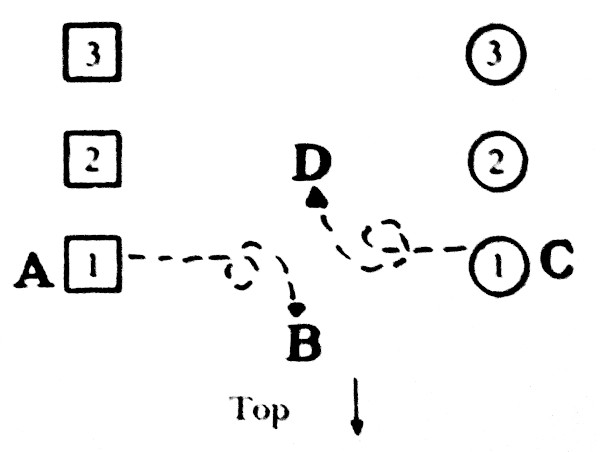
The modern contra figure seems similar to that described by Wilcock in 1868.
The Lowes do not print their definitions of the terms they use in describing country dances, so we must guess. The 1st couple "chassé" — I assume that means, chassé right with no twirls or spins, and presumably all repetitions are the same. Then we have down the middle, up again and poussette. One of these must be progressive, but not both. If you look at Captain Fleming (page 101 of the same work) you will find down the middle, up again used as progressive. While in The Lady of the Lake, page 99, poussette is non-progressive.
Before about about 1860 minor set dances always started with just the top two (or three) couples dancing. Then the top couple would move down one and dance with the next couple (the third from the top), still no one else would be dancing. After two iterations of the dance the new top two couples would join in and you would have four couples dancing. This would continue with new couples starting at the top until the whole line was in motion. When the original top couple reached the bottom they would wait out one iteration, and then start dancing up the line. When they reached the top, they would stop, and would not move again but the dance would continue below them until everyone reached their original place. If you have a line of n couples this would take 3*n-3 iterations of the dance. I show here the dance with 4 couples (which takes 9 iterations to finish) and it shows the origins of the Scottish two couple dance in a four couple set progression (though that only goes through 8 times and so leaves the bottom two couples in the wrong place).
The tune was published by Nathaniel Gow in about 1820. The music was synthesized using Colin Hume's software.
The animation plays at 116 counts per minute normally, but the first time through the set the dance will often be slowed down so people can learn the moves more readily (no music plays during this slow set). Men are drawn as rectangles, women as ellipses. Each couple is drawn in its own color, however the border of each dancer indicates what role they currently play so the border color may change each time through the minor set.
| A1 | 1-2 | 1s chassé right into the center (man down, lady up) |
| 3-4 | 1s set | |
| 5-6 | 1s chassé right to opposite side | |
| 7-8 | 1s set | |
| A2 | 1-2 | 1s chassé right into the center (man up, lady down) |
| 3-4 | 1s set | |
| 5-6 | 1s chassé right home | |
| 7-8 | 1s set | |
| B1 | 1-8 | 1s lead down, turn, lead up to 2nd place as 2s lead up |
| B2 | 1-8 | Full poussette, W1+M2 push |
If you find what you believe to be a mistake in this animation, please leave a comment on youtube explaining what you believe to be wrong. If I agree with you I shall do my best to fix it.
If you wish to link to this animation please see my comments on the transience of my youtube URLs. You may freely link to this page, of course, and that should have no problems, but use one of my redirects when linking to the youtube video itself:
https://www.upadouble.info/redirect.php?id=Petronella-Lowes
The dance itself is out of copyright, and is in the public domain. The interpretation is out of copyright, and is in the public domain. My visualization of this dance is copyright © 2022 by George W. Williams V and is released under a Creative Commons Attribution 4.0 International License.
This website is copyright © 2021-2026 by George W. Williams V My work is licensed under a Creative Commons Attribution 4.0 International License. Most of the dances have more restrictive licensing, see my notes on copyright, the individual dance pages should mention when some rights are waived.