

Dutch Crossing
An online definition may be found here.
Bars: 16.
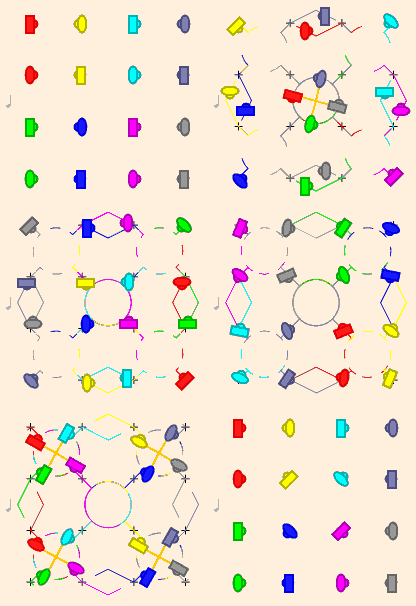 The Dutch Crossing requires 16 dancers arranged in 4 lines with 4 dancers on each line. It consists of two intersecting reels, which in turn intersect a right and left figure. The eight dancers on the diagonals dance the intersecting reels, while the other eight dancers give right hands and left as they travel round the edges of the square.
The figure begins by dividing the big square into 4 little squares of 4 dancers in which everyone does half right hands across (in two bars). In the next two bars the center four dancers do half left hands across, those at the corners of the big square set, while the others face out of their original little squares and do a left pull-by with the nearest dancer in the next little square.
The figure then repeats, after which everyone is diametrically opposed to where they started.
The figure repeats two more times, and everyone is back where they started.
History
Dutch Crossing is also the name of the dance which contains this figure. It was written by Ernst van Brakel and published in Colin Hume's Dances with a Difference, vol. 3, in 1990.
Some dances which (probably) use this figure
- Dances for which I have animations
Note: This list may be incorrect or incomplete.
See Also
This website is copyright © 2021-2026 by George W. Williams V My work is licensed under a Creative Commons Attribution 4.0 International License. Most of the dances have more restrictive licensing, see my notes on copyright, the individual dance pages should mention when some rights are waived.