

Poussette
Also known as: Put Back, Draw.
Bars: 8 for a full, 4 for a half.

 Poussette is a French term, originally meaning little push, and now meaning a baby stroller or perambulator.
Poussettes have a direction which may be specified in various ways as “clockwise”, or “1st corners push”, or “man 1 push, man 2 pull”. In a poussette you take hands with the person across the set (often your partner). Then one of you walks diagonally forward (1s down the set, 2s up) while the other backs up for 4 counts, then everything reverses and the one walking forward now backs up while the one backing up walks forward (but still moving the same way up or down). This is half a poussette.
In a full poussette you continue with the same circular motion until you end up exactly where you started.
Variants
 |  |  |  |  | 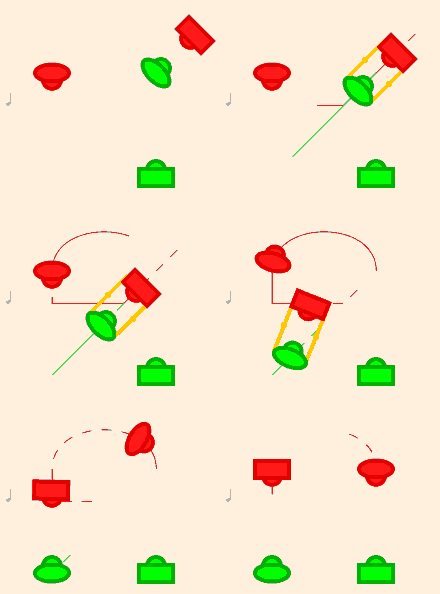 |
| Cooper's Rotational Poussette | Waltzing Turn Poussette | Waltz Poussette? | (R)SCDS Poussette | (R)SCDS Strathspey Poussette | Chevron Poussette |
History
The poussette is an old country dance figure which acquired a French name in about 1770 when Cotillions came over from France. In Playford's day it seems to have been called "put-back" or, "draw" (depending on whether M1 was pulling, or pulling. Note: This is different from the modern "draw poussette", which Colin Hume suggests is a modern misunderstanding).
Playford's The 29th of May (1686) has a nice description of a(n English) poussette:
First cu. take hands, the 2. cu. doing the like at the same time; then the 1. man puts back his wo. and slips down behind the 2. wo. into the 2. cu. place, while the 2. man draws his wo. to him and slips into the 1. cu. place. Do this back again the same way;
While the even earlier Cuckolds all arow (1651) describes a half poussette:
Men put the co. we. back by both hands, fall even on the co. side
The same dance appears in the Lovelace MS which was penned a few years before Playford. It also uses a poussette, though it does not describe it as well:
then each man shall take the woeman, that is right over against him, and the one shall draw her upwards and the other downwards; and presently draw them againe close together in theire places halding hands
The Neals also give a fairly clear description from Dublin in 1726 in the dance A Young Virgin of 15 Years
1st & 2d men take both hands wth their partner's and back to back till in their own places:
The Regency Dance Site has a nice paper by Paul Cooper giving the history of the poussette in English dancing. Most English Country Dances use what Cooper calls a "Rotational Poussette", either going half way round in 4 bars to be progressive, or all the way round in 8 ending back where you started.
Wilson, in his Complete System of English Country Dancing defines a "Half pousette or draw" which is what most people before him called a full poussette, while his "whole poussette" goes round once and a half times.
In William Campbell's 14th book (~1799) is a dance called Lord Nelson's Waltz. The instructions call for a "Poussette" to fill the last 16 bars (at waltz tempo). Both the Regency Dance site and Alan Winston say this should be a "Waltzing Turn Poussette". As yet I have found no contemporary description of this figure, and rely on Winston's description.
By ~1820 something called a "Waltz Poussette" appeared (this may be the same as the waltzing turn poussette?). As far as I know no one ever bothered to define it, so we aren't sure what it entailed. However on page 9 of Lowe's Selection of Popular Country Dances (Edinburgh, 1853) in the description of Spanish Country Dance:
Then pousette, Waltzing round each other. (16 Bars)
This is the final figure of the dance, and needs to be progressive. It suggests to me that the two couples waltzed around each other several times (they had 16 bars) before ending in each others' places. Cooper's paper says that in dances imported from Spain the words "waltz" and "poussette" were used synonymously.
In the US, in 1802, Saltator wrote:
POUCETTE, is to give both hands to partners, by couples and dance round each other, in the time of right and left.
Asa Wilcox was using poussettes in ~1793:
Colledge HornpipeFour hand cross roud back again first & third Couple Draw cross over one Couple - Right & left at top -
As was Saltator in 1802 (see Lasses of Glasgow).
But after that Poussettes died out in the United States, and Howe (who published from 1858-1880 in Boston) did not used them.
Some dances which (probably) use this figure
- Dances for which I have animations
Note: This list may be incorrect or incomplete.
See Also
This website is copyright © 2021-2026 by George W. Williams V My work is licensed under a Creative Commons Attribution 4.0 International License. Most of the dances have more restrictive licensing, see my notes on copyright, the individual dance pages should mention when some rights are waived.