

Double Triangles
An online definition may be found here.
Bars: 8.
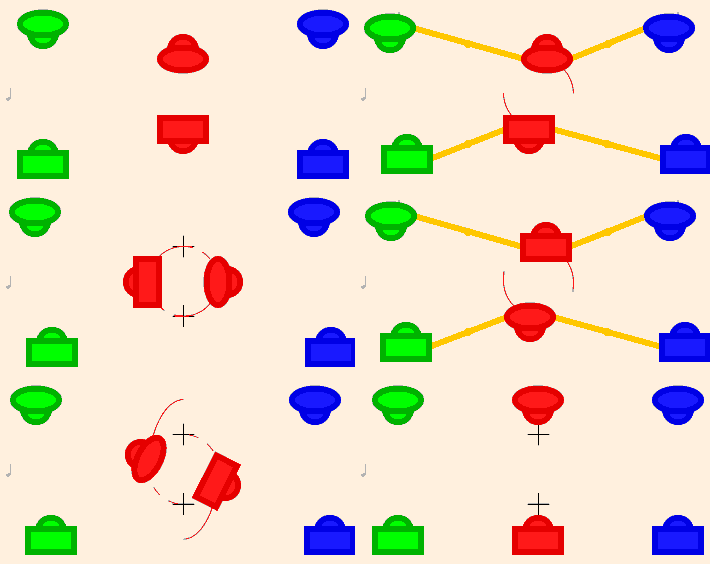 The active couple starts back to back in 2nd place, facing out, they take hands with their corners (who may need to dance in slightly to do so) and set for two bars. Then all drop hands. The corners continue to set, as the actives pas-de-basque around each other clockwise (always back to back with partner) until they are facing out the other side. The actives take hands with new corners, and all set for two bars. Again the corners continue to set, while the actives pas-de-basque back to their starting positions (usually facing in now).
History
Miss Milligan found the term "Double Triangle" in Wilson's dances, but (according to Murrough Landon, personal communication) she had not found any of the books where he defined what his terms meant (Double Triangle is defined in his An Analysis of Country Dancing, 3rd ed. 1811 on page 113). So she appears to have guessed.
The first dance she interpreted that contained this figure was There's Nae Luck Aboot the Hoose (Wilson spelled it There's Nae Luck About the House) published in (R)SCDS Book 10, published 1935. In it she replaces Wilson's figure with finishing reels, which is reasonably close to the original and gets the corners involved too.
She next approached the figure in (R)SCDS Book 15, published in 1949. Three dances in this book use the figure (Lord Rosslyn's Fancy, My Mother's Coming In, and Waverley), and for these she invented the modern figure.
After that she consistently used the modern figure.
Some dances which (probably) use this figure
- Dances for which I have animations
- Dances in (R)SCDS Books
Note: This list may be incorrect or incomplete.
See Also
This website is copyright © 2021-2026 by George W. Williams V My work is licensed under a Creative Commons Attribution 4.0 International License. Most of the dances have more restrictive licensing, see my notes on copyright, the individual dance pages should mention when some rights are waived.