

Table of Contents
A
| Dance Title | Type | Deviser (or Editor/Publisher), Date, Interpreter | Music Performers | Formation |
|---|---|---|---|---|
| All the way to Beckenham |  | Colin Hume 1980 | Kafoozalum | Duple Minor |
G
| Dance Title | Type | Deviser (or Editor/Publisher), Date, Interpreter | Music Performers | Formation |
|---|---|---|---|---|
| Gigue for Genny |  | Dan Herr 1975 | Bare Necessities | 3 Couple Longways permutation: 231 |
| Number of dances | Number of versions | Number with music |
|---|---|---|
| 2 | 2 | 2 |
Warning: The figures for each dance is generated programmatically by regular expression matching and may be in error. Also, for old dances, they reflect the figures used by the interpreter which may not match those of the deviser.
Contra Corners
Also known as: Swing Corners (Wilson).
Bars: 8.
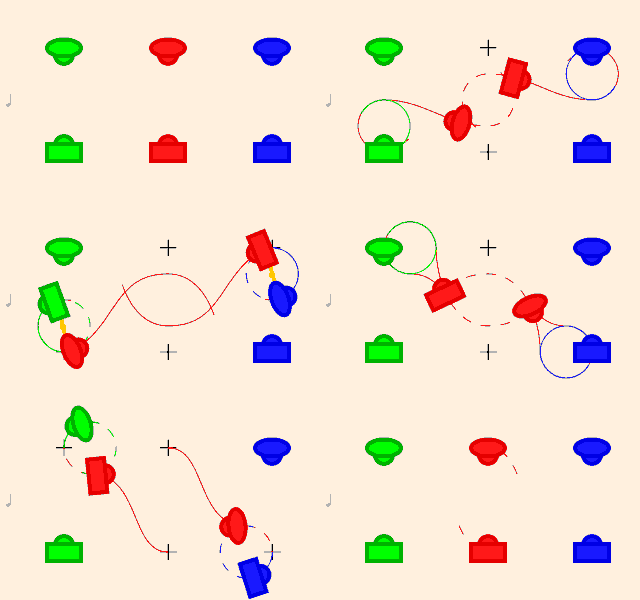
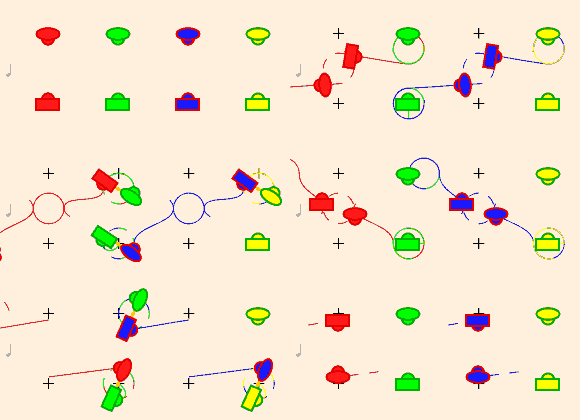 In this version of the figure you pull-by right with your partner, turn your 1st corner left, pull-by right with partner, turn you second corner left.
In a modern contra dance this can be unexpected because one of your corners will be outside your minor set.
History
Early examples of this figure are not very explicit, and it is not always clear which hand you use to turn whom, thus in modern dancing styles we have two different versions of what is basically the same figure.
In US Contra Dancing you turn your partner right, your 1st corner left, your partner right again, and your second corner left. The first description I can find that explicitly says to do this is in Thomas Wilson's An Analysis of Country Dancing from 1808.
Most other styles have settled on: turn your first corner right, partner left, 2nd corner right, partner left.
By 1918 Burchenal's version of Chorus Jig has squashed the original triple minor into a duple minor, meaning that all corners are always active.
See Also
This website is copyright © 2021-2026 by George W. Williams V My work is licensed under a Creative Commons Attribution 4.0 International License. Most of the dances have more restrictive licensing, see my notes on copyright, the individual dance pages should mention when some rights are waived.