

Early Sources of RSCDS dances
None of the dances published by the RSCDS before book 13 were devised by the RSCDS, instead they were considered "traditional" dances. Many dances published in subsequent books fall into that category as well. I have tried to track down the sources of these dances and display here the earliest published versions of the dance's figure which I've been able to find.
In some cases the RSCDS mentions a source. Often I have found earlier examples of the dance. Sometimes I have been unable to find the RSCDS source and will present the earliest source I have found.
When I know the deviser, I mark the name in italics. In most cases for these old dances I only know the publisher.
When a dance source is marked with "†" it means I have been unable to verify the source of the dance, when it is marked with "‡" it means I have been unable to find any Scottish dance manual containing this dance (prior to 1924).
Hovering the mouse over a dance's devisor/publisher will (often) produce a popup containing the text of the original.By default the list below shows only traditional dances interpreted by the (R)SCDS. I believe that Book 34 (1986) was the last book to contain any traditional dances. Before Book 13 all (R)SCDS dances were traditional, but Book 13 contains The Reel of the 51st Division, the first published modern dance. No further modern dances were published until Book 22 (1963), and after that some books contained modern and some traditional dances until Books 31&34, which contains both.
At the end I have several tables of statistics.
Order by:
Include:
(R)SCDS Book Range:
Containing figure:
(R)SCDS dances originaly published in Glasgow
(R)SCDS Book 1, 1924
| Flowers of Edinburgh - RSCDS | J. P. Boulogne, Glasgow, 1827 The Ball-Room, or the Juvenile Pupil's Assistant; Containing the Most Fashionable Quadrilles, with Les Lanciers of Sixteen, As Danced in the Public & Private Assemblies in Paris The earliest source I can find is Wilcock, 1868, who writes (on page 73):
The RSCDS's choreography is the same as Wilcock's except for the standard problem that the RSCDS poussette is progressive and no one else's is (and lead down the middle and up is progressive to Wilcock but not to the RSCDS). Also in Kate Hughes's manuscript, Dancing Book, Ireland, 1867. The tune is a traditional Scottish one. It was synthesized using Colin Hume's software.
| ||||||||||||||||||||||||||||||||||
| Meg Merrilees ~ RSCDS | J. P. Boulogne, Glasgow, 1827† The Ball-Room, or the Juvenile Pupil's Assistant; Containing the Most Fashionable Quadrilles, with Les Lanciers of Sixteen, As Danced in the Public & Private Assemblies in Paris Clementi published a dance of this name in London, but with a different figure. Found in J.P. Boulogne's The Ballroom page 43.
In 1830 Smyth writes: The two first couple figure partners first by the right and then by the left, all four down the middle arm in arm and up again, pousette and right and left. The Lowes write: First Lady swings the second Gentleman, first by the right hand, then by the left; at the same time the first Gentleman does the same with the second Lady; all four down the middle arm in arm, and up again, pousette, and right and left.
| ||||||||||||||||||||||||||||||||||
| Merry Lads of Ayr | J. P. Boulogne, Glasgow, 1827 The Ball-Room, or the Juvenile Pupil's Assistant; Containing the Most Fashionable Quadrilles, with Les Lanciers of Sixteen, As Danced in the Public & Private Assemblies in Paris Longman & Broderip, and Preston both published dances with this name but their figures do not match. In Scottish Country Dances, Books 1-6 the RSCDS published a facsimily of the Boulogne's original:
Wilcock's figure appears to match, but the scan I have is missing half the dance. In The Excelsior Manual of Dancing, Glasgow, ~1872 Wallace writes:
Also found in Kate Hughes's manuscript, Dancing Book, Ireland, 1867.
| ||||||||||||||||||||||||||||||||||
| The Nut | J. P. Boulogne, Glasgow, 1827 The Ball-Room, or the Juvenile Pupil's Assistant; Containing the Most Fashionable Quadrilles, with Les Lanciers of Sixteen, As Danced in the Public & Private Assemblies in Paris Found in J.P. Boulogne's The Ballroom page 42.
If you look at the dance Meg Mirrilees on the next page you will see that Down the middle and up again is a progressive figure, with the 1s ending in 2nd place and the 2s moving up. The Lowes write: The first Gentleman turns the second Lady by the right hand, which he retains, and gives his left to the second Gentleman; the first Lady passes through below the Gentlemen's arms, and her partner following, they go down the middle, up again, and pousette. Lady 1's path seems somewhat different in the Lowes' version than in the RSCDS's.
| ||||||||||||||||||||||||||||||||||
| Petronella | J. P. Boulogne, Glasgow, 1827 The Ball-Room, or the Juvenile Pupil's Assistant; Containing the Most Fashionable Quadrilles, with Les Lanciers of Sixteen, As Danced in the Public & Private Assemblies in Paris The first dance in the first book of the (R)SCDS is Petronella. According to that book this dance was "introduced" by Nathaniel Gow, a composer and musician of Edinburgh, in 1820. Although Gow published many tunes (including this one), I have been unable to find any choreographies by him. Book 1 also says the dance was published in a book called The Ball-Room, 1827 (no editor, or publisher, or location given), actually the book is titled The Ball-Room, or the Juvenile Pupil's Assistant; Containing the Most Fashionable Quadrilles, with Les Lanciers of Sixteen, As Danced in the Public & Private Assemblies in Paris published in Glasgow, 1827 and the author is J. P. Boulogne. This work actually contains three versions of the dance — though the last two have the same figure (all called Petronelle not Petronella), the first is an "English Quadrille", found on page 40, the second a "Spanish Dance" found on page 41, and the last is an "English Country Dance", found on page 43
Sadly Boulogne does not have a glossary where he defines what he means by his figures, so we don't know what the figure of a diamond means exactly, nor what steps are used to do it. We have a bit more luck with Down the middle and up again. This might seem quite straightforward, but it is not. In England at this time, the term was progressive, meaning that the 1s ended up in 2nd place while the 2s moved up (either the 1s went down, came all the way back and cast off, or the 1s end down and only came back to 2nd place). If we look at Meg Mirrilees (another dance on page 43) we see the Boulogne also uses Down the middle and up again as progressive. This means that Boulogne's Pousette was non-progressive, and presumably still meant the standard push-pull poussette that came to the UK from France in about 1760. In 1821, G.M.S. Chivers in The Dancer's Guide page 57, had described Spanish dances as starting improper, and I suspect this might be intended here and explain why the same figure occurs twice. I don't see that it makes much difference whether the first couple is proper or improper. The Spanish version of the dance is subtitled "Hungarian Waltz" in Boulogne (Not a part of Spain I'm familiar with). The next earliest description of the figure I've found was published by the Lowes in Lowes' Ball-Conductor and Assembly Guide. of 1831. The Lowes published in Edinburgh, and their book has three sub-categories of country dance: English, Scotch and Irish. Petronella is categorized as an "English Country Dance". They describe it thusly: First couple chassé round to the right, and set in the middle; round to the right again, and set on the sides; to the right again, and set in places; down the middle, up again, and pousette. By 1853, the Lowes had become just Joseph Lowe, and he published a somewhat different version in his Lowe's Selection of Popular Country Dances (courtesy of the National Library of Scotland):
In ~1868 H. D. Wilcock in Ball-Room Guide; A Manual of Dancing page 70, writes:
In 1868 Elias Howe in The Pianist's Matinee: A Collection of Music for the Piano-Forte, writes: First couple turn round to the right, and balance opposite to each other in the middle of the dance. (4 bars) Again round to the right, and balance on the sides of the dance. (4 bars) Again to the right, and balance in the middle. (4 bars) Again to the right, and balance in places. (4 bars) First couple down the middle and up again (8 bars) Right and left with the next couple. (8 bars) In ~1872 J. F. Wallace in The Excelsior Manual of Dancing, (Glasgow), writes:
In 1897 in D. Anderson's Ball-Room and Solo Dance Guide, (Dundee)
Note: Anderson very explicitly says the lead down and back returns to places, while fifty years earlier it had an implied cast off. That means his "pousette" must be progressive, though he does not say that explicitly. Many pages later in the book Anderson defines a "Petronella Step". He does not explicitly say it is for petronella turns, rather he says This Step may also be used for Contra Dances, Circassian Circle, etc., in setting to partners, but must never be used for Quadrilles.
In ~1898 J. Scott Skinner in The People's Ball Room Guide, (Dundee), writes:
While in the book Prompting: How To Do It by John M. Schell, published Boston, 1890. First couple balance to side (4); balance to center (4); balance to side (4); balance to center (4); first couple down centre and back, cast off (8); right and left (8). Back in Scotland, in Allan's Reference Guide to the Ball-Room, says:
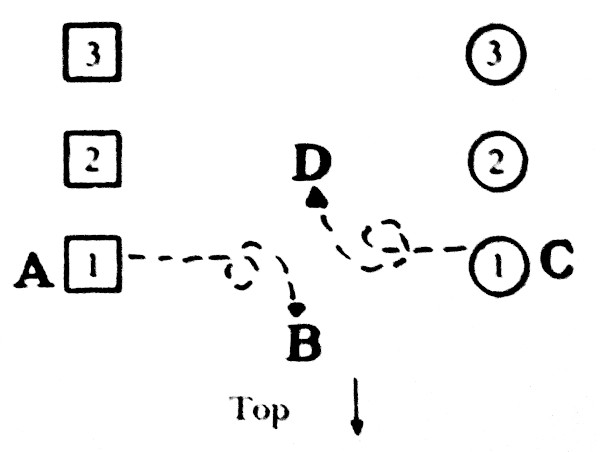
Note that in 1831 the 1s simply chassé into position with no turn, but by 1868 they are turning into the middle, then in 1924 the (R)SCDS describes the figure: 1st woman moves from A to B with two pas de basque, leading off with the right foot and making a three-quarter turn by the right, in the middle of which she has her back to her partner. The modern contra figure seems similar to that described by Wilcock in 1868. As this dance is rather boring for the 2s a number of variations have arisen. The tune was published by Nathaniel Gow in about 1820. The music was synthesized using Colin Hume's software.
|
(R)SCDS Book 3, 1926
| Jenny Come Down to Jock | Mozart Allan, Glasgow, ~1880 Allan's Ball-Room Guide Walsh, 1748, 1760 and Rutherford, 1758 published a dance with this name (well, they called it Hay Jenny come down to Jock) but their figure does not match this one. The RSCDS credits this to Allan, ~1880. My version of Allan's work dates from ~1900 and says:
| |||||||||||||||||||||||||||||||||||||||||||||||||
| Reel of Tulloch ~ RSCDS | J. F. Wallace, Glasgow, ~1900 Wallace's Ball-Room Guide The Register of Dances at Castle Menzies, 1749 contains a dance of this name (also called The Mighty Pretty Valley, but it was a triple minor and so a very different figure. Bride, 1770, and later Longman & Broderip also published dances with this name, again triple minors with different figures. The Fletts say that the dance first appeared in 1819 in Edinburgh, and the first printed description was in The Ball Room Annual, London, 1844, but I can't find this. The Tullock Hold is defined here. To me it looks like the hold in one of the old Regency Linked Arm Allemande figures. In Wallace's Ball-Room Guide, Glasgow, ~1900, he writes:
| R128 2C | ||||||||||||||||||||||||||||||||||||||||||||||||
| Reel of Tulloch | J. F. Wallace, Glasgow, ~1890 Wallace's Ball-Room Guide The RSCDS credits Bremner for publishing the tune. The Register of Dances at Castle Menzies, 1749 contains a dance of this name (also called The Mighty Pretty Valley, but it was a triple minor and had a different figure. Bride, 1770, and later Longman & Broderip also published dances with this name, again triple minors with different figures. The Tullock Hold is defined here. In Wallace's Ball-Room Guide, Glasgow, ~1900, he writes:
|
(R)SCDS Book 4, 1927
| The Merry Dancers ~ RSCDS | J. P. Boulogne, Glasgow, 1827 The Ball-Room, or the Juvenile Pupil's Assistant; Containing the Most Fashionable Quadrilles, with Les Lanciers of Sixteen, As Danced in the Public & Private Assemblies in Paris It has some resemblance to a dance of the same name in Skillern's Twenty Four Country Dances for the Year 1788. Which begins with cast, turn, cast, turn, circle. But that is followed by rights and lefts rather than reels. It does appear in Kate Hughes's manuscript (Dancing Book) Dundalk Ireland, ~1867, (only she calls it "Merry Dance" (not "Dancers")) where she writes:
Found in J.P. Boulogne's The Ballroom page 48.
| |||||||||||||||||||||||||||||||||||
| Waltz Country Dance | J. P. Boulogne, Glasgow, 1827† The Ball-Room, or the Juvenile Pupil's Assistant; Containing the Most Fashionable Quadrilles, with Les Lanciers of Sixteen, As Danced in the Public & Private Assemblies in Paris In (Glasgow, ~1868) Wilcock presents dance with a simpler but vaguely similar figure.
Skinner in The People's Ball Room Guide, Dundee, ~1898 has a dance with this name, but it does not match this figure.
|
(R)SCDS Book 6, 1930
| Mrs. MacLeod | J. P. Boulogne, Glasgow, 1827 The Ball-Room, or the Juvenile Pupil's Assistant; Containing the Most Fashionable Quadrilles, with Les Lanciers of Sixteen, As Danced in the Public & Private Assemblies in Paris Found in J.P. Boulogne's The Ballroom page 47.
It seems pretty clear here that Down the middle and up again is a progressive move. It is also present in Smyth's A Pocket Companion for Young Ladies and Gentlemen Containing Directions for the Performance of Quadrilles, Scotch, English, Irish, French, and Spanish Country Dances, Reels, &c., Edinburgh, 1830, and in the Lowes's Lowes' Ball-Conductor and Assembly Guide, Edinburgh, ~1831. Like Boulogne, both of them call it "Mrs. McLeod" though. Smyth writes: Four hands across and back again. Down the middle and up again, Set corners, and turn round, Set opposite corners and turn round, a reel of three on each side.
| ||||||||||||||||||||||||||||||
| Prince of Orange | Mozart Allan, Glasgow, ~1895 Allan's Reference Guide to the Ball-Room Allan's Reference Guide to the Ball-Room, says: The couples stand in a circle round the room, facing each other.
| ||||||||||||||||||||||||||||||
| Prince of Orange | Mozart Allan, Glasgow, ~1895 Allan's Reference Guide to the Ball-Room Allan's Reference Guide to the Ball-Room, says: The couples stand in a circle round the room, facing each other.
|
(R)SCDS Book 8, 1932
| Calver Lodge | J. P. Boulogne, Glasgow, 1827 The Ball-Room, or the Juvenile Pupil's Assistant; Containing the Most Fashionable Quadrilles, with Les Lanciers of Sixteen, As Danced in the Public & Private Assemblies in Paris Found in J.P. Boulogne's The Ballroom page 42.
The next earliest source I can find is J. F. Wallace's The Excelsior Manual of Dancing, Glasgow, ~1872, who writes (on page 68):
|
(R)SCDS Book 11, 1936
| Glasgow Flourish ~ RSCDS | J. F. Wallace, Glasgow, 1872 The Excelsior Manual of Dancing RSCDS Book 11 says "collected in Fife and Pebbleshire. Wallace in his The Excelsior Manual of Dancing, ~1872, names the dance "Let Glasgow Flourish"
Wallace gives no suggestions as to music. |
RSCDS Book 34, 1986
| Royal Albert Country Dance | Thomas Murphy, Glasgow, ~1890† Thomas Murphy's Aide Memoire |
Statistics
Number of dances published by city (or region)
| Glasgow | 16 |
Number of dances published by semi century
| 1800-1849 | 9 |
| 1850-1899 | 6 |
| 1900-1949 | 1 |
Number of dances by early publisher/devisor
| J. P. Boulogne | 9 |
| J. F. Wallace | 3 |
| Mozart Allan | 3 |
| Thomas Murphy | 1 |
References
| Mozart Allan | Allan's Ball-Room Guide, Glasgow, about 1880. I don't know where to find it. |
| " | Allan's Reference Guide to the Ball-Room, Glasgow, about 1895. May be found in the British Library |
| J. P. Boulogne | The Ball-Room, or the Juvenile Pupil's Assistant; Containing the Most Fashionable Quadrilles, with Les Lanciers of Sixteen, As Danced in the Public & Private Assemblies in Paris, Glasgow, 1827. Found in the RSCDS Archives. |
| Thomas Murphy | Thomas Murphy's Aide Memoire, Glasgow, about 1890. Strathclyde Regional Archives, Glasgow |
| J. F. Wallace | The Excelsior Manual of Dancing, Glasgow, 1872 |
| " | Wallace's Ball-Room Guide, Glasgow, about 1900 |
Scans of old dance manuals are scattered about the internet. The Vaughan Williams Memorial Library, International Music Score Library Project, Scott Pfitzinger's Playford site, Richard Powers' website, Library of Congress, and The Library of Dance all provide primary sources. A number of other sites provide indeces of these sources: The Regency Dance site, The Library of Dance again, and my own site have all proven useful for finding old sources. Finally there is Robert Keller's index which does not provide sources directly but lists thousands of dances, the publications containing them, dates and a brief coded description of the figures. This last has proven invaluable for tracking down dances for which I had no complete sources.
And, of course, both the Scottish Country Dance Database and the Scottish Country Dancing Dictionary provide online descriptions of all the RSCDS books and often hint at early sources.
This website is copyright © 2021-2026 by George W. Williams V My work is licensed under a Creative Commons Attribution 4.0 International License. Most of the dances have more restrictive licensing, see my notes on copyright, the individual dance pages should mention when some rights are waived.