

Early Sources of RSCDS dances
None of the dances published by the RSCDS before book 13 were devised by the RSCDS, instead they were considered "traditional" dances. Many dances published in subsequent books fall into that category as well. I have tried to track down the sources of these dances and display here the earliest published versions of the dance's figure which I've been able to find.
In some cases the RSCDS mentions a source. Often I have found earlier examples of the dance. Sometimes I have been unable to find the RSCDS source and will present the earliest source I have found.
When I know the deviser, I mark the name in italics. In most cases for these old dances I only know the publisher.
When a dance source is marked with "†" it means I have been unable to verify the source of the dance, when it is marked with "‡" it means I have been unable to find any Scottish dance manual containing this dance (prior to 1924).
Hovering the mouse over a dance's devisor/publisher will (often) produce a popup containing the text of the original.By default the list below shows only traditional dances interpreted by the (R)SCDS. I believe that Book 34 (1986) was the last book to contain any traditional dances. Before Book 13 all (R)SCDS dances were traditional, but Book 13 contains The Reel of the 51st Division, the first published modern dance. No further modern dances were published until Book 22 (1963), and after that some books contained modern and some traditional dances until Books 31&34, which contains both.
At the end I have several tables of statistics.
Order by:
Include:
(R)SCDS Book Range:
Containing figure:
(R)SCDS Book 1, 1924
| Circassian Circle ~ RSCDS | G.M.S. Chivers, London, 1822 The Modern Dancing Master Circassia is (or was) a region on the northeastern shore of the Black Sea. In Baltimore in 1820 George Willig Jr. published a dance called "The Circassian" in a pamphlet called Admired Cotillions (in the US the distinction between Quadrilles and Cotillions was often lost, and I think this is actually one set of a quadrille. It isn't in a circle and it is not progressive. Forward two cross over. Chasse. cross. to place. Balance and turn partner. Ladies Chain. promenade and half right and left to place. The figure for this dance is said to come from Le Pantalon in Payne's 1st Set of Quadrilles. The first 24 bars match and the last 8 have been changed to make the dance progressive. The idea of dancing in a circle, and the name "Circassian" come from G.M.S. Chivers. In 1822 in his book The Modern Dancing Master, G.M.S. Chivers introduces a style of dancing he calls "Circassian Circle". He then publishes four dances to be done in this style, none of which is called "Circassian Circle" itself. Chivers's version is different from the modern way of dancing. At the time, in longways sets, only the top two couples would start dancing, in this circle dance only the two couples closest to the music would start, they would pass each other, and then each would dance with the next couple in their direction of motion. And so on.
Note this is simply a general description of how to dance in a circle. It is followed by four figures for this format. the one which most closely matches the modern version is called "La Daphne": Right and left set and turn partners ladies chain half pousette into each others place, and turn partners under the arm The next version I can find is Lowes' Ball-Conductor and Assembly Guide (Edinbourgh, ~1831) where they write:
I think the Lowes are describing a hall full of two couple quadrille sets (that is improper duple minor lines), lined up along each side wall of a building. As with Chivers, and in keeping with the staggered start in use for country dances at the time, only one set start dancing, the one at the top, they pass each other, and one moves down the right wall, and one down the left, as they move down the lines the dancers behind them will also start, then when they reach the bottom instead of becoming 2s and working their way up, the cross over to the other line, and work their way up. When they reach the top of the other line they stop and wait until everyone else has reached their original position. In ~1842 Tilt & Bogue published The Ball-Room Preceptor (Third Edition) containing a description of the Circassian Circle very like Chivers's. Only two couples dance at the start, and no specific figure is provided. (In ~1844 Coulon (London), in 1848 George Appleton, Philadelphia, and in ~1850 Kent & Co., Nottingham copy their description word for word) The next version I've found is Wilson, 1852. Wilson writes: Couples vis-a-vis; form a circle round the room; figure, right and left or hands across; set and turn partners; ladies chain; waltz pass on to next couple; repeat. Wilson defines "Right and Left" on page 15 of The Art of Dancing and it involves no hand clasps. Sometime between 1850 and 1853 in Lowe's Selection of Popular Country Dances:
Joseph Lowe is still recommending the old style progression where only the top couples start. But he now calls this dance "Circassian Circle" rather than one of several dances in that style. In 1897 in D. Anderson's Ball-Room and Solo Dance Guide, (Dundee)
Given the way he sets up the dance, Anderson must have everyone starting at once. Note that in Le Pantalon of Payne's 1st Set of Quadrilles the four bars of setting to partner (which come after the rights and lefts) are two different setting steps: Balancé and Sissone Balotté Jetté and Assemblé. The first is an advance and retire movement (toward and away from partner) and the second a side to side movement (to the right, and back to the left). The tune is a traditional one from the US Revolutionary war, and the music was synthesized using Colin Hume's software.
| |||||||||||||||||||||||||||||||||||||||
| Cumberland Reel ~ RSCDS | Thompson, London, ~1786 Thompson's Compleat Collection of 200 Favourite Country Dances, Vol 5 Thompson (1786) writes: Right hands across half round left hands back again Lead down the middle up again & cast off Allemande with your partner Right & Left Wilson (1809) writes:
A different version may be found in Kate Hughes's Dancing Book from Ireland in 1867
Wilcock (1868) writes:
| |||||||||||||||||||||||||||||||||||||||
| Duke of Perth ~ RSCDS | William Boag, London, ~1797 A Collection of Favourite Reels and Strathspeys by the most Eminent Composers In 1790 Longman & Broderip published a dance named Duke of Perth's Reel, but it has a different figure. Rutherford published a dance named "Keep the Country, Bonny Lassie" in 1775, but with a different figure. Pease Straw has an even longer history with Johnson publishing a dance of that name in 1744, but again with a different figure. According to the Fletts (Traditional Dancing in Scotland, 1964, p. 247) William Boag was the first to publish this figure under the title "Keep the Country, Bonny Lassie". First Cu Swing the Right hand and cast off one Cu: Swing the Left hand round Swing the Corners and your Partner each time Set Corners and turn lead outsides. The Fletts also quote the Blantyre MS. (~1805), titled "Duke of Perth": Hook right hand with partner — turn round — throw off a couple. Hook with partner with left turn round downmost Ladies with right partner with left uppermost Lady with right partner with left twice round, Sett cross pr reels. The (R)SCDS claims this dance comes from J. P. Boulogne's The Ball-Room, or the Juvenile Pupil's Assistant; Containing the Most Fashionable Quadrilles, with Les Lanciers of Sixteen, As Danced in the Public & Private Assemblies in Paris, Glasgow, 1827, titled "Duke of Perth" or "Keep the Country, Bonnie Lassie".
Kate Hughes (in Ireland) recorded a slightly different version in 1867:
J. F. Wallace, in ~1872, published:
D. Anderson, 1897 published something almost word for word from Wallace:
Note that by Blantyre's time the "lead out sides" has become a reel.
| |||||||||||||||||||||||||||||||||||||||
| Fight about the Fireside ~ RSCDS | Nathaniel Gow, Edinburgh, ~1822† Five Favourite Country Dances In 1781 Longman & Broderip published a dance with this name but a different figure. Book 1 attributes this to Nathaniel Gow, but I have been unable to find any choreographies published by him (though lots of music). The earliest source I can find is from the Lowes who write: Down the middle, and up again; reel three and three across the dance, the Lady with the first couple, and the Gentleman with the second; set and turn corners; then set, and turn partners.
| |||||||||||||||||||||||||||||||||||||||
| Flowers of Edinburgh - RSCDS | J. P. Boulogne, Glasgow, 1827 The Ball-Room, or the Juvenile Pupil's Assistant; Containing the Most Fashionable Quadrilles, with Les Lanciers of Sixteen, As Danced in the Public & Private Assemblies in Paris The earliest source I can find is Wilcock, 1868, who writes (on page 73):
The RSCDS's choreography is the same as Wilcock's except for the standard problem that the RSCDS poussette is progressive and no one else's is (and lead down the middle and up is progressive to Wilcock but not to the RSCDS). Also in Kate Hughes's manuscript, Dancing Book, Ireland, 1867. The tune is a traditional Scottish one. It was synthesized using Colin Hume's software.
| |||||||||||||||||||||||||||||||||||||||
| Meg Merrilees ~ RSCDS | J. P. Boulogne, Glasgow, 1827† The Ball-Room, or the Juvenile Pupil's Assistant; Containing the Most Fashionable Quadrilles, with Les Lanciers of Sixteen, As Danced in the Public & Private Assemblies in Paris Clementi published a dance of this name in London, but with a different figure. Found in J.P. Boulogne's The Ballroom page 43.
In 1830 Smyth writes: The two first couple figure partners first by the right and then by the left, all four down the middle arm in arm and up again, pousette and right and left. The Lowes write: First Lady swings the second Gentleman, first by the right hand, then by the left; at the same time the first Gentleman does the same with the second Lady; all four down the middle arm in arm, and up again, pousette, and right and left.
| |||||||||||||||||||||||||||||||||||||||
| Merry Lads of Ayr | J. P. Boulogne, Glasgow, 1827 The Ball-Room, or the Juvenile Pupil's Assistant; Containing the Most Fashionable Quadrilles, with Les Lanciers of Sixteen, As Danced in the Public & Private Assemblies in Paris Longman & Broderip, and Preston both published dances with this name but their figures do not match. In Scottish Country Dances, Books 1-6 the RSCDS published a facsimily of the Boulogne's original:
Wilcock's figure appears to match, but the scan I have is missing half the dance. In The Excelsior Manual of Dancing, Glasgow, ~1872 Wallace writes:
Also found in Kate Hughes's manuscript, Dancing Book, Ireland, 1867.
| |||||||||||||||||||||||||||||||||||||||
| The Nut | J. P. Boulogne, Glasgow, 1827 The Ball-Room, or the Juvenile Pupil's Assistant; Containing the Most Fashionable Quadrilles, with Les Lanciers of Sixteen, As Danced in the Public & Private Assemblies in Paris Found in J.P. Boulogne's The Ballroom page 42.
If you look at the dance Meg Mirrilees on the next page you will see that Down the middle and up again is a progressive figure, with the 1s ending in 2nd place and the 2s moving up. The Lowes write: The first Gentleman turns the second Lady by the right hand, which he retains, and gives his left to the second Gentleman; the first Lady passes through below the Gentlemen's arms, and her partner following, they go down the middle, up again, and pousette. Lady 1's path seems somewhat different in the Lowes' version than in the RSCDS's.
| |||||||||||||||||||||||||||||||||||||||
| Petronella | J. P. Boulogne, Glasgow, 1827 The Ball-Room, or the Juvenile Pupil's Assistant; Containing the Most Fashionable Quadrilles, with Les Lanciers of Sixteen, As Danced in the Public & Private Assemblies in Paris The first dance in the first book of the (R)SCDS is Petronella. According to that book this dance was "introduced" by Nathaniel Gow, a composer and musician of Edinburgh, in 1820. Although Gow published many tunes (including this one), I have been unable to find any choreographies by him. Book 1 also says the dance was published in a book called The Ball-Room, 1827 (no editor, or publisher, or location given), actually the book is titled The Ball-Room, or the Juvenile Pupil's Assistant; Containing the Most Fashionable Quadrilles, with Les Lanciers of Sixteen, As Danced in the Public & Private Assemblies in Paris published in Glasgow, 1827 and the author is J. P. Boulogne. This work actually contains three versions of the dance — though the last two have the same figure (all called Petronelle not Petronella), the first is an "English Quadrille", found on page 40, the second a "Spanish Dance" found on page 41, and the last is an "English Country Dance", found on page 43
Sadly Boulogne does not have a glossary where he defines what he means by his figures, so we don't know what the figure of a diamond means exactly, nor what steps are used to do it. We have a bit more luck with Down the middle and up again. This might seem quite straightforward, but it is not. In England at this time, the term was progressive, meaning that the 1s ended up in 2nd place while the 2s moved up (either the 1s went down, came all the way back and cast off, or the 1s end down and only came back to 2nd place). If we look at Meg Mirrilees (another dance on page 43) we see the Boulogne also uses Down the middle and up again as progressive. This means that Boulogne's Pousette was non-progressive, and presumably still meant the standard push-pull poussette that came to the UK from France in about 1760. In 1821, G.M.S. Chivers in The Dancer's Guide page 57, had described Spanish dances as starting improper, and I suspect this might be intended here and explain why the same figure occurs twice. I don't see that it makes much difference whether the first couple is proper or improper. The Spanish version of the dance is subtitled "Hungarian Waltz" in Boulogne (Not a part of Spain I'm familiar with). The next earliest description of the figure I've found was published by the Lowes in Lowes' Ball-Conductor and Assembly Guide. of 1831. The Lowes published in Edinburgh, and their book has three sub-categories of country dance: English, Scotch and Irish. Petronella is categorized as an "English Country Dance". They describe it thusly: First couple chassé round to the right, and set in the middle; round to the right again, and set on the sides; to the right again, and set in places; down the middle, up again, and pousette. By 1853, the Lowes had become just Joseph Lowe, and he published a somewhat different version in his Lowe's Selection of Popular Country Dances (courtesy of the National Library of Scotland):
In ~1868 H. D. Wilcock in Ball-Room Guide; A Manual of Dancing page 70, writes:
In 1868 Elias Howe in The Pianist's Matinee: A Collection of Music for the Piano-Forte, writes: First couple turn round to the right, and balance opposite to each other in the middle of the dance. (4 bars) Again round to the right, and balance on the sides of the dance. (4 bars) Again to the right, and balance in the middle. (4 bars) Again to the right, and balance in places. (4 bars) First couple down the middle and up again (8 bars) Right and left with the next couple. (8 bars) In ~1872 J. F. Wallace in The Excelsior Manual of Dancing, (Glasgow), writes:
In 1897 in D. Anderson's Ball-Room and Solo Dance Guide, (Dundee)
Note: Anderson very explicitly says the lead down and back returns to places, while fifty years earlier it had an implied cast off. That means his "pousette" must be progressive, though he does not say that explicitly. Many pages later in the book Anderson defines a "Petronella Step". He does not explicitly say it is for petronella turns, rather he says This Step may also be used for Contra Dances, Circassian Circle, etc., in setting to partners, but must never be used for Quadrilles.
In ~1898 J. Scott Skinner in The People's Ball Room Guide, (Dundee), writes:
While in the book Prompting: How To Do It by John M. Schell, published Boston, 1890. First couple balance to side (4); balance to center (4); balance to side (4); balance to center (4); first couple down centre and back, cast off (8); right and left (8). Back in Scotland, in Allan's Reference Guide to the Ball-Room, says:
Note that in 1831 the 1s simply chassé into position with no turn, but by 1868 they are turning into the middle, then in 1924 the (R)SCDS describes the figure: 1st woman moves from A to B with two pas de basque, leading off with the right foot and making a three-quarter turn by the right, in the middle of which she has her back to her partner. The modern contra figure seems similar to that described by Wilcock in 1868. As this dance is rather boring for the 2s a number of variations have arisen. The tune was published by Nathaniel Gow in about 1820. The music was synthesized using Colin Hume's software.
| |||||||||||||||||||||||||||||||||||||||
| Rory O'More ~ Scottish | A Cosmo Mitchell, Aberdeen, ~1890 A Guide to Ball Room Dancing The RSCDS attributes this to Mitchell's A Guide to Ball Room Dancing, a work I haven't found yet. The earliest I have found are the following: D. Anderson's Ball-Room and Solo Dance Guide, he writes:
Also in Skinner writes:
A quite different dance with this name appeared in the US in 1858 (Elias Howe, Boston). It seems likely to me that a dance appeared before 1897 in Scotland, but I haven't found any earlier sources. Kate Hughes's manuscript, Dancing Book, Ireland, 1867, contains yet another version of the figure.
| |||||||||||||||||||||||||||||||||||||||
| Strip the Willow | Anonymous, date unknown† A running step should be used through out. The book says that this should be danced to 40 bar music (even though the dance takes 42 bars) and the last move of the active couple should extend into the next minor set, and on the fourth iteration the active couple should merely cross the set. The website says when dancing to 32 bar music, the second couple should begin on bar 32 (while the active couple is dancing with the 3s).
| |||||||||||||||||||||||||||||||||||||||
| The Triumph ~ RSCDS | Preston, London, 1793 Preston's Twenty four Country Dances for the Year 1793 RSCDS Book1 attributes this dance to J. P. Boulogne's The Ball-Room, 1827, but it has earlier roots. Preston published a version in 1793, and Thompson published something rather different in 1790 named La Triomphe. Preston's version has three lead up abreast, but has not yet developed the triumphal arch over the woman. The 1st. Lady set to the 2d. Gentn. & turn The 1st. Gentn. set to the 2d. Lady & turn The 1st. Lady take the 2d. Gentn. by the right hand & lead him down to the 3d. Cus. place · The 1st. Gentn. cast off & his Partr. all 3 lead up to the top together ·· the 1st. Cu lead down the middle up again & cast off ··
|


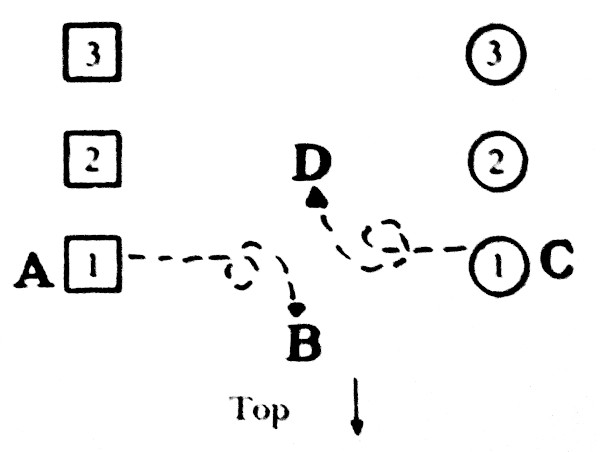
(R)SCDS Book 2, 1925
| The Bob o' Dowally | Walsh, London, ~1760† Caledonian Country Dances RSCDS Book 2 says "Walsh's Caledonian Country Dances 1748-1760. The crib diagram says this comes from Walsh, 1760. Both Walsh and Jackson published collections entitled Caledonian Country Dances around this time, but I can't find anything by either from 1760. The collections I can search do not contain a dance with this name.
| ||||||||||||||||||||||||||||||||||||||||||||||||||||||||||||||||||||||||||||||||||||||||||||||||||||
| The Bumpkin | William Campbell, London, ~1799 Campbell's 14th Book of New and Favorite Country Dances & Strathspey Reels The RSCDS says this dance was "Collected in the town of Lanark", and also states it is found in A Companion to the Reticule, published, London, ~1840 (for young Ladies and Gentlemen, whose birth, connexions, or society, can lay claim to any district NORTH of the TWEED. While the Companion claims this was danced all over Scotland prior to the year 1815. The SCDDB says the dance was devised by Walsh in 1754, and Book 2 says the dance was published in Walsh's Caledonian Country Dances 1748-1760. As far as I can tell Walsh did not publish a dance called "The Bumpkin", but he did publish "The Country Bumkin" in ~1750, but the figure is nothing like this one. Walsh writes: Two Cu. fall back•foot it and change over the like again cross over twice to below lead to the top•foot it and cast off• However, William Campbell did publish The Country Bumpkin in his 14th Book (~1799), and he writes: Six Ladies and 3 Gentlemen in 3 Lines — the middle Gentleman dances with his Hat on — all nine foot up the Room to the top in 3 Lines and turn and foot back again to their places — then the Gentleman in the middle sets to the Lady at the right hand corner, turn her the set to the Lady on the left hand corner and turn her and Hey:— the other two Gentlemen do the same with their corners and Hey at the same time then fall back to their places and foot up the Room as Before and then down again then the Gentleman in the middle foots to the other right hand corner turn round and Hey the other two Gentlemen do the same with their other corner and turn round and hey all at the same time then fall back to their places foot up as before and back again then the three Gentlemen foot to the three Ladies on their right hand turn then to the three Ladies on their Left turn and all Hey then foot up as before and back again then the middle line set to the bottom line turn round and set to the top line then turn round and all Hey up and down the room the Gentleman in the bottom line takes the Hat off the Gentleman of the middle line then falls into the middle line with his two Ladies repeats all the Figure over again the Gentleman of the top line then takes the Hat off the Gentleman of the middle line and with his two Ladies falls in the middle line and repeats all the figure over again — then finish with a threesom Reel across the Room. Is Campbell making a distinction between "heys" (in the first parts of the dance) and "reels" in the last line, or is he just careless? As written in the Companion to the Reticule:
D. Anderson's Ball-Room and Solo Dance Guide, Dundee, ~1900 calls it simply "The Reel of Nine":
The SCDDB says that the reels are left shoulder reels, though I can find no indication of this in RSCDS Book 2, nor in any of the original sources.
| ||||||||||||||||||||||||||||||||||||||||||||||||||||||||||||||||||||||||||||||||||||||||||||||||||||
| Delvine Side | William Campbell, London, ~1800 Campbell's 15th Book of New and Favorite Country Dances & Strathspey Reels Campbell's 15th book does contain a dance with this name, but I have been unable to find more than a table of contents and can't verify the choreography.
| ||||||||||||||||||||||||||||||||||||||||||||||||||||||||||||||||||||||||||||||||||||||||||||||||||||
| The Eightsome Reel | Earl of Dunmore, Scotland, ~1870† My copy of Book 2 claims this was devised by the Earl of Dunmore, but later sources seem unsure. The The Thistle has an article on its origins. The RSCDS numbers couples clockwise (while modern square dance numbers them counter clockwise). Arthur Miller, Leeds, 1900 writes:
| ||||||||||||||||||||||||||||||||||||||||||||||||||||||||||||||||||||||||||||||||||||||||||||||||||||
| The Glasgow Highlanders | Walter F. Gillies, [Unknown City], ~1885† Manual of Dancing, or a Companion to the Ballroom Please see SCDDB for a discussion of the provenance of this dance. An early version of this dance may be found in D. Anderson's Ball-Room and Solo Dance Guide, from ~1897:
On a second chord before the dance begins, the first lady moves into the second man's place. The second man into the second lady's place, and the second lady into the first lady's place. This is like a counter-clockwise becket dance with everyone standing on the same side of the set as his/her partner (ladies on their partner's right). At the end of the first iteration (bars 31-32), during the reel, the first lady moves into the third man's place. The third man into the third lady's place and the third lady into where you'd expect the first lady to be (the original place of the second lady). The step suggest for the setting is Forward on right, hop; back on left, hop; step behind with right, step left, right and hop.
| ||||||||||||||||||||||||||||||||||||||||||||||||||||||||||||||||||||||||||||||||||||||||||||||||||||
| Greig's Pipes ~ RSCDS | William Boag, London, 1797† A Collection of Favourite Reels and Strathspeys by the most Eminent Composers I can't track down Boag's publication, but I have found it in Lowes' Ball-Conductor and Assembly Guide in ~1830 published by the Messrs. Lowe who write: First couple turn by the right hand, and the Gentleman passes one couple down the middle; then turn quite round by the left hand, and set, three and three, in lines across the dance; turn round with both hands; then the Lady goes between the second and third Gentlemen, and the Gentleman between the second and third Ladies; set, holding the hands; set corners, and reel. The Lowes title it Greig's Pipes, or the Cameronian Rant.
| ||||||||||||||||||||||||||||||||||||||||||||||||||||||||||||||||||||||||||||||||||||||||||||||||||||
| The Haymakers ~ RSCDS | Thompson, London, ~1770 Thompson's Compleat Collection of 200 Favourite Country Dances, Vol II
In A Pocket Companion, for Young Ladies and Gentlemen..., Smyth, 1830 calls the dance The Haymakers and writes: The top Lady and bottom Gentleman advance to the middle, and turn by the right hand: the first Gentleman and last Lady do the same. The same couple repeat the same with the left hand, These again repeat the same by both hands. The first two advance and pass back to back, and return to their places. The other two do the same. The first Lady and bottom Gentleman advance, bow and curtsey, and return to their places; the others do the same. The whole chassé from top to bottom. the first couple half pousette with each couple till they reach the bottom of the Dance. In Ball-Room Guide: A Manual of Dancing, H. D. Willock, 1868 calls the dance Sir Roger de Coverly, or The Haymakers and writes:
In Kate Hughes's manuscript from Dundalk Ireland, 1867 it is also called "Hay Makers".
| ||||||||||||||||||||||||||||||||||||||||||||||||||||||||||||||||||||||||||||||||||||||||||||||||||||
| The Perth Medley | Anonymous, date unknown†
| ||||||||||||||||||||||||||||||||||||||||||||||||||||||||||||||||||||||||||||||||||||||||||||||||||||
| The Princess Royal ~ RSCDS | Joseph Lowe, Edinburgh, ~1850 Lowe's Selection of Popular Country Dances Common name for dances; Wright, Walsh, Straight, Campbell, Howe and Wilcock all have figures for it, but I have found none which seems to match this one. Lowe writes: First couple turn round to the right, and set opposite to each other in the middle of the Dance (4 Bars) Again round to the right, the Lady going between the second and third Gentlemen, and the Gentlemen between the second and third Ladies (4 Bars) Six hands round and back again (8 Bars) The Lady between the two Gentlemen, and the Gentleman between the two Ladies, advance and retire. (4 Bars) The Gentleman who commenced the Dance, then turns his partner to her own side. (2 Bars) And all clap their hands, counting 1, 2, 3, 1, 2, 3 (2 Bars) Then the three Ladies on their own side, and the three Gentlemen on theirs go three hands round. (4 Bars) Then commence the Figure again. Courtesy of National Library of Scotland, licensed under: 
| ||||||||||||||||||||||||||||||||||||||||||||||||||||||||||||||||||||||||||||||||||||||||||||||||||||
| The Soldier's Joy ~ RSCDS | Anonymous, date unknown† Common tune for dancing in both the UK and the US; Thompson, Wilson, Howe, Washburn, Squire, and Schell all have figures set to it, but I have found none which seems to match this one.
| ||||||||||||||||||||||||||||||||||||||||||||||||||||||||||||||||||||||||||||||||||||||||||||||||||||
| Speed the Plough - RSCDS | Joseph Lowe, Edinburgh, ~1850 Lowe's Selection of Popular Country Dances Common tune for dancing in both the UK and the US; Wilson, Preston, Cahusac, Bland & Weller, Smyth, Hill, Howe, Washburn, Squire, and Schell all have figures set to it, but most do not seem to match this figure. However Joseph Lowe's version seems a good match.
| ||||||||||||||||||||||||||||||||||||||||||||||||||||||||||||||||||||||||||||||||||||||||||||||||||||
| La Tempête ~ RSCDS | Lowe, Edinburgh, ~1850 Lowe's Selection of Popular Country Dances ▶ In the US, (R)SCDS Book 2 is out of copyright, I am not sure of the legal status in other countries. If you click here then you assert that you have a legal right to view the text.  The couples stand in fours across the room, all facing the top, except the first two couples, who face down. Women on the right of their partners (See Fig.)
Collected locally. (I believe this to be the original text as printed in 1925, subsequent revisions of the book use different words but describe the same figure.) If you look at the Scottish Country Dance Database and Dictionary they both claim the four face four version of the dance should be done round the room as well, but the book shows a longways dance with four lines of two couples each, not a round the room dance. In his The Modern Dancing Master, Chivers, London, 1822 describes dancing four face four dances round the room. He calls this a Chivonian Circle. The (R)SCDS did not say how many times the dance should be repeated. For a four line dance the traditional number would be nine repetitions leaving everyone where they started, but the SCDS is more likely to follow their own methods and only repeat the dance 8 times (leaving the bottom two lines in the wrong places). In it's 2008 revision of Book 2, the RSCDS attributes this dance to Lowe's Selection of Popular Country Dances, ~1850. Lowe actually publishes two different figures, one which he teaches and which he claims to be the original version, and one which everyone else in Edinburgh dances. Lowe's "Original" version is unlike any other version I've found (nobody else has the dancers clapping, ever), while the other version seems more like the other contemporary versions I've found. The (R)SCDS chose Lowe's "Original" as the basis for their dance. Lowe writes:
I think Lowe wants the top couples to pass under the arches made by the bottom as couples, rather than passing by the right, as is the modern method. Lowe also has people do a couples mad robin along their own line, rather than a couples do-si-do with the people opposite. Joseph Lowe did not suggest dancing it as a round the room dance. The earliest source I have for that is in Albert W. Newman's A Complete Practical Guide to Modern Society Dancing, Philadelphia, 1903 who wrote:
He, like the (R)SCDS, only recommends the round the room format when the set is a standard improper duple minor rather than a four face four. Despite the RSCDS's claims, this dance, and the idea of dancing in a four face four (Mescolanze) formation, predate Mr. Lowe. The earliest version I have found was published by Kattfuß in Germany in 1802. According to The Regency Dance site Joseph Binns Hart published "Hart's 2nd Set of Quadrilles" sometime between 1818 and 1820. In this work he has a dance called Hart's Tempete Dance which was a dance with two couples facing two other couples (a rare formation for cotillions, but not unknown), however unlike cotilions (or quadrilles) Hart's dance progresses. In his Hart's Second Set of Quadrilles, Hart writes: Form a line of 4, the 2 Ladies on the 2 Gentlemens right, 4 more opposite to the first 4, form lines of 4 behind the 2d. line as many as intend to dance. Then in ~1825 GMS Chivers published a dance called La Tempête in his "Dancing Master in Miniature". The Contrafusion site says the dance was originally European and dates it back to 1802. In the US, the earliest source I can lay my hands on is from New York in the US in 1851, which was a mescolanze (but not a round the room dance) Mr. Whale & Daughter published La Tempète, as danced at the Queen's Last Ball This popular Dance is danced by any number of double couples standing as above at commencement. All begin together, — Advance and retire twice, — Partners together gallop across eight steps each way, — Advance and retire twice, — Hand four round in the centre, (as above) Sides the same turning with both hands, — Hands across, (as above) Sides the same, — Advance and retire once, — Go forward to dance with next vis a vis. Also in 1851, also in New York, Burnton published The Original Tampete
I have a page devoted to a more complete history of this dance.
| ||||||||||||||||||||||||||||||||||||||||||||||||||||||||||||||||||||||||||||||||||||||||||||||||||||


(R)SCDS Book 3, 1926
| Blue Bonnets ~ RSCDS | Goulding & D'Almaine, London, 1827 Goulding & D'Almaine's Twenty-four Country Dances for the Year 1827 The RSCDS attributes this to Mozart Allan's Allan's Reference Guide to the Ball-Room, Glasgow, ~1895, and a dance with this name and figure is in that work, but it occurred elsewhere earlier. Published by Goulding & D'Almaine in 1827 as Blue Bonnets are over the Border. I do not have access to the original text. but Robert Keller gives the figures as: Smyth, in 1830, page 31, calls it Blue Bonnets Over the Border and writes: First Lady and second Genlemen advance and retire, and pass back to back, the first Gentleman and second Lady the same Down the middle and up again, and poussette. So where is the progression in this dance? Either in the poussette or in "down the middle and up again". If you look at Mrs McLeod (page 33) you will see that, for Smyth, "down the middle and up again" is progressive. Smyth (an Edinburgh dancing teacher) classifies this as a "Scotch Country Dance".
| |||||||||||||||||||||||||||||||||||||||||||||||||
| The Dashing White Sergeant - RSCDS | D. Anderson, Dundee, 1897 Ball-Room and Solo Dance Guide The tune was composed around 1820 by Sir Henry Rowley Bishop. The RSCDS has trios alternately of 1 man and two women facing 1 woman and two men. This is (intended to be) the official RSCDS version, according to The SCD Dictionary at Ceilidhs it is danced slightly differently, with right hand turns instead of two hand turns, a right shoulder reel (or chain) rather than a left, and in the final pass through the 2s make arches while the 1s dive through. Note: J.P. Boulogne published a very different dance (standard duple minor formation) in 1827 in his book The Ballroom. Note: this is completely different from the traditional contra dance with the same name.
| |||||||||||||||||||||||||||||||||||||||||||||||||
| The Eight Men of Moidart | Neil Stewart, Edinburgh, ~1761† A Collection of the Newest and Best Reels or Country Dances The RSCDS attributes this dance to Neil Stewart's A Collection of the Newest and best Reels or Country Dances, c. 1761-1763. The only work with this name and author at the National Library of Scotland was published ~1775 and contains only tunes with no figures. The RSCDS goes on to say that the tune comes from Caledonian Country Dances ~1754 (which Book 10 says was published by Johnson). This work seems to have disappeared. In any case, the tune was published earlier, by Rutherford (in Rutherford's Choice Collection of Sixty of the most Celebrated Country Dances, 1750) and Johnson (in A Choice Collection of 200 Favourite Country Dances, Vol. 8, 1753). (Neither of those dances matches this figure).
| |||||||||||||||||||||||||||||||||||||||||||||||||
| Fairy Dance | Skillern & Challoner, London, 1807 Popular Country Dances, no. 5 The RSCDS attributes this to Mozart Allan's Allan's Reference Guide to the Ball-Room, Glasgow, ~1895, and a dance with this name is in that work, and also to J. P. Boulogue, 1827, but it occurred elsewhere earlier. Skillern & Challoner in 1807 write: Hands 3 on the Gentlemens side, the same on the Ladys side, down the middle up again, and All'mand. The Lowes in ~1831 write: Three hands round on the Ladies' side; ditto on the Gentlemen's; down the middle, up again; set, and turn corners; set, and turn partners. (Allan copies the Lowes word for word)
| |||||||||||||||||||||||||||||||||||||||||||||||||
| Foursome Reel ~ RSCDS | W. Smyth, Edinburgh, 1830 A Pocket Companion for Young Ladies and Gentlemen Containing Directions for the Performance of Quadrilles, Scotch, English, Irish, French, and Spanish Country Dances, Reels, &c. This dance was probably danced for about a hundred years before anyone bothered to publish it. The earliest Scottish source I can find is Smyth in 1830 who writes: At the commencement, the Gentlemen place their partners at the end of the room, and stand either before or beside them.— If before them, all four begin at once, but if otherwise the Ladies must begin first, each person describing the figure eight, and the Gentlemen set to the Ladies alternately. The Lowes in ~1831 write: Before commencing the Reel of Four, the Gentlemen place their partners upon opposite sides of the room, or at the ends, and stand either before or beside them; if before them, all the four must begin at once; but if otherwise, the Ladies ought to begin first; each person describes the figure of eight, and the Gentlemen set to the Ladies alternately. Arthur Miller, Leeds, 1900 writes:
Unfortunately this description is misleading. The figure of a reel for four people is not a figure eight, it's a figure eight with an extra loop. The Fletts kindly point this out. The Fletts also mention that the reel should be performed "giving shoulders", that is when passing someone of the opposite sex in the reel the shoulder closest to that person should lead (so the dancers are almost back to back), while when passing someone of the same sex the outside shoulder should lead (so the dancers are almost face to face). The RSCDS says nothing of this, but doesn't say not to do it either... Although the glory of the dance is in the various setting steps used, the arms were also involved. The Fletts say that the most common position was for the dancers to hold their arms akimbo. Though the gentlemen often raised their arms (one, or both, or alternating), and the ladies sometimes raised theirs, and sometimes used them to hold their skirts out. The earliest written description of the dance actually comes from Thomas Wilson's Analysis of Country Dancing, London, 1808 (page 120). His version is rather different. It starts with two facing couples, each couple turns (I presume a two hand turn), and then everyone turns their opposite, that repeats (turn partner, turn opposite), then the 1st couple crosses in between the second and hey with them. On the second iteration the 2nd couple cross to hey with the 1st.
| |||||||||||||||||||||||||||||||||||||||||||||||||
| Jenny Come Down to Jock | Mozart Allan, Glasgow, ~1880 Allan's Ball-Room Guide Walsh, 1748, 1760 and Rutherford, 1758 published a dance with this name (well, they called it Hay Jenny come down to Jock) but their figure does not match this one. The RSCDS credits this to Allan, ~1880. My version of Allan's work dates from ~1900 and says:
| |||||||||||||||||||||||||||||||||||||||||||||||||
| Lady MacIntosh's Rant | David Rutherford, London, 1756‡ Rutherford's compleat Collection of 200 of the most celebrated Country Dances both Old and New, Vol. 1 Rutherford spells the dance "Lady McIntosh's Rant" and writes: Cast off one Couple Cast up Again Lead down two Couples up again, foot it foot it & cast off Right Hand and Left Rutherford's music consists of a two bar strain and a four bar strain.
| |||||||||||||||||||||||||||||||||||||||||||||||||
| Rachael Rae ~ RSCDS | W. Smyth, Edinburgh, 1830 A Pocket Companion for Young Ladies and Gentlemen Containing Directions for the Performance of Quadrilles, Scotch, English, Irish, French, and Spanish Country Dances, Reels, &c. The RSCDS attributes this to Mozart Allan's Allan's Reference Guide to the Ball-Room, Glasgow, ~1895, and a dance with this name is in that work, but it occurred elsewhere earlier. Both Smyth and the Lowes published it in about 1830, I think Smyth was earlier. Smyth, in 1830, page 32, writes: Four hands across and back again, down the middle and up again, Ladies out side and back again, and pousette, The Lowes, in 1831, page 107, writes: Four hands across; down the middle; up again; lead out to the sides, three and three in line, (The Lady between the two Gentlemen, and the Gentleman between the two Ladies); back again, and pousette with the top couple. These clearly describe the same dance. It seems likely to me that the hands across, should be back again to fill out eight bars. Both Smyth and the Lowes use "down the middle and up again" as a progressive move. (and poussette is not) But if the Lowes are to be believed it should leave the 1s in 2nd place improper (note the 2s aren't improper, so the change can't happen in the hands across). So presumably they wheel around at the bottom rather than turning individually. But how do the 1s become proper again? We could have the 1s do half a draw poussette, and half a regular poussette but I'm not aware of any draw poussettes in 19th century dances so that doesn't seem a good solution. lead out to the sides ... back again usually takes 4 bars... Summing up all the figures leaves 28 bars, so perhaps a four bar movement was omitted? Smyth (an Edinburgh dancing teacher) and the Lowes (also Edinburgh dancing teachers) classify this as a "Scotch Country Dance". Both spell the dance "Rachel Rae". In Allan's Reference Guide to the Ball-Room, Glasgow, ~1895, the dance has become Rachael Rae.
| |||||||||||||||||||||||||||||||||||||||||||||||||
| Reel of Tulloch ~ RSCDS | J. F. Wallace, Glasgow, ~1900 Wallace's Ball-Room Guide The Register of Dances at Castle Menzies, 1749 contains a dance of this name (also called The Mighty Pretty Valley, but it was a triple minor and so a very different figure. Bride, 1770, and later Longman & Broderip also published dances with this name, again triple minors with different figures. The Fletts say that the dance first appeared in 1819 in Edinburgh, and the first printed description was in The Ball Room Annual, London, 1844, but I can't find this. The Tullock Hold is defined here. To me it looks like the hold in one of the old Regency Linked Arm Allemande figures. In Wallace's Ball-Room Guide, Glasgow, ~1900, he writes:
| R128 2C | ||||||||||||||||||||||||||||||||||||||||||||||||
| Reel of Tulloch | J. F. Wallace, Glasgow, ~1890 Wallace's Ball-Room Guide The RSCDS credits Bremner for publishing the tune. The Register of Dances at Castle Menzies, 1749 contains a dance of this name (also called The Mighty Pretty Valley, but it was a triple minor and had a different figure. Bride, 1770, and later Longman & Broderip also published dances with this name, again triple minors with different figures. The Tullock Hold is defined here. In Wallace's Ball-Room Guide, Glasgow, ~1900, he writes:
| |||||||||||||||||||||||||||||||||||||||||||||||||
| The Rock and the Wee Pickle Tow | Lowe, Edinburgh, ~1831 Lowes' Ball-Conductor and Assembly Guide The RSCDS attributes this to Mozart Allan's Allan's Reference Guide to the Ball-Room, Glasgow, ~1895, and a dance with this name and figure is in that work, but it occurred elsewhere earlier. Johnson published a dance called Rock and a Wi Pickle in 1742, but the figure is completely different. The Lowes write: First couple cross over, giving the right hand, and cast off one couple; cross back again, giving the left hand, and up to places; four hands round, and back again; down the middle, and up again, and pousette. If you look at other dances by the Lowes you will find that "down the middle and up" is progressive, and "poussette" is not. This is at variance with the RSCDS which does the reverse, but is quite in keeping with 19th century dances.
| |||||||||||||||||||||||||||||||||||||||||||||||||
| St. Patrick's Day | W. Smyth, Edinburgh, 1830 A Pocket Companion for Young Ladies and Gentlemen Containing Directions for the Performance of Quadrilles, Scotch, English, Irish, French, and Spanish Country Dances, Reels, &c. The RSCDS attributes this to Allan's Ball-Room Guide, ~1880, but it appeared earlier. Rutherford published a dance with this name in 1756, but it does not match this figure. Smyth writes: Four hands across half round and pousette, back to places, the first couple down the middle and turn half round and up again, four hands round at top, then turn to proper sides. The Lowes write something similar: Cross hands half round and pousette back to places; the first couple down the middle, and turn half round; up again and hands four at top; then turn to proper sides. Finally Allan writes:
| |||||||||||||||||||||||||||||||||||||||||||||||||
| Scottish Reform | Anonymous, Perthshire and Argyll, ~1832† The RSCDS says this was collected in Perthshire and Argyll. The Thompsons published a dance called The Prince of Wales in ~1770, but it does not match this figure. The Scotch Reform act passed in 1832 so presumably the dance was devised around then.
|
(R)SCDS Book 4, 1927
| Corn Rigs | Anonymous, date unknown† The RSCDS attributes this dance to Wilson, but I have my doubts. In 1816 Wilson in A Companion to the Ball Room, London, gives three figures to this tune, in 1830 Smyth in A Pocket Companion... gives a figure, as do Anderson (1897) and Allan (~1900). But none of those figures seems to match the RSCDS figure.
| |||||||||||||||||||||||||||||||||||
| The Falkland Beauty | Lowe, Edinburgh, ~1831 Lowes' Ball-Conductor and Assembly Guide The RSCDS claims this is "from the Border Country". The Lowes write: The first Lady crosses over, and sets between the second and third Gentlemen; the first Gentleman the same, and sets between the second and third Ladies; the six in hand advance and retire, and hands three round on the sides; pousette by the first and second couples.
| |||||||||||||||||||||||||||||||||||
| The Foula Reel | Anonymous, Shetland, date unknown† The RSCDS claims this dance was collected in Shetland.
| |||||||||||||||||||||||||||||||||||
| The Haughs O' Cromdale ~ RSCDS | Anonymous, date unknown† The RSCDS claims Wilson is the source for this dance; I have my doubts. He certainly wrote dances with this name, but if his work is the source, it has been so modified by the interpretation that almost nothing of the original is left. The second "single figure" seems the closest, but even it only shares half of the first figure... Wilson, on page 37, writes: SINGLE FIGURE (Each strain repeated) Wilson's music consists of 2 four bar strains, both repeated. Wilson's dance is not set to strathspey time. Wilson spells his title "The Haughs of Cromdale" rather than "The Haughs O' Cromdale".
| |||||||||||||||||||||||||||||||||||
| Highland Laddie | Anonymous, date unknown† A dance named Highland Laddie was published by Walsh, Wright and also Johnson in 1740. Its figure is unlike this dance. The RSCDS attributes this dance to Wilson, 1816, but I have my doubts. Wilson Wilson did publish dances called Highland Laddie in both 1809 and 1816. Two of those dances start with a cast down two couples followed by a lead back to the top. In The Treasures of Terpischore, Wilson, on page 43, writes: Single Figure While in Companion to the Ball Room, Wilson, on page 36, writes: SINGLE FIGURE (Tune played straight thro')
| |||||||||||||||||||||||||||||||||||
| Kenmure's On and Awa' | Nathaniel Gow, Edinburgh, 1822† Gow's Five Favourite Country Dances for 1822 The Scottish Country Dancing Dictionary attributes this to Gow, 1822, while the SCDDB says "Unknown" (1822). As far as I can tell, Gow did not publish any choreographies, though he did publish music. I can't find any publications from 1822 which appear appropriate. However, in Lowes' Ball-Conductor and Assembly Guide, Edinburgh, ~1831 the the Lowes write: First couple join hands, and set to second Lady; same to second Gentleman; down the middle, and up again; four hands across, and back again, and pousette at top.
| |||||||||||||||||||||||||||||||||||
| Light and Airy | William Campbell, London, ~1804†‡ Campbell's 19th Book of New and Favorite Country Dances, & Strathspey Reels Campbell did publish a dance with this title in his 19th Book, but I do not know whether its figure matches that of the RSCDS dance. On the other hand, in Thompson's Compleat Collection of 200 Fashionable Country Dances, Vol. III", ~1773, Charles and Samuel Thompson write: Cast off two Cu. and clap hands cast up and do the same cross over two Cu. lead up to the top and clap hands lead down two Cu. up again and cast off and clap hands
| |||||||||||||||||||||||||||||||||||
| The Merry Dancers ~ RSCDS | J. P. Boulogne, Glasgow, 1827 The Ball-Room, or the Juvenile Pupil's Assistant; Containing the Most Fashionable Quadrilles, with Les Lanciers of Sixteen, As Danced in the Public & Private Assemblies in Paris It has some resemblance to a dance of the same name in Skillern's Twenty Four Country Dances for the Year 1788. Which begins with cast, turn, cast, turn, circle. But that is followed by rights and lefts rather than reels. It does appear in Kate Hughes's manuscript (Dancing Book) Dundalk Ireland, ~1867, (only she calls it "Merry Dance" (not "Dancers")) where she writes:
Found in J.P. Boulogne's The Ballroom page 48.
| |||||||||||||||||||||||||||||||||||
| The Ninety-second | William Campbell, London, ~1804†‡ Campbell's 19th Book of New and Favorite Country Dances, & Strathspey Reels Campbell did publish a dance with this title in his 19th Book, but I do not know whether its figure matches that of the RSCDS dance. Campbell is also said to be the devisor (and not just the publisher) of this dance.
| |||||||||||||||||||||||||||||||||||
| Queen's Welcome | Kate Hughes, Dundalk, Ireland, 1867 Kate Hughes' Dancing Book The RSCDS attributes this to Wallace, ~1880. The Library of Dance dates Wallace's work to ~1900. Perhaps there were multiple publications, or just uncertainty. In any event it appears earlier, in Kate Hughes's manuscript from Dundalk Ireland, 1867:
At this time the word "swing" was used for almost any circular movement, and could certainly have meant a right hands across/left hands back. In Wallace's Ball-Room Guide, Glasgow, ~1900, he writes:
| |||||||||||||||||||||||||||||||||||
| Torryburn Lassies | Kate Hughes, Dundalk, Ireland, ~1867 Kate Hughes' Dancing Book The RSCDS says this was collected in Perthshire and was also found in Allan's Reference Guide to the Ballroom, ~1895, but it appeared elsewhere earlier. An early version of the dance appears in Kate Hughes's manuscript, the Dancing Book, Dundalk Ireland, 1867. She calls the dance "Torrayburn Lassies".
At this time "swing" meant almost any circular movement. The first swing could certainly match the "circle three" of the RSCDS, though presumably followed by a "and back to the right". The "swing four" could be a circle four, or a hands across, or who knows what. Wallace in his The Excelsior Manual of Dancing, ~1872, calls the dance simply "Torryburn"
But in Allan's Reference Guide to the Ball-Room, Glasgow, ~1895, the dance has become Torryburn Lassies.
| |||||||||||||||||||||||||||||||||||
| Waltz Country Dance | J. P. Boulogne, Glasgow, 1827† The Ball-Room, or the Juvenile Pupil's Assistant; Containing the Most Fashionable Quadrilles, with Les Lanciers of Sixteen, As Danced in the Public & Private Assemblies in Paris In (Glasgow, ~1868) Wilcock presents dance with a simpler but vaguely similar figure.
Skinner in The People's Ball Room Guide, Dundee, ~1898 has a dance with this name, but it does not match this figure.
|
(R)SCDS Book 5, 1929
| Cold and Raw ~ RSCDS | Henry Playford, London, 1689‡ A new Addition to the Dancing Master The RSCDS attributes this to the 9th edition to the Dancing Master. This dance has a rather confusing history in the Dancing Master. In 1651 (the first edition) Playford called essentially the same tune "Stingo, or The Oyl of Barly". This dance had a completely different figure though. Then in 1689 addition to the 7th edition he published two dances with different figures but the same tune: "Juice of Barley" and "Cold and Raw". In the 9th edition (1695) the dance originally titled "Juice of Barley" became "Cold and Raw". The original "Cold and Raw" disappeared from the 9th through the 16th editions, and then reappeared as "Cold and Raw" in the 17th edition (1721) while the "Juice of Barley" figure then vanished. The RSCDS version appears to be based on the "Juice of Barley" figure. Playford writes: The 1. cu. go back to back with their Partners, and the 2. cu. do the same at the same time. Although Playford explicitly specifies a two hand turn, the RSCDS has chosen to do a right hand turn.
| |||||||||||||||||||||
| Culloden's Fancy | Johnson, London, ~1754†‡ Caledonian Country Dances Vol. II RSCDS Book 5 attributes this to "Caledonian Country Dances, c. 1754". Both Johnson (1750) and Walsh (1748, 1751, 1755) published books called "Caledonian Country Dances" around the 1750s, but none of those books has a dance with a name like "Culloden's Fancy". There may, of course, be other publishers or publications of which I'm not aware. Note: RSCDS Book 10, for the dance The Lady's Breist Knot has a more nearly complete attribution: "Jno Johnson Caledonian Country Dances Vol. II, c. 1754" but I still can't find it. Note: RSCDS Book 28, for the dance Not I contains the comment "The source given is Caledonian Country Dances, 1754 but attempts to trace this manuscript have been unsuccessful. However in ~1756, Thomas Collett in Twenty Four New Country Dances. Published by Subscription published a dance with that name, and according Robert Keller's site, that dance has the following figures: Foot it/ Turn/ Hands across half/ Partner Change/ Lead up and Cast down. Which is a pretty got match to the RSCDS figures (the only differences being that the "hands across half" becomes a "right and left half", and the partner change becomes a two hand turn once and a half, in both cases people end in the same places).
| |||||||||||||||||||||
| Duke of Hamilton's Reel | Johnson, London, ~1754†‡ Caledonian Country Dances Vol. II The RSCDS attributes this to "Caledonian Country Dances, c. 1754". Both Johnson and Walsh published books with "Caledonian" in the title in the 1750s, but none of those books has a dance with a name like "Duke of Hamilton's Reel". There may, of course, be other publishers or publications of which I'm not aware. Note: RSCDS Book 10, for the dance The Lady's Breist Knot has a more nearly complete attribution: "Jno Johnson Caledonian Country Dances Vol. II, c. 1754" but I still can't find it. Note: RSCDS Book 28, for the dance Not I contains the comment "The source given is Caledonian Country Dances, 1754 but attempts to trace this manuscript have been unsuccessful. Rutherford (1750 & 1759), Bride (1770), and Longman & Broderip (1781) all published dances with this name, but none matches the RSCDS figure.
| |||||||||||||||||||||
| Dumbarton Drums ~ RSCDS | Thomas Wilson, London, 1816‡ A Companion to the Ball Room Wilson writes (on page 40): SINGLE FIGURE (Tune played straight thro') Wilson usually gives multiple figures for a tune, the (R)SCDS appears to have conflated the first figure and the last. They seem to have taken the first 8 bars from the first figure (the hey), and added the last 16 bars of the final figure, except these have been reinterpreted to take up 24 bars. The music consists of two 8 bar strains. Wilson defines most of his figures in his An Analysis of Country Dancing.
| |||||||||||||||||||||
| Jenny's Bawbee ~ RSCDS | Thomas Wilson, London, 1816‡ A Companion to the Ball Room A "bawbee" is not, as I had assumed, a baby, but according to Wikipedia it is a small coin, a Scottish sixpence, worth about an English half-penny. Wilson writes (on page 67): SINGLE FIGURE (Each strain repeated) Wilson usually gives multiple figures for each tune, the RSCDS appears to be following the first SINGLE FIGURE. The music consists of two 4 bar strains. I assume the music should be played at 2 beats per bar and that " " indicates two repetitions of each strain. Wilson defines all his figures in his An Analysis of Country Dancing.
| |||||||||||||||||||||
| Lady Susan Stewart's Reel | Johnson, London, ~1754†‡ Caledonian Country Dances Vol. II The RSCDS attributes this to "Caledonian Country Dances, c. 1754". Both Johnson (1750) and Walsh (1748, 1751, 1755) published books called "Caledonian Country Dances" around the 1750s, but none of those books has a dance with a name like "Lady Susan Stewart's Reel". There may, of course, be other publishers or publications of which I'm not aware. Note: RSCDS Book 10, for the dance The Lady's Breist Knot has a more nearly complete attribution: "Jno Johnson Caledonian Country Dances Vol. II, c. 1754" but I still can't find it. Note: RSCDS Book 28, for the dance Not I contains the comment "The source given is Caledonian Country Dances, 1754 but attempts to trace this manuscript have been unsuccessful.
| |||||||||||||||||||||
| Linton Ploughman | Anonymous, Peebles-shire, date unknown† The RSCDS says "collected in Peebles-shire."
| |||||||||||||||||||||
| The Punch Bowl | Anonymous, date unknown† The RSCDS attributes this to Rutherford, but I have my doubts. Playford (1701), Johnson (1751) and Rutherford (1756) published dances called "The Punch Bowl" but none has a figure with matches this one.
| |||||||||||||||||||||
| Round About Hullachan | Anonymous, Perthshire, date unknown† The RSCDS says "collected in Perthshire," and attributes the tune to Bremner.
| |||||||||||||||||||||
| Scottish Ramble | Johnson, London, ~1752 Two Hundred Favourite Country Dances, Vol. 8 RSCDS Book 5 attributes this to Caledonian Country Dances, ~1754. Several people were publishing works with that title around that time, but I can't find this dance in any of them (or none that I have access to). Note: RSCDS Book 10, for the dance The Lady's Breist Knot has a more nearly complete attribution: "Jno Johnson Caledonian Country Dances Vol. II, c. 1754" but I still can't find it. Note: RSCDS Book 28, for the dance Not I contains the comment "The source given is Caledonian Country Dances, 1754 but attempts to trace this manuscript have been unsuccessful. Johnson calls the dance The Scotch Ramble and writes: First Cu. cast off two Cu. Lead up to the Top and cast off Hands 4 round with the 3d. Cu. Right hands and Left with the 2d. Cu. foot it at both Corners & turn Lead out on both sides and turn
| |||||||||||||||||||||
| Teviot Bridge | Anonymous, Caithness, date unknown† The RSCDS says "collected in Caithness."
| |||||||||||||||||||||
| The White Cockade - RSCDS | William Campbell, London, ~1788‡ Campbell's Third Collection of the newest and most favorite Country Dances & Cotillions The websites attribute this to Preston and he did publish two dances with this name, the first published in 1790 does not match this figure, the second published in Preston's Selection of the most favorite Country-Dances, Reels, 1798 does match this figure. However, Campbell published that same figure earlier, in about 1788, and Longman & Broderip did so in 1790. All of these seem to start the dance with partner changes without setting, but otherwise they match. The Lowes published a dance with this name, but the figure does not match.
|
(R)SCDS Book 6, 1930
| The Bob of Fettercairn | William Campbell, London, ~1796†‡ Campbell's 11th Book of New and Favorite Country Dances & Strathspey Reels According to The Regency Dance site in his book Campbell's 11th Book of New and Favorite Country Dances & Strathspey Reels there is a dance "The Bob of Fattercairn". But I don't have access to the original to verify that the figures match.
| |||||||||||||||||||||||||||||||||||||||||||||||||||||||||||||||||||||||||||
| The Edinburgh Volunteers ~ RSCDS | Bartholomew Cooke, Dublin, 1796‡ Cooke's Selection of the Present Favorite Country Dances for the Year 1796 Cooke writes: 1st. La. turn 2d Gent. 1st. Gent. do the same. fall in at top & bottom & at the sides 6 hands round back again & turn your Part.
| |||||||||||||||||||||||||||||||||||||||||||||||||||||||||||||||||||||||||||
| I'll Mak' Ye Fain to Follow Me | William Boag, London, 1797† A Collection of Favourite Reels and Strathspeys by the most Eminent Composers I can't track down Boag's publication, but it appears (as "I'll Make You Be Fain To Follow Me") in J.P. Boulogne's The Ballroom from 1827:
Lowes' Ball-Conductor and Assembly Guide in ~1830 published by the Messrs. Lowe who write: The first Gentleman follows his partner round two couples; the first Lady goes down backs two couples, while the Gentlemaan goes down the middle; The Lady then goes up the middle; and the Gentleman up behind the back, passing in between the second and third couples; six hands round; swing corners.
| |||||||||||||||||||||||||||||||||||||||||||||||||||||||||||||||||||||||||||
| Lennox Love to Blantyre | Anonymous, Dumfriesshire, Scotland, ~1730 Holmain MS From the Holmain MS (dated sometime between 1710 and 1750): First Cross hands and go 3/4 round and cast down below the first pair then Cross hands with the third pair set below them and cast up one pair, then right & left, then sett to the 2d woman, She to the first man & turn them then to the 1st woman She to the 2d man & then reel the man with the two women & the woman with the two men then Sett to their partner & turn her. Originally spelled "Lennons Love to Blanter".
| |||||||||||||||||||||||||||||||||||||||||||||||||||||||||||||||||||||||||||
| Lord MacDonald's Reel | William Campbell, London, ~1793‡ Campbell's Eighth Collection of the newest & most favorite Country Dances and Reels According to The Regency Dance site Campbell wrote: Foot it & cast off 2 Cu Foot it & cast up again lead down 2 Cu up again & cast off Sett Corners & turn lead outsides Wallace published a dance with this name, but it has a different figure.
| |||||||||||||||||||||||||||||||||||||||||||||||||||||||||||||||||||||||||||
| Mrs. MacLeod | J. P. Boulogne, Glasgow, 1827 The Ball-Room, or the Juvenile Pupil's Assistant; Containing the Most Fashionable Quadrilles, with Les Lanciers of Sixteen, As Danced in the Public & Private Assemblies in Paris Found in J.P. Boulogne's The Ballroom page 47.
It seems pretty clear here that Down the middle and up again is a progressive move. It is also present in Smyth's A Pocket Companion for Young Ladies and Gentlemen Containing Directions for the Performance of Quadrilles, Scotch, English, Irish, French, and Spanish Country Dances, Reels, &c., Edinburgh, 1830, and in the Lowes's Lowes' Ball-Conductor and Assembly Guide, Edinburgh, ~1831. Like Boulogne, both of them call it "Mrs. McLeod" though. Smyth writes: Four hands across and back again. Down the middle and up again, Set corners, and turn round, Set opposite corners and turn round, a reel of three on each side.
| |||||||||||||||||||||||||||||||||||||||||||||||||||||||||||||||||||||||||||
| Oxton Reel | Anonymous, Oxton, Berwickshire, date unknown† RSCDS Book 6 claims this was "collected in Oxton, Berwickshire."
| |||||||||||||||||||||||||||||||||||||||||||||||||||||||||||||||||||||||||||
| Prince of Orange | Mozart Allan, Glasgow, ~1895 Allan's Reference Guide to the Ball-Room Allan's Reference Guide to the Ball-Room, says: The couples stand in a circle round the room, facing each other.
| |||||||||||||||||||||||||||||||||||||||||||||||||||||||||||||||||||||||||||
| Prince of Orange | Mozart Allan, Glasgow, ~1895 Allan's Reference Guide to the Ball-Room Allan's Reference Guide to the Ball-Room, says: The couples stand in a circle round the room, facing each other.
| |||||||||||||||||||||||||||||||||||||||||||||||||||||||||||||||||||||||||||
| Rothesay Country Dance | Anonymous, Rothesay, Isle of Bute, date unknown† RSCDS Book 6 claims this was "collected in Rothesay, Isle of Bute."
| |||||||||||||||||||||||||||||||||||||||||||||||||||||||||||||||||||||||||||
| Roxburgh Castle | Anonymous, Roxburghshire, date unknown† RSCDS Book 6 claims this was "collected in Roxburghshire."
| |||||||||||||||||||||||||||||||||||||||||||||||||||||||||||||||||||||||||||
| Sixteensome Reel | Anonymous, date unknown† Clearly based on The Eightsome Reel just as in quadrilles where The Lancers for 16 was based on The Lancers.
| |||||||||||||||||||||||||||||||||||||||||||||||||||||||||||||||||||||||||||
| The Threesome Reel ~ RSCDS | Anonymous, Perthshire and Angus, date unknown† RSCDS Book 6 claims this was "collected in Perthshire and Angus." This is not the traditional version recorded by the Fletts, nor the versions found in Wilson, 1808. Often the center dancer holds a ribbon in each hand, with the side dancers holding the ribbon rather than the center dancer's hands. The RSCDS instructions say that after the circling motion the dancers end where they started. All the example videos show the dancers advancing, and then only circling half, facing the opposite direction and on opposite sides of the center dancer. The dance repeats advancing in the back where they came from and turning.
| M(S48+R48) 3P/3P | ||||||||||||||||||||||||||||||||||||||||||||||||||||||||||||||||||||||||||
(R)SCDS Book 7, 1931
| The Braes of Tulliemet | Anonymous, date unknown† | |
| Captain MacDonald's Fancy | Longman & Broderip, London, 1790‡ Longman and Broderip's Third Selection of...Country Dances, Reels &c. Longman & Broderip entitle their dance "Captn. Mc.Donald's Fancy" and its figure is lead, lead, circle, turn, turn, turn, turn. The RSCDS seems to have turned the circle into hands across, but otherwise the figures match. In about ~1792, William Campbell published "Capt. Mc. Donalds Fancy" in his Campbell's Seventh Collection of the newest & most Favorite Country Dances and Cotillions but its figure does not match this one. | |
| Come Ashore, Jolly Tar | Anonymous, Angus and Perthshire, date unknown† | |
| Hamilton House ~ RSCDS | William Campbell, London, ~1789 Campbell's Fourth Collection of the newest and most Favorite Country Dances & Cotillions | |
| The Highland Plaid | William Campbell, London, ~1788†‡ Campbell's Third Collection of the newest and most favorite Country Dances & Cotillions The Regency Dance site confirms that Campbell did publish a dance named "The Highland Plaid, or the Tartan Plaiddie" in his 3rd collection, but it does not describe the figure. In Dale's Selection of the Most Favorite Country Dances and Reels he published a figure similar to the RSCDS's one: Change sides and back again; Hands across and back again; Lead down the middle, up again; cast off and Allemand. | |
| Lady Mary Menzie's Reel ~ RSCDS | Castle Menzies, Scotland, 1749 The Register of Dances at Castle Menzies Quoted from The Register of Dances at Castle Menzies (as transcribed by Jim Healy): 1st pair goes cross hands round with the 2d pair then back again & casts off, then the 1st woman and the 1st man leads up and sets to the 2d pair then leads down and sets to the 3d pair; then the 1st woman turns the 2d man & sets to her partner, then turns the 3d man and sets again to her partner who was doing the same on the woman's side: then reels at the sides, & falls into their places. | |
| Menzies Rant ~ RSCDS | Castle Menzies, Scotland, 1749 The Register of Dances at Castle Menzies Quoted from The Register of Dances at Castle Menzies (as transcribed by Jim Healy): 1st man turns 2d woman & casts off, then the 1st woman does the same then the 1st pair goes figure of eight through the 2d pair; then the 1st man sets to the 2d woman & turns her, then the 1st woman the same; then the 1st pair goes four hands round with the 2d pair & right & left | |
| Mid Lothian | William Campbell, London, ~1795‡ Campbell's 10th Book of New and Favorite Country Dances & Strathspey Reels Campbell writes: Cast off 2 Cu. up again ·.· Lead down the middle up again Poussette quite round with the 2d. Cu. swing corners hands four half round Right & Left :: The RSCDS's interpretation is pretty accurate, except for the perennial problem that, for Campbell, "lead down the middle and up" is progressive while "poussette" is not progressive. | |
| The Priest and his Books | Castle Menzies, Scotland, 1749 The Register of Dances at Castle Menzies Quoted from The Register of Dances at Castle Menzies (as transcribed by Jim Healy): 1st man leads up the 3d woman to the top & she casts off, then the 1st woman does the same, then both 1st and 3d pair dances down the middle; & the 3d pair turns each other round while the 1st pair dances up again & casts off; then the 1st pair leads down between the 3d pair and casts up. | |
| Red-House ~ SCD | Henry Playford, London, 1695 The Dancing Master, 9th ed. Playford writes: The 1. cu. meet and set, and cast off into the 2. cu. place Then meet and set again, and cast off into their own places The 1. man cast off below the 2. man, and go above the 2. wo. into the 2. man's place, his wo. folloing him at the same time Then the 2. wo. cast up above the 1. wo. and go below the 1. man into her own place, the 1. man following her at the same time Then the 1. cu. and 2. man go the Hey till they come into their own places Then the 1. cu. and 2. wo. go the Hey on the other side, and so cast off into the 2. cu. place | |
| Ye'll Aye Be Welcome Back Again ~ RSCDS | Castle Menzies, Scotland, 1749 The Register of Dances at Castle Menzies The Castle Menzies manuscript entitles this "He'll Aye Be Welcome Back Again". Quoted from The Register of Dances at Castle Menzies (as transcribed by Jim Healy): 1st man sets to the 2d woman & turns her the 1st woman does the same then the 1st pair dances down two couple & up again (the woman going down the midle the man behind backs, & returning the contrary way) then casts off; then the 1st man turns the 3d woman, then his own partner half round, then turns the 2d woman, the 1st woman does the same on the man's side att the same time; then the 1st pair leads out at the sides | |
| Ye're Welcome Charly Stuart | Castle Menzies, Scotland, 1749 The Register of Dances at Castle Menzies The Castle Menzies manuscript entitles this "You'r Wellcome Charly Stuart". Quoted from The Register of Dances at Castle Menzies (as transcribed by Jim Healy): 1st pair sets to each other & casts off then the 2d pair does the same then goes cross hands, back again & casts off, then sets cross, & reels att the sides |
(R)SCDS Book 8, 1932
| The Bleu Ribbon ~ RSCDS | Castle Menzies, Scotland, 1749 The Register of Dances at Castle Menzies Quoted from The Register of Dances at Castle Menzies (as transcribed by Jim Healy): 1st man goes figure eight round the 2d man & the 3d woman the 1st woman does the same round the 2d woman & 3d man then the 1st pair leads forward to the 2d pair then leads up & casts off, then does the same below and casts up; then the 1st woman goes round the 2d man & turns her partner, who was doing the same round the 3rd woman then she goes round the 2d woman then the 1st pair leads out att the sides | |||||||||||||
| Braes of Athol ~ RSCDS | Walsh, London, 1731 The Compleat Country Dancing Master vol 1 Walsh writes: The 1st Cu. foots it and cast off The 1st Cu. foots it again, 1st Man casts down and the 1st Wo. cast up The 1st Man Heys with the 2d and 3d Wo. 1st Wo. Heys at the same Time with the 2d and 3d Men First Man Heys with the 2d and 3d Men, 1st Wo at the same Time Heys with the 2d and 3d We. The 1st Man foots it with the 3d Wo. and turns her, the 1st Wo. does the same at the same Time with the 2d Man Then the 1st Man foots it with the 2d Wo. and turns her, the 1st Wo. does the same at the same Time with the 3d Man The 1st Cu. leads through the 2d and 3d Men, and turn in the 2d Cu. Place Then the 1st Cu. leads through the 2d and 3d We. and turn in the 2d Cu. Place. Walsh's music consists of four 4 bar strains, each repeated. Walsh spells the title "Athol Brays". | |||||||||||||
| Calver Lodge | J. P. Boulogne, Glasgow, 1827 The Ball-Room, or the Juvenile Pupil's Assistant; Containing the Most Fashionable Quadrilles, with Les Lanciers of Sixteen, As Danced in the Public & Private Assemblies in Paris Found in J.P. Boulogne's The Ballroom page 42.
The next earliest source I can find is J. F. Wallace's The Excelsior Manual of Dancing, Glasgow, ~1872, who writes (on page 68):
| |||||||||||||
| Jessie's Hornpipe | Anonymous, date unknown† | |||||||||||||
| The Lass o' Livingston | M. J. C. Fraisier, Boston, MA, ~1796 The Scholars Companion: Containing A Choice Collection Of Cotillons & Country-Dances RSCDS Book 8 says this is from the Lowes' collection of 1844. But there is an earlier source. I do not claim this dance originated in the US, merely that the first source I have for it comes from the US. It is much more likely that it originated in the UK. M. J. C. Fraisier's The Scholars Companion Containing a Choice Collection of Cotillions & Country-Dances, Boston, ~1796 contains the earliest version of this dance I have found. He calls it "Lass of" rather than "Lass o'". It is not a perfect match, but there are clear similarities. The 1st gent. and lady allemande with their opposite with the right hand, ditto with your own partner with the left hand, lead down the middle, up again, cast off 1 cou. 6 hands round and chain at top. The "allemande" above sounds very like the standard linked arm allemande of the regency period. The next example comes from the Lowes' Lowes' Ball-Conductor and Assembly Guide, Edinburgh, ~1831: First Gentleman turns the second Lady, fully round by the right hand; first Lady does the same with the second Gentleman; down the middle, and up again; poussette and right and left. | |||||||||||||
| Lassie Wi' the Yellow Coatie | Johnson, London, 1742 A Choice Collection of 200 Favourite Country Dances, Vol. 2nd The RSCDS attributes this dance to David Rutherford, but John Johnson published the same figure a few years earlier. Rutherford writes: The first Couple casts of two Couple cast up again Cross over & half figure right hand and Left quite round with the second Couple foot it Corners and turn foot it the other Corners and turn Lead through the Mens side and turn your Partner Lead through the Womens side and turn it out | |||||||||||||
| The Lovers' Knot | Anonymous, Galloway, date unknown† RSCDS Book 8 says this was "collected in Galloway." | |||||||||||||
| Off She Goes - RSCDS | William Campbell, London, ~1804†‡ Campbell's 19th Book of New and Favorite Country Dances, & Strathspey Reels William Campbell published a dance of this name in his 19th book, but I do not know if the figure matches. | |||||||||||||
| Peggy's Love ~ RSCDS | Thomas Wilson, London, 1816‡ A Companion to the Ball Room RSCDS Book 8 says this was "collected in Moray." Wilson, on page 54, writes: SINGLE FIGURE 1st strain repeated 2d. played straight thro' & D.C. Wilson usually gives multiple figures for each tune, the RSCDS appears to be following the DOUBLE FIGURE. Wilson defines most of his figures in his An Analysis of Country Dancing. | |||||||||||||
| The River Cree | Anonymous, Galloway, date unknown† RSCDS Book 8 says this was "collected in Galloway." | |||||||||||||
| Tibby Fowler O' The Glen | Blantyre MS, Scotland, ~1805 | |||||||||||||
| Tulloch Gorm | William Campbell, London, ~1796†‡ Campbell's 11th Book of New and Favorite Country Dances & Strathspey Reels The RSCDS attributes this to William Campbell, and he did publish a dance named Tulloch Gorum, but I can't check whether the figure matches. In 1796 Skillern published Tulloch Goram and later Skillern (again), and Bland and Wilson all published dances named Tulloch Gorum whose figures do not match. Smyth and the Lowes (~1830) published a dance called Tullochgorum but again the figure does not match that of the RSCDS. Allan (~1895) also published a Tullochgorum but his figure does not match that of the RSCDS. |
(R)SCDS Book 9, 1934
| The Birks of Abergeldie | Anonymous, Dumfriesshire, Scotland, ~1730 Holmain MS From the Holmain MS (dated sometime between 1710 and 1750): First sett & cast down, sett & cast down again, then lead up & cast down one pair, then right & left, then sett to the 2d woman, she to the 1st man, & turn them, then set to the 1st woman, she to the 2d man, & turn your partner, then lead down & cast up & turn your partner, lead up & cast down & turn your partner. Skillern (1776), Longman & Broderip (1790), Bartholomew Cooke (1796), Bland & Weller (1800), and Wilson (1809, 1816) published dances with this name, but their figures do not match that of the RSCDS. | |
| The Braes of Busby | Anonymous, Border Country, date unknown† RSCDS Book 9 says "collected in the Border Country." Longman & Broderip published a dance called The Braes of Bushbie in 1795, but its figure does not match this one. | |
| Cadgers in the Canongate ~ RSCDS | Walsh, London, 1760 Country Dances Selected, Part 1 RSCDS Book 9 says that Walsh published this in Caledonian Country Dances, ~1748, but the earliest I have been able to find is ~1760. Walsh writes: First Cu. hey contrary sides then on your own sides the 1st Cu. foot it to the 2d Wo. and turn her the same to the 2d Man the 1st and 2d Cu. foot it and Right hands across Foot it and Left hands across back again cross over one Cu. and turn Right and Left at top Walsh spells "Canongate" as "Conongate". Cannongate is a major street in historic Edinburgh (gate=street), and a "cadger" is a carter who brings produce to market. | |
| Cauld Kail | Anonymous, Dumfriesshire, Scotland, ~1730 Holmain MS From the Holmain MS (dated sometime between 1710 and 1750):
| |
| Dalkeith's Strathspey | Anonymous, Border Country, date unknown† RSCDS Book 9 says "collected in the Border Country." | |
| The Duchess of Atholl's Slipper ~ RSCDS | Longman & Broderip, London, 1790‡ Longman and Broderip's Fourth Selection of...Country Dances, Reels &c. RSCDS Book 9 says "collected in the Border Country." Longman & Boroderip first published a dance called "The Duchess's Slipper" in 1790, and republished it in 1796 (with the same figure) in Twenty Four Country Dances for the Year 1796. The 1st. Lady hay with her partner and the 2d. Gent: The 1st. Gent: hay with his partner and the 2d. Lady Lead down two Cou: up again one Cou: Allemande The music consists of a four bar strain and an eight bar strain, both repeated. As always, note the lead down and back is progress in the original, while the allemande is not. The instructions say the 1s should lead down, but dancing down with nearer hands joined flows more easily from the two hand turn, and that's what the videos I've watched show, so that's what I'm doing here. | |
| The Jimp Waist | Anonymous, Border Country, date unknown† RSCDS Book 9 says "collected in the Border Country." On the second cord the 1s cross down as the 2s move up. | |
| Madge Wildfire's Strathspey | John Sutherland, Edinburgh, 1820† The Heart of Midlothian, Favourite Dances for 1820 | |
| Miss Clemy Stewart's Reel - RSCDS | Castle Menzies, Scotland, 1749 The Register of Dances at Castle Menzies Quoted from The Register of Dances at Castle Menzies (as transcribed by Jim Healy): [1st man] casts off & turns the 3d woman then the 1st woman the same, then cross hands above & below, the 1st pair sets cross & reels at the sides. | |
| Mrs. Grant's Fancy | Longman & Broderip, London, 1790‡ Longman and Broderip's Third Selection of...Country Dances, Reels &c. Longman & Boroderip this dance in 1790, and according to Robert Keller's coded notes, the RSCDS figure matches the original. | |
| My Love, She's but a Lassie Yet | Anonymous, Perthshire, date unknown† | |
| New Rigged Ship | Anonymous, date unknown† Campbell (~1795), Bland & Weller (~1800), Preston (1804), Wilson (1809 & 1816) and Tegg (1825) all published dances with this name, but none matches this figure. RSCDS Book 9 attributes the dance to Blantyre MS, 1805. A claim I cannot verify. |
(R)SCDS Book 10, 1935
| Crief Fair ~ RSCDS | Thomas Wilson, London, 1816‡ A Companion to the Ball Room Wilson writes (on page 76): SINGLE FIGURE Each strain repeated The music consists of three 4 bar strains. I assume the music should be played at 2 beats per bar and that " " indicates two repetitions of each strain. Wilson usually gives multiple figures for a tune, the RSCDS has interpreted the first figure he describes. Wilson defines most of his figures in his An Analysis of Country Dancing. | |
| General Stuart's Reel | Castle Menzies, Scotland, 1749 The Register of Dances at Castle Menzies Quoted from The Register of Dances at Castle Menzies (as transcribed by Jim Healy): 1st man sets to the 2d woman, & casts off, then the 1st woman does the same, then the 1st man turns the 3d woman by the right hand & goes half round his partner, who was turning the 2d man by the right hand then the 1st man turns the 2d woman by the left hand, while the 1st woman turns the 3d by the left hand; then the 1st pair setts cross, & then to each other, & reels att the side. | |
| The Infare ~ RSCDS | Castle Menzies, Scotland, 1749 The Register of Dances at Castle Menzies The Register spells the sub-title "Will Ye Marry Kitty". Quoted from The Register of Dances at Castle Menzies (as transcribed by Jim Healy): 1st man sets to the 2d woman & turns his partner with cross'd hands as in Jamaica then the 1st woman sets to the 2d man & then turns her own partner as above, then the 1st pair casts down one couple & turns each other half round as before; then the 1st woman goes round the 3d woman & comes into her own place; the 1st man does the same round the 3d man at the same time The only dance called Jamaica that I know is from Playford's 4th (and subsequent) editions of The Dancing Master, and it does indeed have a crossed hand turn. The first man take his wo. by the right hand, then the left, ans so holding hands change places, then do the same to the 2. wo. ... Note that in Jamaica, the turn is only half. From the comment here on the third turn I assume that is intended in this dance too — however, that leaves the 1s on the wrong sides, however the description, the 1st woman goes round the 3d woman & comes into her own place; the 1st man does the same round the 3d man at the same time sounds more like a half figure eight than it does like a lead down, and that would fix things. Jamaica gives four bars for the half turn. Modern interpretations spend those four bars thus: 1 bar to take right hands, 1 bar to take left, 2 bars to turn half. In a strathspey you could achieve the same effect in half the number of bars. | |
| The Isle of Skye ~ RSCDS | Thomas Wilson, London, 1816‡ A Companion to the Ball Room In his Rutherford's compleat Collection of 200 of the most celebrated Country Dances both Old and New, Vol. 2, ~1759, David Rutherford published The Isle of Skie, and dance which begins with "set, cross, set, cross", but the rest of the dance is different. His music consists of 2 four bar strains. In his Treasures of Terpsichore, 1809, Thomas Wilson published Isle of Sky: Set and change sides down the middle, up again, and turn your partner In his A Companion to the Ball Room, 1816, Thomas Wilson published a different Isle of Sky: SINGLE FIGURE 1st. strain repeated 2d. played straight thro Wilson's music consists of a four bar strain (repeated) and an eight bar strain (not repeated). Wilson defines his lead down the middle up again may be found on pages 10-11 of his An Analysis of Country Dancing, and it means: "lead down two couples, turn, lead up to the place of the couple who were below (who move up)" Wilson does not specify a hand hold for the lead, nor whether the 2s take hands. Some sources show a two hand turn with the 2s at the end, some a right hand turn. (Wilson's original has no turn). | |
| Lady Jean Murray's Rant ~ RSCDS | David Rutherford, London, ~1756‡ Rutherford's compleat Collection of 200 of the most celebrated Country Dances both Old and New, Vol. 1 Rutherford spells the title "Lady Jane Murray's Rant". Rutherford writes (in dance 139) The first Man casts off, & the 2d Woman casts up at the same time & turns The first Wo. and 2d Man does the same Hands a cross with the 2d Couple & back again Foot to your Partner & right Hands & Left The music consists of 2 four bar phrases, each presumably played at 4 counts per bar. | |
| Lady's Breist Knot | David Rutherford, London, ~1759‡ Rutherford's compleat Collection of 200 of the most celebrated Country Dances both Old and New, Vol. 2 RSCDS Book 10 attributes this to "Jno Johnson Caledonian Country Dances Vol. II, c. 1754". According to Robert Keller's site, Johnson published "A Choice Collection of 200 Favourite Country Dances" Vol. 6&7 in ~1751, and Vol. 8 in ~1753. None of these has a dance called "Briest Knot" or "Breast Knot" or anything similar. Johnson did publish a "24 country dances for the year ..." series. The one for 1755 does not have a dance with this name. (I don't have access to any of the others). He also published "Caledonian Country Dances", the one published in ~1750 does not contain a dance with this name. He may have published other books but I do not have access to them. However, in ~1759, Rutherford published "Rutherford's compleat Collection of 200 of the most celebrated Country Dances both Old and New, Vol. 2" which contains a dance called "The Ladies Breast Knott" whose figure matches that of the RSCDS. Rutherford writes (in dance 79) First Cu cast off & hands across with the 3d Cu the 2d Cu does the same Hands round 6 lead down two Cu: & cast up into the 2d Cus: Places & turn your Partner Thompson also published a dance called The Breast Knott in 1771, but its figure does not match. | |
| Maggie Lauder ~ RSCDS | Thomas Wilson, London, 1816‡ A Companion to the Ball Room In his A Companion to the Ball Room, page 41, 1816, Thomas Wilson published several versions of Maggie Lauder: SINGLE FIGURE The music consists of 2 eight bar strains, each potentially repeated. The RSCDS has chosen the third figure (the one labelled "OR THUS") which Wilson intends as a 16 bar reel, but the RSCDS decided on a 32 bar strathspey. Wilson says the hands across should be "quite round", but the RSCDS has them be half round. I would concur with this when trying to fit the dance into 16 bars, but am confused by it in the 32 bar strathspey case. | |
| Miss Mary Douglas ~ RSCDS | Thomas Wilson, London, 1816‡ A Companion to the Ball Room In his A Companion to the Ball Room, 1816, Thomas Wilson published Lady Mary Douglas:, wherein he writes: SINGLE FIGURE Tune played straight thro and Da Capo The music consists of 2 eight bar strains. The RSCDS has chosen the DOUBLE FIGURE which means the music should be played ABBABB (I think). " " indicates a strain. Wilson defines his figures in his An Analysis of Country Dancing.
| |
| The Montgomeries' Rant | Castle Menzies, Scotland, 1749 The Register of Dances at Castle Menzies Quoted from The Register of Dances at Castle Menzies (as transcribed by Jim Healy): The 1st pair goes back to back & casts off then back to back again & 2d woman casts up, & the man down, then reels above & below then the 1st pair sets hand in hand to the 2d woman then to the 3d man then to the 3d woman & then to the 2d man; then leads out att the sides. | |
| The Scots Bonnet | Anonymous, Roxburghshire, date unknown† RSCDS Book 10 says "collected in Roxburghshire." Rutherford (~1756) published a dance called Scots Bonnet, while in ~1757 Thompson published the same figure and called it Scotch Bonnet, but their figure does not match this one. Wilson in 1809 published several figures called Scotch Bonnet, but, again, none matches this one. | |
| The Shepherd's Crook - Book 10 | Anonymous, Roxburghshire, date unknown† RSCDS Book 10 says "collected in Roxburghshire." | |
| There's Nae Luck Aboot the Hoose ~ RSCDS | Thomas Wilson, London, 1816‡ A Companion to the Ball Room In his A Companion to the Ball Room, 1816, Thomas Wilson published There's Nae Luck About the House:, wherein he writes: SINGLE FIGURE (Each strain repeated) The music consists of 2 four bar strains, both repeated. The RSCDS has picked the third figure (the one marked "DOUBLE FIGURE") which means the music should be played AABBAABB. " " indicates two repetitions of a strain. Wilson defines his figures in his An Analysis of Country Dancing.
|
(R)SCDS Book 11, 1936
| Dainty Davie ~ RSCDS | Henry Playford, London, 1701 The Dancing Master, 11th ed. The RSCDS attributes this figure to Walsh (who did print it in The Compleat Country Dancing Master in 1718, but Playford published it considerably earlier. Playford (and Walsh) spell the title "Dainty Davy" rather than "Davie". Playford's music is a 32 bar reel rather than a 16 bar strathspey. Playford writes: The 1. cu. clap hands and cross over below the 2. cu. and turn to your own sides The 2. cu. do the same The 1. cu. cross over below the 2. cu. and Figure through the 3d. cu then Figure through the 1. cu. and turn in the 2. cu. place Each Strain twice. Clearly having the 1s figure eight through the 1. cu. is a misprint, presumably the 2s are meant (or perhaps the couple now standing in the 1s place - which is the 2s) | |
| Glasgow Flourish ~ RSCDS | J. F. Wallace, Glasgow, 1872 The Excelsior Manual of Dancing RSCDS Book 11 says "collected in Fife and Pebbleshire. Wallace in his The Excelsior Manual of Dancing, ~1872, names the dance "Let Glasgow Flourish"
Wallace gives no suggestions as to music. | |
| Inch of Perth | Bowman, Scotland, ~1761† The RSCDS attributes this dance to Alexander Bowman. Hugh Thurston's Scotland's Dances, 1954 refers to something called the Bowman MS (held in the Laing Collection at the University of Edinburgh) dated somewhere between 1750 and 1800. Anderson published a dance called Perth Inch in 1897 but the figure is different. | |
| Invercauld's Reel | Bowman, Scotland, ~1761† The RSCDS attributes this dance to Alexander Bowman. Hugh Thurston's Scotland's Dances, 1954 refers to something called the Bowman MS (held in the Laing Collection at the University of Edinburgh) dated somewhere between 1750 and 1800. | |
| Johnny McGill | William Boag, London, 1797†‡ A Collection of Favourite Reels and Strathspeys by the most Eminent Composers | |
| Knit the Pocky | Turnbull, [Unknown City], date unknown† Five Favourite Country Dances, adapted by Mr. Turnbull | |
| The Long Chase | Blantyre MS, Scotland, ~1805† According to Hugh Thurston's Scotland's Dances, 1954 (on page 98) this dance was taught by Mr. William Seymour for Kilbride in 1805. I do not have a description of the figure so I can't check that it matches the modern one. In many ways this is a three couple dance in a four couple set with the 1s progressing one space down, but there are a number of whole set figures. | |
| Miss Murray of Ochertyre | John Bowie, Perth, 1789 A Collection of Strathspey Reels and Country Dances John Bowie calls the dance Miss Murray Ochtertyre, and writes: Four hands half round then make two Cross Jumps then go the other half: the same back again: down the middle & cast up round the third Couple: up the middle & Cast of round the 2d. Couple. William Campbell published Mrs Murray of Auchtentyre in his Campbell's 12th Book of New and Favorite Country Dances & Strathspey Reels in about 1797, but his figure does not match this one. Preston's Twenty four Country Dances for the Year 1798 he published a dance called Mrs Murray of Archentyres Reel but, again, the figure does not match this one. | |
| Monymusk | Preston, London, 1786 Twenty four Country-Dances for the Year 1786 Monymusk is an estate in Aberdeenshire is Scotland. Cracking Chestnuts says the tune was written by Daniel Dow and published in Thirty Seven New Reels and Strathspeys in 1776. Francis Werner set figures to the tune in his 8 Cotillions, 6 Favorite Contry Dances and two Minuets, with their proper Figures for the Harp, Harpsichord and Violin Book xvii for the year 1785. John Preston in 1786 published a different set of figures. Hugh Thurston in Northern Junket Vol 11#9 (1974) claims: "But Monymusk is not a traditional Scottish dance. It was resurrected in 1934 (out of a book published in England in 1786) and there is no evidence that it was ever danced in Scotland before that date." In another article he says "Second, it is reconstructed wrongly". Werner Book XVIII For the Year 1785 (London, 1785) writes: Turn your partner with the right hand; quite round, and cast off one Cu. Turn with the left quite round, Set three and three top and bottom, and turn your Partner, Set three and three sideways and turn your Partner. Hands six quite round and back again Lead out sides and turn your Partner with both hands. In Preston's Twenty four Country-Dances for the Year 1786: Turn your partner with the right hand and cast off one couple turn your partner with the left hand and cast back, the lady falling in at the top, the Gent: at the bottom set three and three and turn your partner set three and three sideways and turn your partner hands six round and back again lead through the bottom and come up one Cu: lead through the top The (R)SCDS used to claim that Preston was the source they looked at, modern publications of Book 11 give credit to Werner. I presume Preston was all they were aware of in 1936. However the first 8 bars of the (R)SCDS dance do look more like Werner's version, suggesting they weren't very accurate in their interpretation. John Griffiths in The Gentleman & Lady's Companion (Norwich, CT, 1798) has a different figure: Six hands half way round and back, first and second gentlemen balance together and turn round, the 1st and 2nd ladies do the same, down the middle, up again, cast off, right and left In A Treatise on Dancing (Boston, 1802) Saltator writes: First couple cross over, down the out side, promenade round the gentleman, fall between the second couple, the lady between the third, six dance address, first couple promenade and fall below the second, six demicircinate, right and left atop. Wilson Treasures of Terpsichore, page 80 (London, 1809)
Howe Complete Ball-room Hand Book, page 82 (Boston, 1858) First couple join right hands and swing once and a half round, go below second couple (the first lady goes below second gentleman on the outside) (first gentleman at the same time goes below and between second and third ladies) — forward and back six, first couple swing three quarters round — first gentleman goes between second couple (on the inside) first lady goes between third couple (on the indside) forward and back six, first couple swing three quarters. Burchenal American Country-dances, page 55 (New York/Boston, 1912) Swing Once and a Half Around | |
| The Moudiewort | Bowman, Scotland, ~1761† The RSCDS attributes this dance to Alexander Bowman. Hugh Thurston's Scotland's Dances, 1954 refers to something called the Bowman MS (held in the Laing Collection at the University of Edinburgh) dated somewhere between 1750 and 1800. | |
| Rakes of Glasgow | Preston, London, 1806‡ Twelve Favorite Country Dances for the Year 1806 | |
| Sleepy Maggie | Bowman, Scotland, ~1761† The RSCDS attributes this dance to Alexander Bowman. Hugh Thurston's Scotland's Dances, 1954 refers to something called the Bowman MS (held in the Laing Collection at the University of Edinburgh) dated somewhere between 1750 and 1800. |
(R)SCDS Book 12, 1938
| The Black Dance | Thompson, London, 1770 Twenty Four Country Dances for the Year 1770 The RSCDS attributes this to David Rutherford, but it was actually published by John (Rutherford), and, in any case was published earlier with the same figure by Thompson. Rutherford writes: Turn right hands and then left lead you Partner down and bring up the third Wo. then the first and third Cu. turn right hands & then left lead the third Wo. down and your Partner up & cast off. For once the RSCDS interpretation seems to match the original closely. | |
| Earl of Home | Nathaniel Gow, Edinburgh, ~1820 RSCDS Book 12 says "collected in the Border Country." | |
| Fiddle Faddle ~ RSCDS | Walsh, London, 1735 Caledonian Country Dances with a Thorough Bass for the Harpsicord, 3rd Ed. RSCDS Book 12 attributes this to Johnson's Caledonian Country Dances of 1748 but it appears earlier. According to Robert Keller's site this appeared in Walsh's 2nd Edition of Caledonian Country Dances, but I only have access to the 3rd wherein Walsh writes: The 1st Cu. foots it and casts off then foot it again, and the Man casts off, and the Wo. casts up figure contrary sides figure on your own sides Foot it corners and turn ∴ foot it other corners and turn ∵ Hey contrary sides foot it to your Partner and turn it out. Johnson published the same figure in about 1742. The music consists of four 4 bar strains. There are 8 sub-figures with a mark between them, suggesting that each strain should be repeated. Unfortunately the figures seem take different amounts of time. I'd expect The 1st Cu. foots it and casts off to take 4 bars, but I'd expect figure contrary sides to take 8. So perhaps Walsh means only half of a figure of eight. That would take 4 bars. But we still have Hey contrary sides. That takes 8 bars (or maybe 6, but not 4). Could we do half a hey? No, that leaves the corners in the wrong place. Could the 1s do half a hey while everyone else does a full hey? Then we need to make sure the 1s don't bump into the 2s+3s as the 1s set and the corners finish. This solution does not seem a good one, but I can't think of a better. I doubt it's what Walsh intended. Could the final strain be played 3 times? Walsh does use a pecular mark at the end of this sub-figure. That just seems worse. Does Walsh intend the music to be played at four counts per bar rather than two? But most of the sub-figures fit into 4 bars... | |
| Grant's Rant ~ RSCDS | Thompson, London, 1770 Twenty Four Country Dances for the Year 1770 The RSCDS attributes this dance to Rutherford (1775), but the figure is nothing like Rutherford's figure. Thompson (1770) published the same figure as Rutherford, and Bride (1775) published yet another figure (none matching the RSCDS figure). Rutherford writes: Hands four quite round back again cross over two Cu. lead up to the top and cast off hands four at bottom right and left at top | |
| Green Grow the Rashes ~ RSCDS | Walsh, London, ~1740 The Compleat Country Dancing-Master Book 1, 4th Ed. The RSCDS attributes this dance to Johnson (who published it in ~1748), but Walsh published it first. Hey on the Men's side Then foot it to Partners then to sides turn single after Each then the 1st Man turn 3d. Cu. half round and cast up into the 2d Place The Wo. do the same back again change sides and foot it cast up change sides and foot it cast off The music consists of two 4 bar strains. | |
| Jenny Dang the Weaver | Johnson, London, ~1742‡ A Choice Collection of 200 Favourite Country Dances, Vol. 2nd Walsh published a dance called Jenny Dang the Weaver in his book Twenty Four Country Dances for the Year 1736 (and in several later books), but it has a different figure from this dance. Johnson published his version first in about 1742 in A Choice Collection of 200 Favourite Country Dances, Vol. 2nd, and also in later books. Johnson called it Musselborough, or Jenny bang the Weaver. Johnson writes:
The music consists of two 4 bar strains. The dance appears to need 64 counts of movement, so I presume the strains are intended to be played at 4 counts per bar. After the first turn, Johnson says: Then the 2d. Cu. being at top. Only the 2s aren't at the top. Only W2 is at the top (and that's assuming that the turn in the previous figure is once and a half. So we assume that Johnson left out how far to turn and that the 2nd corners should do the same as the first. Only then will the 2s be at the top. The RSCDS also made this choice. Johnson says to take Hands which implies a two hand turn, but the RSCDS chose a right hand one. Johnson has the lead down followed by a cast up to the top, while the RSCDS has a lead down, lead up to 2nd place. Johnson's then Right and Left would have to be three changes (because the 1s are at the top and they need to progress) rather than the four used by the RSCDS. | |
| Kiss Me Quick, My Mither's Coming | Walsh, London, 1740 The Compleat Country Dancing-Master Book 2, 3rd Ed. RSCDS Book 12 attributes this to Johnson's Caledonian Country Dances of 1748 but it appears earlier. Walsh published Kiss Quick Mother's A'Comeing (sic) in his The Compleat Country Dancing-Master Book 2, 3rd Ed. ~1740 Given that this is the third edition, the dance may well have appeared earlier but I don't have access to the earlier editions. Johnson republished it a few years later in his Caledonian Country Dances of ~1748. In 1735 Walsh a different figure named Kiss me fast my Mother's coming. The Merry Medley, 1749 published yet another figure named Kiss me quick my Mother's coming. Anyway in 1740 Walsh writes:
Music consists of two 8 bar strains both repeated. Note the kiss has been replaced by a bow | |
| The Laird of Dumbiedykes' Favourite | John Sutherland, Edinburgh, 1820† The Heart of Midlothian, Favourite Dances for 1820 | |
| The Machine without Horses | John Rutherford, London, 1772 Twelve Selected Country Dances for the Year 1772 Rutherford writes: The 1st. Cu. cast off one Cu. right hands across with the 3d. Cu cast up and left hands across with the 2d. Cu. lead down between the 3d. Cu. the 2d. Cu. follows cast up into your own places cross over one Cu. right & left | |
| The Reel of Glamis ~ RSCDS | Walsh, London, ~1735 Caledonian Country Dances, 2d Edition RSCDS Book 12 attributes this to Johnson's Caledonian Country Dances of 1748 but it appears earlier. According to Robert Keller's site in Walsh's Caledonian Country Dances, 2d Edition he published a dance called The Reel of Glames with essentially this figure. Then in his The Second Book of the Compleat Country Dancing-Master, The 3d. Edition, ~1736, he published a dance called The Cleaver Lad, or The Gin I was a Bonny Lad with the same figure. In Wright's Compleat Collection of Celebrated Country-Dances, Vol. 1 he published a dance called The Reel of Glamis with the same figure. And this one I can find online. Later Johnson published the same figure and called the dance The Reel of Glamis. Wright writes:
The music consists of 2 four bar strains, both repeated. Given that they need to be played at four counts per bar to fill out the figure. There is one big problem with this description of the figure: both the 1s and the 2s end the corner changes progressed by improper, and there is nothing in the description to get them proper. But the description doesn't quite fill up the music, and there is easily room to throw in hole in the wall cross with partner. | |
| Sodger Laddie ~ RSCDS | Walsh, London, 1731 The Compleat Country Dancing Master vol 1 Walsh writes: The 1st Man Heys with the 3d Cu. his Partner at the same Time heys with the 2d Cu. Then the 1st Man Heys with the 2d Cu. 1st Wo. at the same Time Heys with the 3d Cu. First Cu. leads thro' the 2d and 3d We. and turn in the 2d Cu. Place First Cu. leads through the 2d and 3d Men and turns at Top The 1st Cu. Back to Back and cast off and turn The 2d Cu. does the same First Man leads the 2d Wo. off and turns her First Wo. leads the 2d Man off and turns him, 1st Man cast off at the same Time. Walsh spells the dance "Soldier Ladie" rather than "Sodger Laddie". Walsh uses a 32 bar jig tune repeated twice, while the RSCDS has cut the dance length in half. | |
| The Yellow-Haired Laddie | Walsh, London, ~1737 Caledonian Country Dances. Book the Second RSCDS Book 12 attributes this to Johnson's Caledonian Country Dances of 1748 but it appears earlier. According to Robert Keller's site Walsh published a dance called The Yellow Hair'd Laddie in his Caledonian Country Dances. Book the Second published ~1737. Some years later Johnson published a dance with the same name and figure in his Caledonian Country Dances...ye 3d. Edition with Additions. A copy of this is online. Johnson writes: The 1st. Cu. lead thro' the 2d. Cu. & turn in their own Places, then Back to Back and turn The 2d. Cu. do the same with the 3d. Cu. Then the 1st Cu. cast behind the 3d. Cu. and lead up to the Top and turn then Back to Back and Right Hand & Left to the end of the Tune — The music consists of 2 eight bar strains, both repeated. What to make of The 1st. Cu. lead thro' the 2d. Cu. & turn in their own Places? What are "their own Places"? Sometimes that means their original places, and sometimes it means their progressed places. The RSCDS thinks it means their progressed places (which means the 2s must move up), but the next instruction The 2d. Cu. do the same with the 3d. Cu. suggests that the 2s and 3s are adjacent, which won't happen if the 2s have moved up. RSCDS seems to assume that's a misprint, and that Walsh means "1s" instead of "3s". But if we assume Walsh meant what he wrote we still get a consistent dance. I think The 1st. Cu. lead thro' the 2d. Cu. is probably an abreviation for "1s lead down and cast back to place". We've got 4 bars of music at 3 counts a bar, and even at minuet pacing that's a lot of music just to lead down one couple, but it's about right to lead down and cast up. Then the 1s can do their turns and back-to-back "in their own Places" at the top of the set. And then the 2s can do the same with the 3s. In the second half of the dance Walsh says Then the 1st Cu. cast behind the 3d. Cu. and lead up, but the RSCDS has them casting down 1 couple and leading up, not the 2 couple cast Walsh asks for Some sources say the turns in the first 32 bars should be right hand, and some say both hand. The crib diagram shows the "down the middle" to be with near hands joined but the online instructions say "lead". |
(R)SCDS Book 13, 1945 (Victory Book)
| Barley Bree | Anonymous, Borders, date unknown† RSCDS Book 13 says "collected in the Borders. | |
| Bridge of Nairn | Robert Bremner, Edinburgh, ~1765 A Collection of Scots Reels or Country Dances The RSCDS attributes this to Bremner's work: A Second Collection of Scots Reels or Country Dances, which they date variously to ~1757 and ~1765. In ~1765 Bremner published A Collection of Scots Reels or Country Dances; a work which only contains tunes with no figures. According to Hugh Thurston the second collection was published in London in 1769. As far as I can tell, what was published in London was actually titled: For the Year 1769. A Collection of Scots Reels or Country Dances. At any rate, that work contains this dance. Cast off two couples lead up to the Top and cast off set cross corners swing corners and swing your partner and lead outsides | |
| The Duran Ranger | Anonymous, Borders, date unknown† | |
| Fly Not Yet | Lowe, Edinburgh, ~1831 Lowes' Ball-Conductor and Assembly Guide RSCDS Book 13 says "collected in Fife. Goulding published a dance of this name in his Twenty-four Country Dances for the Year 1812, but the figure is different and the music is shorter. In about 1831, the Lowes wrote: The first Lady turns off, and goes half round two couples; at the same time her partner follows her, and (bringing her back by the promenade) turns her into her place; she then goes down the middle, her partner following her, and bringing her back by the promenade; they join hands four round with the second couple, and advance and retire; then cross hands fully round, and turn partners half round by the right hand; they join hands round again, and advance and retire, then pousette. The Lowes call this an "Irish Country Dance". | |
| The Highland Reel | Eugene Coulon, Angus, 1844 The Ball-Room Polka, Polka Cotillon, and Valse à Deux Tems. RSCDS Book 13 says "collected in Angus. The earliest source I can find for this was published in London, in 1844. The next two sources I have were both published in 1848. One in the US, and the other in the UK. John Johnson published a dance with this name in 1744, David Rutherford published one in 1756 but they both have a different formation and figure. In his The Ball-Room Polka, Polka Cotillon, and Valse à Deux Tems. (London, 1844), page 63, Eugene Coulon writes:
In his The Ball-Room Companion, A Hand-Book For The Ball-Room And Evening Parties (New York, 1848), page 61, George Appleton writes: What is called the HIGHLAND REEL is danced to a three-part tune. Those taking part in it are arranged in parties of three, down the room, as follows:— A lady between two gentlemen facing the three opposite, all advance and retire; each lady then performs the reel with the gentleman on her right, and the opposite gentlemen to places; hands three round and back again; all six advance and retire; then lead through to the next three, and continue the figure to the bottom of the room. It is generally danced with the Highland step. This is exactly the same as the RSCDS version (except that the RSCDS has men in the middle, and women on the outside, and is a round the room dance. In London, at the same time, Charles Mitchell published A Guide to the Ball-Room & Illustrated Polka Lesson Book:
The wording is almost the same on both sides of the Atlantic In London, ~1857, in Milner and Sowerby's Etiquette for Ladies and Gentlemen, they write: This is a favourite dance, and is easily learned. It is performed by the company arranged in parties of three, all down the room, in the following manner: a lady between two gentlemen facing the opposite three; they all advance and retire, each lady then performs the reel with the gentleman on her right hand, and the opposite gentleman, to places; hands three round and back again; all six advance and retire; then lead through to the next trio and continue the figure to the bottom of the room, as in the Spanish Dance. And his note at the end of The Spanish Dance reads: The dance is executed either in a line or in a circle; and sixteen or twenty couples may engage in it. In his Complete Ball-room Hand Book (Boston, 1858), page 88 Howe writes: Form: a lady between two gentlemen facing three opposite; the same up and down the room. All forward and back, each lady executing the reel with her right hand partner, and then with her left hand partner to place — three hands round, and back again — all forward and back, all forward again and pass to the next couple, (as in the Haymakers.) Basically the same as Appleton except that the reels are with the people in the trio instead of with the left hand person in the opposite trio. In his Squire's Practical Prompter: or, Ball Room Call Book (Cincinnati, 1887), page 75, A. Squire writes: Form: a lady between two gentlemen facing three opposite; the same up and down the room. All forward and back, each lady executing the reel with her right-hand partner, and then with her left-hand partner to place; three hands around and back again; all forward and back, forward again and pass through opposite and face next three. Which is basically a repeat of what Howe wrote. In his The Excelsior Manual of Dancing, Glasgow, ~1872, J. F. Wallace writes:
| |
| A Kiss for Nothing | Anonymous, date unknown† | |
| Ladies' Fancy | D. Anderson, Dundee, ~1886 D. Anderson's Ball-Room Guide I have not yet found a copy of Anderson's earlier work but this dance also appears in D. Anderson's Ball-Room and Solo Dance Guide, of 1897, wherein he writes:
On page 117 Anderson claims to be the devisor of this dance. | |
| Miss Cahoon's Reel | Robert Bremner, London, 1769‡ For the Year 1769. A Collection of Scots Reels or Country Dances The RSCDS attributes this to Bremner's work: A Second Collection of Scots Reels or Country Dances, which they date variously to ~1757 and ~1765. In ~1765 Bremner published A Collection of Scots Reels or Country Dances; a work which only contains tunes with no figures. According to Hugh Thurston the second collection was published in London in 1769. As far as I can tell, what was published in London was actually titled: For the Year 1769. A Collection of Scots Reels or Country Dances. At any rate, that work contains this dance. Robert Bremner writes: The 1st Cu: cast off one Cu: hands four round with the 3d. Cu: cast up and hands four round with the 2d. Cu: cross over two couples lead up to the Top, foot it and cast off turn corners with your right hands and turn Partner with your left the other corners the same Hey contrary sides then your own sides The RSCDS claims this comes from A Collection of Scots Reels or Country Dances and it may be in that, but I know it is in For the Year 1769. A Collection of Scots Reels or Country Dances (both by Bremner). | |
| Mrs. Stewart's Strathspey | Jacob Harbour, [Unknown City], ~1800 Harbour's Third Book of New & Favorite Country Dances, Strathspey Reels, Waltz, & Hornpipes | |
| The Nether Bow has Vanished | Robert Bremner, London, 1769‡ For the Year 1769. A Collection of Scots Reels or Country Dances The RSCDS attributes this to Bremner's work: A Second Collection of Scots Reels or Country Dances, which they date variously to ~1757 and ~1765. In ~1765 Bremner published A Collection of Scots Reels or Country Dances; a work which only contains tunes with no figures. According to Hugh Thurston the second collection was published in London in 1769. As far as I can tell, what was published in London was actually titled: For the Year 1769. A Collection of Scots Reels or Country Dances. At any rate, that work contains this dance. Robert Bremner writes: The first Cu: foot it to the 2d. Wo: and hands round 3 the same to the 2d. Man lead down one Cu: up again and cast off foot it ℵ hands round 4 with the 3d. Cu: foot it and hands round 4 with the 2d Cu: lead up to the Top ℵ cast off right ℵ left at top The RSCDS claims this comes from A Collection of Scots Reels or Country Dances and it may be in that, but I know it is in For the Year 1769. A Collection of Scots Reels or Country Dances (both by Bremner). | |
| Strathglass House | Robert Bremner, London, 1769‡ For the Year 1769. A Collection of Scots Reels or Country Dances The RSCDS attributes this to Bremner's work: A Second Collection of Scots Reels or Country Dances, which they date variously to ~1757 and ~1765. In ~1765 Bremner published A Collection of Scots Reels or Country Dances; a work which only contains tunes with no figures. According to Hugh Thurston the second collection was published in London in 1769. As far as I can tell, what was published in London was actually titled: For the Year 1769. A Collection of Scots Reels or Country Dances. At any rate, that work contains this dance. Robert Keller Bremner titled this dance Straglass House - Strathspey. Robert Bremner writes: The 1st, 2d, and 3d Cu: foot it and hands round Six the same back again cross over two Cu: lead up to the Top and cast off Turn corners with your right hands ℵ turn partner with your Left the other corners the same lead outsides and turn The RSCDS claims this comes from A Collection of Scots Reels or Country Dances and it may be in that, but I know it is in For the Year 1769. A Collection of Scots Reels or Country Dances (both by Bremner). |
(R)SCDS Book 14, 1947
| The Bonniest Lass in all the World | Thompson, London, ~1757 Thompson's Compleat Collection of 200 Favourite Country Dances, Vol I Thompson writes: The 1st. Cu. Foot it and turn then Foot it sides and turn then lead down two Cu. cast up one and Foot it and Right hands and Left at top The 1st. Man hands 3 round with the 3rd. Cu. and the 1st. Wo. hands 3 round with the 2nd. Cu. then the Man hands round with the 2nd. Cu. and the Wo. with the 3rd. Cu. lead out sides and turn There seems to be some doubt as to the turns in the first 8 bars, some sources say they are right hand turns, some say both hand turns. | |
| The Crooket Horned Ewie ~ RSCDS | David Rutherford, London, 1758 Twenty Four Country Dances of the Year 1758 Rutherford spells this dance as "The Crocked Horn'd Ewe". Rutherford writes: The first Cu. Lead thro the 2d. Cu. & cross over into ye. 3d. Cu.s Place The 2d. does the same The 3d. Cu. casts off into their own Place, then the 3 Men turns their Partners & the first Cu. cross over two Cu. Lead up to the Top foot it & cast off Lead thro ye. 3d. Cu. cast up into ye. 2d. Cu.s Place & turn your Partner | |
| The De'il Amang the Tailors | Joseph Dale, [Unknown City], ~1799 Dale's Collection of Reels and Dances RSCDS Book 14 attributes this to Dale, in 1799, but I cannot find the original. However it was published by Cahusac in Cahusac's Annual Collection of Twelve favorite Country Dances With their Basses for the Year 1801 as The Devil among the Taylors., and he writes: The 1t. & 2d. sett all four & right hands across do the same back again lead down the middle up again & allemand hands 6 round | |
| Grant's Reel ~ RSCDS | Johnson, London, 1751 A Choice Collection of 200 Favourite Country Dances, Vol. 6th The RSCDS attributes this dance to David Rutherford, but John Johnson published the same figure a few years earlier. He and Rutherford used the same words, and Rutherford is online. Rutherford writes: The first Man sets to the 2d. Wo. & turn her His Partner does the same with the 2d. Man Cross over 2 Cu. Lead up to the Top foot it & cast off · Back to Back with your Partner Right Hand and Left Quite round with the 2d. Couple ·· The instructions as printed by Rutherford do not work, they end with the 1s improper. To avoid this I have changed the cast off at the end of B1 to a cross and cast. The threes are idle. And the "cross 2 couple, lead to top" seems too much to fit in four bars. The dance cries out to be a duple minor (as is done in the Scottish interpretation). | |
| Jimmy's Fancy ~ RSCDS | Thompson, London, ~1757 Thompson's Compleat Collection of 200 Favourite Country Dances, Vol I Thompson writes: The 1st. and 2nd. Cu. hands across Left hands back again 1st. Cu. cast off. the Man hands round with the 3rd. and the Wo. with the 2nd. the 1st. Man heys with the 3rd. Cu. and the Wo. with the 2nd. Cu. Set contrary corners and turn lead thro' Bottom & Top and turn | |
| Keep the Country, Bonnie Lassie ~ RSCDS | John Rutherford, London, 1775‡ Rutherford's Compleat Collection of 200 of the most Celebrated Country Dances, both Old and New | |
| Lamb Skinnet ~ RSCDS | Thompson, London, ~1757‡ Thompson's Compleat Collection of 200 Favourite Country Dances, Vol I Thompson writes: The 1st. Cu. cast off half Figure with the 2nd. Cu. cast off half Figure with the 3rd. Cu. lead up to the Top Foot it cast off Right and Left | |
| Miss Nancy Frowns ~ RSCDS | Johnson, London, ~1752 Two Hundred Favourite Country Dances, Vol. 8 May be found in the Vaughan Williams Memorial Library online collection: Johnson Vol. 8. Johnson writes: First and 2d. Cu. foot Partners then foot sideways Cross over 2 Cu. Lead up to the Top and cast off the Man whole figure at Bottom and Wo. the same at top at the same time Hands across at Bottom Right and Left at Top The original music consists of a 4 bar A strain and an 8 bar B strain. The A music appears to be repeated 4 times, the B twice. Johnson's book is undated, Robert Keller provides 1752 as a date. The RSCDS attributes this dance to Thompson, 1755, but Johnson probably published the figure (the same words even) earlier. The RSCDS has changed Cross over 2 Cu. Lead up to the Top and cast off (which means, 1s cross by right, go below 2s, cross by left, go below 3s, then lead up and cast down) into a weaving pattern through the other couples which catches the spirit of the movement if not the exact nature of it. They also changed the figure of eights into reels, which basically follow the same tracks for the 1s but give the others something to do. Finally they have changed Right and Left at Top to a "left hands across". The right and left would have needed to fit into four bars, instead of the normal 8, and 70% of the time Johnson follows a right hands across with a left hands back, so RSCDS may be right to consider this a misprint. | |
| Push about the Jorum ~ RSCDS | Bride, London, 1775‡ Bride's Favorite Collection of Two Hundred Select Country Dances The RSCDS attributes this dance to Skillern, but Bride published the figure first, then Skillern, Longman & Broderip, and Thompson published it as well. The only one I can find is Thompson, who writes: The 1st. Lady turns the 3d. Gent 1st. Gent. turns the 3d. 1st. Lady Allemand Right & Left with the 2d Gent. at the same time the 1st. Gent. Allemands with the 2d Lady Sett 3 & 3 top & bottom the same sideways hands six round back again lead out sides The original music consisted of 3 eight bar strains, all repeated. | |
| She's Ower Young to Marry Yet ~ RSCDS | Thompson, London, ~1757 Thompson's Compleat Collection of 200 Favourite Country Dances, Vol I Thompson writes: The 1st. Cu. Foot it to the 2nd Wo. hands three round Foot it to the 2nd Man hands all four round lead down two Cu. and the 2nd. and 3rd. follows cross over and turn your Partner Rutherford published an earlier version of this dance: Foot it all four & Hands across quite Round Foot it and the same back again Gallop down the Middle & up again & Cast off Right Hand & Left | |
| What a Beau My Granny Was ~ RSCDS | Longman & Broderip, London, 1790‡ Longman and Broderip's Selection of...Country Dances, Reels &c. RSCDS Book 14 attributes this to Preston, ~1800, but Longman & Broderip published it in 1790. Longman & Broderip named the dance What a Beau Your Granny Was. As did Bland & Weber in 1797, Preston in 1798 and Dale in 1800. I can't find Longman & Broderip, but in ~1800, in Dale's Selection of the Most Favorite Country Dances and Reels (dance 17), Joseph Dale writes: The three Ladies lead round the three Gent: at the same time the three Gent: set and hands three round. | |
| Willie with his Tartan Trews ~ RSCDS | Johnson, London, 1750 A Choice Collection of 200 Favourite Country Dances, Vol. 5th Johnson published this in his 5th volume of Country Dances (1750), and Rutherford published essentially the same figure in 1759. Both Johnson and Rutherford spell this dance as "Willie with his tartan Trues". The RSCDS credits this dance to Rutherford Rutherford writes: Hey Contrary sides Hey on your Own sides Cross over two Couple Lead up to Top, foot it And Cast off Foot it Corners & turn Foot it the Other Corners & turn Lead out Each side & turn your Partner |
(R)SCDS Book 15, 1949
| Argyll's Bowling Green | Anonymous, Dumfriesshire, Scotland, ~1730 Holmain MS From the Holmain MS (dated sometime between 1710 and 1750): First sett to your partner, & cast off one pair, sett again, & she turns up & he turns down betwixt the third pair, she betwixt the 2d pair, then leads up joining three hands & meets, then 3 hands round, & reels, then he setts to the 2d woman she to the 1st man & turns them, then he setts to the 1st woman, she to the 2d man, & turn your partner, then 4 hands round with the 1st pair, & cast off, then meet and turn your partner. Originally spelled "Argiles Bouling Green". | |
| The Camp of Pleasure | Platt, London, 1791 Six Cotillions and 12 Country Dances, for the Year 1791 RSCDS Book 15 says "from an old book of Scottish and Irish Dances (title page lost)." Longman & Broderip published Platt's Six Cotillions and 12 Country Dances, for the Year 1791 which contains a dance with this name and essentially this figure (according to Robert Keller's site. In 1792 Bland and Longman & Broderip published a different figure giving it the same name. | |
| Campbell's Frolic ~ RSCDS | Johnson, London, 1751 A Choice Collection of 200 Favourite Country Dances, Vol. 6th Johnson published this in his 6th volume of Country Dances (1751), and Rutherford copied him word for word in 1756. The RSCDS credits this dance to Rutherford. Both Johnson and Rutherford spell this dance as "Campbel's Frolick". Rutherford writes: Foot it all 4 and Hands across & cast off The same with the 3d. Cu. Lead up to the Top foot it & cast off Hands round all 6 & turn your Partner | |
| The Gates of Edinburgh ~ RSCDS | David Rutherford, London, ~1756 Rutherford's compleat Collection of 200 of the most celebrated Country Dances both Old and New, Vol. 1 Rutherford writes: Hey contrary sides Hey on your own sides Then the Man falls in at Bottom & the Wo. falls In at Top Foot it all six & turn your own Partner Then the Wo. falls in of the Man's side & the Man on the Woman's side foot it all 6 & turn yr. Partner | |
| I'll Gang Nae Mair Tae Yon Toon | Thomas Wilson, London, 1825‡ Analysis of the London Ballroom The crib diagram attributes to Wilson, 1825. According to The Regency Dance site Wilson didn't publish anything in 1825. The Scottish Country Dance Database also gives a date of publication as 1825, but gives no devisor. Quite a number of people published dances named I'll gang nae mair to yon town but none matches the RSCDS figure: Thomas Wilson, 1809, Hime, 1810, Chivers, 1821, Chivers, 1821 (different work), J.P. Boulogne, 1827, R. Hill, 1830. | |
| Lochiel's Awa' To France | Blantyre MS, Scotland, 1805 The crib diagram attributes this to the Blantyre MS which is dated ~1805. I cannot verify this claim. | |
| Lord Rosslyn's Fancy | Thomas Wilson, London, 1815‡ Le Sylphe, An Elegant Collection of Twenty four Country Dances, for the Year 1815 | |
| Middling, Thank You | Thomas Wilson, London, ~1814†‡ No. 26 of Button & Whitaker's Selection of Dances, Reels and Waltzes According to the Regency Dance site, Button & Whitaker published a dance with this name in their 26th selection, and their page on Thomas Wilson indicates that he was the deviser of the Country Dances in that selection. Sadly I do not have access to the figures of these dances. | |
| My Mother's Coming In | Thomas Wilson, London, ~1814†‡ No. 26 of Button & Whitaker's Selection of Dances, Reels and Waltzes | |
| Theeket Hoose ~ RSCDS | Thompson, London, ~1757‡ Thompson's Compleat Collection of 200 Favourite Country Dances, Vol I Thompson writes: The 1st. Cu. gallop down two Cu. up again and cast off the 2d. Cu. do the same the two Men lead between the two We. and turn the We. do the same between the two Men the 1st. Cu. heys with the 2d. Wo then with the 2d Man cross over half figure Right and Left | |
| This Is No' My Ain House | Anonymous, Dumfriesshire, Scotland, ~1730† Holmain MS From the Holmain MS (dated sometime between 1710 and 1750): Cross four hands & cast down one pair, cross hands again, & turn down another pair, then sett & lead up to the head, then cast down then sett, & turn your partner, then go round the 2d woman, she round the 1st man, then back to back, & go round the 1st woman she round the second man, then turn her, then set to the 2d woman, she to the 1st man, & turn, then sett to the 1st woman, she to the 2d man, & turn your partner. Originally spelled "This is not My Own House". In 1803 Preston published a dance with this name and a different figure. | |
| Waverley | Thomas Wilson, London, ~1816†‡ Twenty Four Country Dances with Figures by Mr. Wilson for the Year 1816 The RSCDS attributes this dance to Button, Whitaker & Beadnell, in the book Twenty Four Country Dances with Figures by Mr. Wilson for the Year 1816, but no dance with either name is listed in the Regency Dance site's list of all dances published by Button & Whitaker. Nor can I find any reference to a dance with either of the names Waverley and Fergus McIver in any other place. On the other hand the use of double triangles does imply Wilson is the deviser (Assuming that was part of the original figure) Wilson defined all his figures in his book The Analysis of Country Dancing. Double triangles appear in the 3rd edition of that work. Wilson's double triangles are completely different from those of the RSCDS. Wilson probably invented the figure and used the term to mean: the middle couple loop first corner right shoulder pass outside partner's place, then loop 2nd corner right shoulder and return to place. |
RSCDS Book 16, 1951
| The Birks of Invermay | Thomas Skillern, London, 1776‡ Skillern's Compleat Collection of Two Hundred & Four Reels and Country Dances | |
| Ca' the Ewes ~ RSCDS | Thomas Wilson, London, 1816 A Companion to the Ball Room Wilson writes (page 113): SINGLE FIGURE (Each strain repeated) Wilson usually gives multiple figures for each tune, I am following the second DOUBLE FIGURE. The music is two 4 bar strains, each repeated, and then the whole tune repeated. Wilson defines most of his figures in his An Analysis of Country Dancing. | |
| The Caledonian Rant ~ RSCDS | Thomas Wilson, London, 1816 A Companion to the Ball Room Wilson, on page 101, writes: SINGLE FIGURE Each strain repeated This is an interpretation of the DOUBLE FIGURE. The music is two 4 bar strains. The strain marks suggest to me that the music should be played ABABABAB, while the text suggests AABBAABB. The figures suggest that each bar has two beats, not four. Wilson defines foot corners on page 75 of An Analysis of Country Dancing as the four dancers move to the center and foot together. He does not say so but presumably they must return to places. | |
| The Duke of Atholl's Reel | Thomas Skillern, London, ~1776‡ Skillern's Compleat Collection of Two Hundred & Four Reels and Country Dances | |
| Fidget | Thomas Wilson, London, 1814†‡ Button and Whitaker's Twenty Four Country Dances for the Year 1814 A dance with this name was published by Button & Whittaker, but whether it matches the figure I do not know. The RSCDS attributes this dance to the publishers but Wilson was the deviser: see the Regency Dance site's paper on Button and Co. The use of double triangles does suggest Wilson was the choreographer. | |
| The Golden Pheasant | Thomas Wilson, London, 1813†‡ Le Sylphe, An Elegant Collection of Twenty four Country Dances, for the Year 1813 A dance with this name was published by Button & Whittaker, but whether it matches the figure I do not know. The RSCDS attributes this dance to the publishers but Wilson was the deviser: see the Regency Dance site's paper on Button and Co. The use of double triangles does suggest Wilson was the choreographer. | |
| Lady Harriet Hope's Reel ~ RSCDS | Thomas Wilson, London, 1816‡ A Companion to the Ball Room In his A Companion to the Ball Room, 1816, Thomas Wilson published Lady Harriet Hope's Reel:, wherein he writes: SINGLE FIGURE (1st. strain repeated 2d. played straight thro') The music consists of a four bar strain and an eight bar strain. The RSCDS has picked the third figure (the one marked "DOUBLE FIGURE") which means the music should be played AABAAB. " " indicates two repetitions of a of the first strain, and " " indicates one repetition of the second (each accounting for 8 bars of music). Wilson defines most of his figures in his Analysis of Country Dancing, but he does not define what he means by set 3 hands 6 round & back again. It seems unlikely that he would have people do two bars of setting, then three bars circling left and three right; the RSCDS's suggestion of set, circle left half, set, circle right half seems better. The RSCDS has changed the first figure eight into a reel of four, and made it progressive. Wilson's lead down the middle up again takes only four bars, not the 6 given to it by the RSCDS and doesn't involve changing sides. Wilson's set should be for four bars, not two (he liked things in four bar chunks). Wilson's whole figure contrary corners means half figure eight down around the 3s then half figure eight up around the 2s (see his description). The RSCDS has turned this into a finishing reel with a cross by the right. | |
| Lord Hume's Reel ~ RSCDS | Thomas Wilson, London, 1816‡ A Companion to the Ball Room In his A Companion to the Ball Room, 1816, Thomas Wilson published Lord Hume's Reel, wherein he writes: SINGLE FIGURE (1st. strain repeated 2d. played straight thro') The music consists of a four bar strain and an eight bar strain. The RSCDS has picked the third figure (the one marked "DOUBLE FIGURE") which means the music should be played AABAAB. " " indicates two repetitions of a of the first strain, and " " indicates one repetition of the second (each accounting for 8 bars of music). Wilson defines his figures in his An Analysis of Country Dancing. Many of them mean what you expect, but a few are surprising:
| |
| Mr. Wilson's Hornpipe ~ RSCDS | Thomas Wilson, London, 1816‡ A Companion to the Ball Room In Treasures of Terpischore, Wilson, 1809, he published a danced called "Wilson's Hornpipe". In his A Companion to the Ball Room, 1816, he published "Mrs. Wilson's Hornpipe." I cannot find any dance of his called "Mr. Wilson's Hornpipe". "Mrs. Wilson's Hornpipe"'s figure is closest to the RSCDS version. Wilson writes: SINGLE FIGURE Tune played straight thro The music consists of 2 eight bar strains. The RSCDS figure matches the last figure (the OR THUS of the DOUBLE). Wilson defines most of his figures in his An Analysis of Country Dancing, 3rd Edition. in this dance all the figures are pretty self-explanatory. The only two I shall reference are:
| |
| Struan Robertson's Reel | John Rutherford, London, 1775‡ Rutherford's Compleat Collection of 200 of the most Celebrated Country Dances, both Old and New, Vol. 3 The dance was originally published in 1771, presumably in a "Twenty four country dances for the Year 1771", a work now lost. | |
| Todlen Hame ~ RSCDS | Thomas Wilson, London, 1816‡ A Companion to the Ball Room Wilson writes (page 46): SINGLE FIGURE 1st. strain played straight thro 2d. repeated The music is an eight bar strain and a four bar strain. In the double figure (which is what the RSCDS uses) these should be played ABBABB. Wilson defines most of his figures in his An Analysis of Country Dancing, 3rd Edition.
| |
| Woo'd and Married and A' | Thomas Wilson, London, 1816‡ A Companion to the Ball Room In Wilson's A Companion to the Ball Room, 1816, he published "Woo'd & Married & A'". Wilson writes: SINGLE FIGURE (Each strain repeated) Wilson's music is a slip-jig with 2 four bar strains. The RSCDS uses the DOUBLE FIGURE so it should be played AABBAABB. Wilson defines most of his figures in his An Analysis of Country Dancing, 3rd Edition.
|
RSCDS Book 17, 1953 (Coronation Book)
| Bob Sanders | Cahusac, London, 1758‡ Cahusac's Twenty Four Country Dances for the Year 1758 | |
| Bonnie Kate of Aberdeen ~ RSCDS | Thompson, London, 1771 24 Country Dances for the Year 1771 Thompson writes: Hey contrary sides Hey your own sides cross over 2 Cu. Lead up the middle and cast off Hands 6 round and right and left at Top | |
| Captain MacBean's Reel | Thompson, London, 1757 Thompson's Compleat Collection of 200 Favourite Country Dances, Vol I Thompson writes: The 1st. Cu. half figure down on their own sides and turn the same up again and turn Gallop down and up and cast off Right hands and Left The standard progression is a little tricky here. I have the 1s pass both 2s and 3s in the final rights and lefts. | |
| The Countess of Crawford's Reel | Johnson, London, ~1754†‡ Caledonian Country Dances Vol. II RSCDS Book 17 attributes this to "Caledonian Country Dances", 1754. Walsh published books with "Caledonian Country Dances" in their titles in about 1735, 1737, 1740, 1745, 1748, 1751 and 1755, and Johnson published one in 1750. None of these works contains a dance with anything approaching this name. Note: RSCDS Book 10, for the dance The Lady's Breist Knot has a more nearly complete attribution: "Jno Johnson Caledonian Country Dances Vol. II, c. 1754" but I still can't find it. Note: RSCDS Book 28, for the dance Not I contains the comment "The source given is Caledonian Country Dances, 1754 but attempts to trace this manuscript have been unsuccessful. | |
| Donald Bane ~ RSCDS | Thomas Wilson, London, 1816‡ A Companion to the Ball Room Donald Bane is an anglicization of Domnall Bán (Donald the Fair) and was the great-grandson of the king killed by MacBeth. Wilson writes (on page 80): SINGLE FIGURE Each strain repeated Wilson usually gives multiple figures for a tune, this is an attempt to understand the double figure he describes. The music consists of two 4 bar strains. Wilson's usual statement for double figures (which he gives on the dance above this) is Tune played twice through with repeats. So the music should probably be played AABBAABB. Wilson spells the dance "Donaldbane". Wilson defines most of his figures in his An Analysis of Country Dancing. It is not obvious to me where in this sequence Wilson expects progression to happen. Perhaps the first movement of set contrary corners has the 1s moving down and the 2s up. | |
| The Gentle Shepherd | Anonymous, date unknown† RSCDS Book 17 says "from an old book of Scottish-Irish dances (title page lost). | |
| Keppoch's Rant ~ RSCDS | Johnson, London, 1750 A Choice Collection of 200 Favourite Country Dances, Vol. 5th Johnson published this in his 5th volume of Country Dances (1750), and Rutherford published essentially the same figure in 1756. The RSCDS credits this dance to Rutherford Rutherford writes: Hands four all round with the 2d Couple & cast off The same with the 3d Couple foot it & right Hand & left up into the 2d Couple's Place. & turn your Partner Hands round all six & turn your Partner Rutherford's music has a 4 bar A part and an 8 bar B, both repeated. | |
| Lucy Campbell | Anonymous, date unknown† RSCDS Book 17 says "from an old book of Scottish and Irish dances (title page lost). Bartholomew Cooke published a dance called Lucy Campbell in about 1790 in his book Tracy's Selection Of The Present Favorite Country Dances, but his figure does not match that of the RSCDS. Campbell and Dale both published a Miss Campbell's Reel but it doesn't match either. | |
| Miss Heyden | Anonymous, Dumfriesshire, Scotland, ~1730 Holmain MS From the Holmain MS (dated sometime between 1710 and 1750): First Sett & cast off Sett again & turn your partner he sets to the man & she to the woman & turns them then Cross over & clap by turns; & the next pair does the same then Dance four hands half round & back again then set to the 2d woman & she to the 1st Man then sett & turn your partner. | |
| The Perthshire Highlanders | William Campbell, London, ~1796†‡ Campbell's 11th Book of New and Favorite Country Dances & Strathspey Reels The RSCDS attributes this to William Campbell, and he did devise and publish a dance named The Perthshire Highlanders, but I can't check whether the figure matches. | |
| A Trip to Aberdeen ~ RSCDS | David Rutherford, London, 1759 Rutherford's compleat Collection of 200 of the most celebrated Country Dances both Old and New, Vol. 2 Rutherford writes: First Man cast off and turn the 3d. Wo: First Woman cast off and turn the 3d. Man Hands round 6 that back again foot it corners and turn Lead out sides and turn The big problem I have with interpreting this dance is what to make of the strain markers ( , , and . Given the variety of the markers I would expect the tune to have three strains, each to be played twice. But Rutherford prints a rather standard jig with an A and B strain both repeated. Is one of the strains to be repeated four times? AAAABB? but if so why not use , and for the third and fourth markers? I suppose AABBAA could be intended but that doesn't seem likely to me either. AAABBB really doesn't match the markers. The RSCDS interpretation suggests that first four marks should each represent half a strain, and in other dances Rutherford seems to take a relaxed approach to what the marks mean. And it does seem likely this is a normal 32 bar jig given how the music is printed. | |
| Twenty-First of September | Anonymous, date unknown† Although my copy of RSCDS Book 17 gives no attribution for this dance, both the Scottish Country Dance Dictionary, and the Scottish Country Dance Database attribute it to William Campbell, but The Regency Dance site's list of his dances does NOT include one with anything like this name. |
RSCDS Book 18, 1955
| The Axum Reel | Anonymous, Orkney, date unknown† RSCDS Book 18 says "collected in Orkney." The starting position is best described by looking at the crib diagram.
The axum reel is best described by looking at the crib diagram.
| |
| Johnny Groat's House ~ RSCDS | David Rutherford, London, ~1756 Rutherford's compleat Collection of 200 of the most celebrated Country Dances both Old and New, Vol. 1 The RSCDS interpretation of this dance is basically the same as the original, the only difference being that the circle six, might just have been a circle left. Rutherford writes: The first Cu. Gallop down one Cu. & up again And cast off The same with the 3d. Cu. and Cast off Hands round all six Lead up To the Top Foot it and cast off Johnson published a dance titled Johnny Grot's House in 1750, but with a different figure. | |
| Lady Auckland's Reel | William Campbell, London, ~1793†‡ Campbell's Eighth Collection of the newest & most favorite Country Dances and Reels The RSCDS attributes this to William Campbell, and he did devise and publish a dance named Lady Auckland's Reel, but I can't check whether the figure matches. | |
| Lady Baird's Reel | Thomas Wilson, London, 1816‡ A Companion to the Ball Room In his A Companion to the Ball Room, 1816, Thomas Wilson published Lady Bairds Reel: SINGLE FIGURE Each strain repeated Wilson's music consists of two 4 bar strains, both repeated. The RSCDS chose to interpret the DOUBLE FIGURE so the music should be played AABBAABB. Wilson defines most of his figures in his An Analysis of Country Dancing, 3rd Edition.
| |
| Lady Louisa MacDonald's Strathspey | William Boag, London, 1797†‡ A Collection of Favourite Reels and Strathspeys by the most Eminent Composers | |
| The Lassies of Dunse ~ RSCDS | Johnson, London, 1742 A Choice Collection of 200 Favourite Country Dances, Vol. 2nd The RSCDS interpretation seems basically the same as the original. RSCDS attributes this dance to David Rutherford, but Johnson published the same figure earlier. Unfortunately I can't find his work online so I provide a link to Rutherford. Both Johnson and Rutherford spell the title as "The Lasses of Dunce". Rutherford writes: The first Man Cast of and the second Woman Casts up at the same time, and turns The second Man and first Woman does the same Lead Down two Couple foot it and half Figure with the third Couple Lead up to the top foot it and half Figure with the second Couple Some sources say the 1s "lead" down (and up) while others say they "dance". This animation follows the ones which say "dance". | |
| Leith Country Dance | Anonymous, date unknown† | |
| Longwise Eightsome Reel | Hill MS, Aberdeenshire, 1841† RSCDS Book 18 says "collected in Aberdeenshire (Hill MS - adapted)." | |
| Off She Goes In the North | Hill MS, Aberdeenshire, 1841† RSCDS Book 18 says "collected in Aberdeenshire (Hill MS - adapted)." Preston, Thompson, Wilson and Tegg all published dances named "Off She Goes", but none matches the figure. | |
| Prince of Wales | William Campbell, London, 1795†‡ Campbell's 10th Book of New and Favorite Country Dances & Strathspey Reels Although my copy of RSCDS Book 18 gives no attribution for this dance, both the Scottish Country Dance Dictionary, and the Scottish Country Dance Database attribute this dance to William Campbell, 1795. According to the Regency Dance site's paper on Campbell's dances, Campbell never published a dance called Prince of Wales, but in 1795 he did publish (and indeed devised) a dance called The Princess of Wales's Strathspey, perhaps that is the origin of this dance. (I do not have access to Campbell's book to check the figure so I can't be sure. This is one of the few books by Campbell which can actually be dated, he took it in to the Stationer's Hall in 1795 to register the copyright. | |
| The Sutters of Selkirk | Walsh, London, ~1735 Caledonian Country Dances, 2d Edition The RSCDS attributes this dance to Johnson, and he did publish it in at least two books, but Walsh got there first and he published it in at least three books. Both of them spelt the dance Sulters of Selkerke. According to Robert Keller's site these dances match the figure of the RSCDS interpretation. |
RSCDS Book 19, 1957
| Admiral Nelson | Blantyre MS, Scotland, 1805† | |
| The Alewife and her Barrel ~ RSCDS | Johnson, London, 1750 A Choice Collection of 200 Favourite Country Dances, Vol. 5th Johnson published this in his 5th volume of Country Dances (1750), and Rutherford publishes essentially the same figure in 1756. Both Johnson and Rutherford spell "alewife" as "ale wife". Rutherford is online, so... Rutherford writes: Cast off & turn your Partner Cast up again & turn Foot it & Hands across The same Back again First Man set to the second Wo. & turn her First Woman does the same Cross over figure In & Right Hand & Left | |
| The Deuks Dang ower my Daddie | David Rutherford, London, 1756 Rutherford's compleat Collection of 200 of the most celebrated Country Dances both Old and New, Vol. 1 Rutherford calls this dance Just as I am in the Morning. Rutherford writes: The 1st Cu. casts of one Cu. cast up again cross over and turn · the 2d Cu. does the same the 1st Man Leads his Partner off and Leaves her in the 2d Mans Place then turns the 2d Wo then Leads her thro the Mens side and turns her then the 1st Cu. half figures Round the 2d Cu. and turns The Lowes published a dance called "The Deuks dang o'er my Daddie" in ~1831 but it has a different figure. | |
| Lochiel's Rant ~ RSCDS | David Rutherford, London, ~1756 Rutherford's compleat Collection of 200 of the most celebrated Country Dances both Old and New, Vol. 1 On page 64 Rutherford writes: The first Man sets to the 2d. Wo. & turns her with his right Hand, & his Partner with his Left First Wo. does the same Lead down between the 2d. Cou. & without Side the 3d. turn your Partner, lead up to the Top, foot it, & cast off foot it Corners & turn foot it ye other Corners & turn yr. own Partner The music consists of a four bar strain and an eight bar one. They both need to be played at four counts per bar to fit in all the movements. | |
| New Park | Bishop, London, 1788‡ Six New Minuets and Twelve Country Dances for the year 1788 | |
| None So Pretty - Wilson ~ RSCDS | Thomas Wilson, London, 1816 A Companion to the Ball Room Wilson writes: SINGLE FIGURE1st. strain repeat 2d. played straight thro & D.C. Wilson has a different figure for this tune in his earlier book Treasures of Terpsichore, 1809. Preston has yet another figure in 1796. Cahusac gives two figures in 1795. Campbell has a figure in Campbell's 9th Book of New and Favorite Country Dances & Strathspey Reels from about 1794. While Rutherford, 1756 and Johnson, 1742 give the same figure (Rutherford's compleat Collection of 200 of the most celebrated Country Dances both Old and New, Vol. 1) — but the music they give is a different tune (for one thing it is a jig, not a reel). The following is an attempt to understand Wilson's DOUBLE FIGURE which is the basis of the Scottish Country Dance. In An Analysis of Country Dancing Wilson defines some of the terms he uses. A "whole figure" is just a "full figure eight" (as you might expect, Playford uses the same phrase). Wilson does not explicitly define "whole figure contrary corners" in his first edition, but he does in his second on page 104 of the 2nd edition of the Analysis (1811). Rather awkwardly, Wilson provides two different (contradictory) directions. In the first "the 1s cross down, W1 in front of M1, W1 around M3, M1 around W3, then cross up, W1 around W2, M1 around M2, and return home". In the second the "1s cross up, W1 around M2, M1 around W2, then cross down W1 around W3, M1 around M3, and return home. Chain figure for four is also defined in the second edition, on page 76 and it is what anyone else would call rights and lefts. Wilson gives a very unclear definition of "allemande" it might be a modern gypsy, or a back to back (he defines neigther of these figures). He says the two people doing the allemande walk in circles around one another, he does not mention taking hands, he does not say how their faces are oriented. | |
| Rakish Highlandman ~ RSCDS | Thomas Wilson, London, 1816‡ A Companion to the Ball Room Wilson, on page 96, writes: SINGLE FIGURE Tune played straight thro This is an interpretation of the DOUBLE FIGURE. The music is two 8 bar strains (jigs) both repeated. Wilson defines most of his figures in his An Analysis of Country Dancing. | |
| The Sandal | Thomas Wilson, London, 1813†‡ No. 21 of Button & Whitaker's Selection of Dances, Reels and Waltzes According to the the Regency Dance site Wilson devised, and Button & Whitaker published, a dance with this name but whether its figure matches the RSCDS's, I cannot say. Since the dance contains double triangles, it seems likely Wilson was its deviser. | |
| A Trip to Holland | William Campbell, London, ~1793†‡ Campbell's Eighth Collection of the newest & most favorite Country Dances and Reels According to the the Regency Dance site William Campbell published a dance with this name but whether its figure matches the RSCDS's, I cannot say. Straight & Skillern published a dance with this name in 1769, but its figure does not match. | |
| Tweedside | Anonymous, date unknown† The RSCDS attributes this to Johnson who did publish a dance with the name "Tweedside" in A Choice Collection of 200 Favourite Country Dances, ~1740 and again in Caledonian Country Dances, 3rd Ed, ~1748, but Walsh published the same figure earlier (1735). In any case their figure does not match the RSCDS's figure. The music is a minuet. | |
| Two and Two | Thompson, London, 1763‡ Twenty Four Country Dances for the Year 1763 Thompson writes: Set to your partner and turn foot it sides and turn Hands round Back to Back all 4 Gallop down one Cu: up again and cast off | |
| The Widows | Blantyre MS, Scotland, 1805† |
RSCDS Book 20, 1959
| Captain McBride's Hornpipe ~ RSCDS | William Campbell, London, ~1795 Campbell's 10th Book of New and Favorite Country Dances & Strathspey Reels Campbell writes: The 1st. Lady sets to the 2d. Gent & turn at the same time the 1st. Gent sets to the 2d. Lady & turn The 1st. Lady set to the 3d. Gent & turn Lead up to the top & foot it & cast off hands 4 round & back again Right & Left at top Campbell titles this Admiral McBride's Hornpipe, and he is said to be its devisor. The interpretation seems close to the original. | |
| The College Hornpipe - RSCDS | William Boag, London, 1797 A Collection of Favourite Reels and Strathspeys by the most Eminent Composers | |
| The Drummer - Rutherford ~ RSCDS | David Rutherford, London, ~1756 Rutherford's compleat Collection of 200 of the most celebrated Country Dances both Old and New, Vol. 1 Rutherford writes: The first Cu. sets to the 2d. Wo. & Hands round all three The same to the Man Hands round all four with the 2d. Cu. Right Hand & Left into the 2d. Cu.s place Foot it Corners & turn Hey Contrary sides Foot it to your Partner and turn it out | |
| The Express | Thomas Wilson, London, 1814†‡ Le Sylphe, An Elegant Collection of Twenty four Country Dances, for the Year 1814 According to the the Regency Dance site Wilson devised, and Button & Whitaker published, a dance with this name but whether its figure matches the RSCDS's, I cannot say. Since the dance contains double triangles, it seems likely Wilson was its deviser. | |
| Miss Bennet's Jig | William Campbell, London, ~1793†‡ Campbell's Eighth Collection of the newest & most favorite Country Dances and Reels According to the the Regency Dance site Campbell did publish a dance with this name (well, he spelled Jig with two "g"s). Whether the figure matches I cannot check. The Regency Site claims that Mr. Pollock was the devisor. | |
| Miss Burns's Reel | William Campbell, London, ~1788†‡ Campbell's Third Collection of the newest and most favorite Country Dances & Cotillions The RSCDS attributes this dance to William Campbell. According to the the Regency Dance site Campbell never published a dance called "Miss Burns's Reel". He did publish one called "Miss Weddenburns Reel" and perhaps that is what was intended. Whether the figure matches I cannot check. | |
| Miss Devon's Reel | D. Mackenzie, London, 1795‡ Campbell's 10th Book of New and Favorite Country Dances & Strathspey Reels The RSCDS attributes this dance to William Campbell, and he did publish it, but he attributes it to "D. Mackenzie". On page 17 of book 10, Campbell writes: The 1st. & 2d. Cu Reel on the Ladys side the same on the Gents. side the 1st. Cu. lead down the middle up again to the top and Allemande. The music consists of a four bar strain and an eight bar strain. I assume it is intended to be played AABB. I think the RSCDS's interpretations of the reels is unlikely, given how crowded that would make the duple minor set. | |
| Miss Jessie Dalyrymple's Reel | T. Straight, [Unknown City], 1783 24 Favourite Dances the Year 1783 Straight writes: The 1st & 2d Cu set & change sides back again hands across quite round back again cross over 1 Cu right & left at top | |
| Miss Ogilvie's Fancy | William Campbell, London, 1795‡ Campbell's 10th Book of New and Favorite Country Dances & Strathspey Reels On page 24 of book 10, Campbell writes: The 1st. & 2d. Cu Poussette quite round to their own places Lead down the middle up again hands 4 round at bottom Right & Left at top. The music consists of an eight bar strain and a sixteen bar strain. I assume it is intended to be played AAB. Campbell spells the dance "Miss Ogleves Fancy". | |
| Quiet and Snug ~ RSCDS | David Rutherford, London, ~1756 Rutherford's compleat Collection of 200 of the most celebrated Country Dances both Old and New, Vol. 1 Rutherford writes: The first Cu. sets to the 2d Wo. and turns his own Partner Then sets to the 2d Man & turn his Own Partner Gallop down the Middle & up again And cast off Right Hand & Left Johnson and Walsh earlier published dances with this name, but a different figure. This is almost the same as the original, except that, in turning the music into a strathspey, the two hand turns have become turn twice rather than once. | |
| Up in the Air | William Boag, London, 1797†‡ A Collection of Favourite Reels and Strathspeys by the most Eminent Composers | |
| Village Reel | William Campbell, London, ~1793†‡ Campbell's Eighth Collection of the newest & most favorite Country Dances and Reels According to the the Regency Dance site Campbell did publish a dance with this name. Whether the figure matches I cannot check. |
RSCDS Book 21, 1961
| An' Thou Wert My Only Dear | Thompson, London, ~1757‡ Thompson's Compleat Collection of 200 Favourite Country Dances, Vol I Thompson calls this dance And thou wart mine only Dear, and writes: The 1st. Cu heys with the 2d. Wo. then with the 2d. Man the 1st. Cu lead down one Cu cast up and turn then the 2d Cu. lead up and cast off and turn the 1st. Man set across and turn the Wo. do the same Gallop down and up cast off Right Hands and Left The music is a jig with two eight bar strains. From Thompson's markings I'm guessing it should be played ABABABAB. | |
| The Braes of Breadalbane | Thomas Skillern, London, 1795‡ Twenty Four Country Dances for the Year 1795 | |
| The Buchan Eightsome Reel | Anonymous, date unknown† Book 21 has a note: "Collected in Aberdeenshire." | |
| Kingussie Flower | D. Anderson, Dundee, ~1886 D. Anderson's Ball-Room Guide I have not yet found a copy of Anderson's earlier work but this dance also appears in D. Anderson's Ball-Room and Solo Dance Guide, of 1897, wherein he writes:
On page 117 Anderson claims to be the devisor of this dance. | |
| The Lea Rig | Anonymous, date unknown† | |
| Loch Leven Castle | Anonymous, date unknown† Book 21 contains the note "Collected in Glenesk, Angus". | |
| The Maid of the Mill | Anonymous, date unknown† Book 21 has the comment "Collected from an old manuscript." Playford published a dance called "The Maid in the Mill" in 1698, Thompson published a different figure in 1780. Walsh published a dance called "Maid of the Mill" in 1766, and Hime published a different figure in 1795. None of these matches the RSCDS figure. | |
| Marchioness of Blandford's Reel ~ RSCDS | William Campbell, London, ~1795 Campbell's 10th Book of New and Favorite Country Dances & Strathspey Reels Campbell writes: 1st. Cu set & change sides Back again — Lead down the middle up again to the top then 1st. & 2d. Cu hands across half round back again — Poussette quite round with the 2d. Cu hands 6 round Allemande. Where does Campbell mean the progression to happen? set & change sides Back again is not progressive. What about Lead down the middle up again to the top? The "up again to top" does sound as if it returns the 1s to their original places. Yet if you look at Campbell's The new German Waltze (also in book 10) you will see him use those same words where that is the only move which could be progressive. So I conclude that neither Poussette quite round nor Allemande is progressive. Campbell's hands 6 round suggests a 3 couple dance, but all the other figures are either for the 1s+2s or the 1s alone, Changing the circle six to circle four easily makes for a 2 couple dance. | |
| Muirland Willie | Anonymous, date unknown† Book 21 says "Collected from an old manuscript." Both Walsh and Jackson published a dance with this name but a different figure (several publications between 1735 and 1755). | |
| My Only Jo and Dearie, O ~ RSCDS | Thomas Wilson, London, 1816‡ A Companion to the Ball Room In Wilson's A Companion to the Ball Room, 1816, (page 33) he published "My Only Joe & Deary O". Wilson writes: SINGLE FIGURE (Tune played straight thro') Wilson provides 2 eight bar strains, presumable played as reels not strathspeys. Wilson defines most of his figures in his An Analysis of Country Dancing, 3rd Edition.
| |
| The Stoorie Miller | Anonymous, date unknown† Book 21 has the comment "Collected from an old manuscript." | |
| Within a Mile o Edinburgh Toon | Cahusac, London, 1795‡ Cahusac's Twenty Four Country Dances for the Year 1795 John Young (Playford) published a dance called 'Twas Within a Furlong of Edinborough Town in 1696, but its figure does not match this one. Cahusac published Within a Mile of Edenburgh in 1795 with a figure which does match. The RSCDS attributes this to Skillern (with the SCDDB giving a date of 1795). I am aware of two dance books published by Skillern in 1795 (For the Year 1795 Twelve Country Dances & Cotillions, and Twenty Four Country Dances for the Year 1795) and neither contains a dance with a name like this one. Nor can I find any dances with a name like this in any of the other works by Skillern of which I'm aware. The RSCDS may know of other works, or they may have changed the name beyond my ability to guess. |
RSCDS Book 24, 1968
| Adieu Mon Ami | Thomas Wilson, London, 1814 Le Sylphe, An Elegant Collection of Twenty four Country Dances, for the Year 1814 | |
| Balquidder Strathspey | John Rutherford, London, ~1775‡ Rutherford's Compleat Collection of 200 of the most Celebrated Country Dances, both Old and New, Vol. 3 | |
| The Campbells Are Coming | Anonymous, date unknown† Book 24 has the comment: "Collected by Miss Jenny MacLaghlan." Howe in Howe's Drawing-Room Dances (Boston, 1859) published a dance similar to this. It is not a round the room, but it does begin with the 1s improper, starts with balances and turns and includes a ladies chain. Probably not a source for this dance, but likely something derived from the same root. | |
| The Duke He Was a Bonnie Beau | Anonymous, date unknown† Book 24 has the comment: "Collected by Miss Jenny MacLaghlan." | |
| The Hollin Buss | Anonymous, date unknown† Book 24 has the comment: "Collected by Miss Jenny MacLaghlan." | |
| I Canna Buckle To | Anonymous, date unknown† Ladies New Pocket Companion The RSCDS attributes this to Ladies New Pocket Companion (with no date nor publisher). I have been unable to find this work. | |
| The Mairrit Man's Favourite | Anonymous, date unknown† Book 24 has the comment: "Collected by Miss Jenny MacLaghlan." | |
| Oh Whistle and I'll Come Tae Ye, My Lad | Anonymous, date unknown† Book 24 has the comment: "Collected by Miss Jenny MacLaghlan." Bourne, ~1820 in Admired Cottillions for Balls and Private Parties, 4th Sett (New York) published a dance with this name, but a different figure. | |
| The Sailor | Anonymous, date unknown† | |
| Saint Andrew's Day ~ RSCDS | Anonymous, date unknown† | |
| The Scotch Circle | Anonymous, date unknown† Book 24 has the comment: "Collected by Miss Jenny MacLaghlan." | |
| The Wild Geese | Anonymous, date unknown† |
RSCDS Book 25, 1970
| The Braes of Mellinish | Anonymous, date unknown† | |
| The Bramble Bush | Anonymous, date unknown† | |
| The Chapman | Anonymous, date unknown† In his Twenty four Country Dances for the Year 1789, Goulding published a dance called "Chapman's Dance", but it's figure does not match this one. | |
| The Deacon of the Weavers | Robert Bremner, London, 1769‡ For the Year 1769. A Collection of Scots Reels or Country Dances Robert Bremner writes: The first and 2d. Cu: foot it and right and left half round the same back again lead down two Cu. up again ℵ cast off set corners lead outsides and turn | |
| The Fête | Anonymous, date unknown† | |
| Haste to the Wedding ~ RSCDS | Anonymous, date unknown† | |
| Lady of the Lake ~ RSCDS | Hill MS, Aberdeenshire, 1841† The Scottish Country Dance Dictionary attributes this to "J Cameron". In 1821, GMS Chivers published a dance with this name but a different figure. Boulogne (1827) Smyth (1830), and the Lowes (1831) did the same. Elias Howe, in Boston, 1858, published a dance with this name and a figure with some similarities, probably not a source but an example of a dance which evolved from the same root. | |
| Miss Brown's Reel | Bartholomew Cooke, Dublin, 1796‡ Cooke's Selection of the Present Favorite Country Dances for the Year 1796 The Scottish Country Dance Dictionary attributes this to "F Gilruth". In his Cooke's Selection of the Preset Favorite Country Dances for the Year 1796 (Dublin), Cooke writes: Change Sid: & Back again Down the mid: up again. Cast off & turn your Part: | |
| Miss Dumbreck | Hill MS, Aberdeenshire, 1841† | |
| Miss Isabella McLeod | Anonymous, date unknown† The Scottish Country Dance Dictionary attributes this to "Dorothy Arton". | |
| Saw Ye My Wee Thing | Anonymous, date unknown† | |
| The Three Bonnie Maidens | Anonymous, date unknown† The Scottish Country Dance Dictionary attributes this to "D Gracie". |
RSCDS Book 26, 1972
| Airdrie Lassies | Anonymous, Mr. W Brown, Airdrie, Lanarkshire, date unknown† RSCDS Book 26 says "collected from Mr. W Brown, Airdrie, Lanarkshire." | |
| Fairly Shot O' Her | Anonymous, date unknown† Walsh, and then Johnson, published a dance named Fairly Shot on Her, but the figure does not match this one. Johnson also published Fairly Shut of Her, but, again, the figure doesn't match. | |
| The Frisky | Thompson, London, 1774‡ Twenty Four Country Dances for the Year 1774 The Scottish Country Dance Dictionary and the Scottish Country Dance Database attribute this to Bremner, but there is no dance of that name in the one book by him that I have access to. However, it does appear in Thompson's Twenty Four Country Dances for the Year 1774: Turn Right hands & cast off 1 Cu. turn Left & cast off below 3d Cu. hands round 6 lead up to the top foot it & cast off | |
| The Ladies of Dunse | Anonymous, date unknown† | |
| Lady Mary Cochrane's Reel | Anonymous, date unknown† | |
| Lady Maxwell's Reel | Anonymous, date unknown† In 1805 Preston published a dance called Miss Maxell's Reel, but the figure does not match. | |
| Lord Elgin's Reel | Anonymous, date unknown† In his 9th book (~1794) William Campbell published a dance called Lord Elgin's Strathspey, but its figure does not match this one. (Bartholomew Cooke republished that figure in 1797) | |
| A Mile to Ride | Anonymous, date unknown† Johnson in ~1751 published a dance called A Mile to Ride, but it did not match this figure. Thompson, in 1771, Goulding, in 1808, and Wilson in 1809 and 1816 published dances called Ride a Mile, but none matches this figure. | |
| The New Waterloo Reel | R. Owen, [Unknown City], date unknown† RSCDS Book 26 says "the source previously given for this dance is The Collection of Robert Owen but we have not been able to verify this." | |
| Old Nick's Lumber Room | Thompson, London, 1759‡ Twenty Four Country Dances for the Year 1759 Thompson writes: Swing right hands & cast off one Cu the same again lead to the top & cast off lead to the bottom & cast up one whole figure at top & bottom then the same on your own sides 4 hnds round at bottom right and left at top . Also published in The London Magazine: Swing right hands and cast off one couple , the same again , lead to the top and cast off , lead to the bottom and cast up one , whole figure at the top and bottom , then the same on your own sides , four hands round at bottom , right and left at top . | |
| Rob Roy MacGregor ~ RSCDS | G.M.S. Chivers, London, 1821 The Dancer's Guide Wilson published several figures named Rob Roy in his L'Assemblee of 1819 but none has a figure which matches the RSCDS version. On page 73 of his The Dancers' Guide, 1821, Chivers writes: Rob Roy Macgregor... First couple lead down the middle, the second follow, half right and left back again, and half right and left swing corners right and left at top On page 69 of his The Excelsior Manual of Dancing, ~1872, J. F. Wallace writes:
| |
| Sugar Candie | Anonymous, date unknown† |
RSCDS Book 27, 1975
| Auld Lang Syne ~ RSCDS | Thomas Wilson, London, 1816 A Companion to the Ball Room Wilson spells the title "Auld Langsyne". Wilson writes (page 113): SINGLE FIGURE (Each strain repeated) Wilson usually gives multiple figures for each tune, the RSCDS appears to be following the DOUBLE FIGURE. Wilson defines all his figures in his An Analysis of Country Dancing. | |
| Burns' Hornpipe | Hill MS, Aberdeenshire, 1841 | |
| Duchess of York | Preston, London, 1797†‡ Preston's New Country Dances | |
| La Flora | Monro, [Unknown City], ~1790 Monro's Country Dances | |
| Miss Murray of Lintrose | John Bowie, Perth, 1789 A Collection of Strathspey Reels and Country Dances John Bowie calls this dance Miss Murray Lintrose, writes: Cast back one Couple Almand half round; cast back another Couple Almand half round; Lead up the middle cast of: Lead down one Couple & cast up one Couple: first Lady Almand with 2d. Gent: first Gent. Almand with 2d. Lady: | |
| Miss Nellie Wemyss | Anonymous, date unknown† | |
| Nineteenth of December | Thomas Collett, London, 1775†‡ Twenty four New Country Dances. Published by Subscription | |
| Reel of Five ~ RSCDS | W. Smyth, Edinburgh, 1830† A Pocket Companion for Young Ladies and Gentlemen Containing Directions for the Performance of Quadrilles, Scotch, English, Irish, French, and Spanish Country Dances, Reels, &c. Smyth writes:
A year later, the Lowe brothers published a very similar version:
The earliest written description of the dance actually comes from Thomas Wilson's Analysis of Country Dancing, London, 1808 (page 125). Wilson provides two versions, the first is similar to this one, except that instead of orbiting the set during the reel, the inactive dances cross through the reel (and then cross back) instead. The other version, which he claims is the "common reel" reads: The Lady in the middle at B, heys with the Ladies at A C, then sets to them, she then sets to the Gentlemen at F D; then heys with the Gentlemen at F D, which brings one of them into the centre, so that they all progressively occupy every situation in the figure. Unfortunately his description of the progression omits some vital movements. The RSCDS claims that J. Grahamsley Atkinson, Jun. was the source for this dance in his Scottish National Dances - A Practical Handbook, Edinburgh, 1900, but Smyth was there first, and Wilson before him. Atkinson doesn't mention music; the RSCDS says it should be a strathspey/reel medley. | |
| Round Reel of Eight | Anonymous, date unknown† | |
| Sally's Fancy | David Rutherford, London, ~1750‡ Rutherford's Choice Collection of Sixty of the most Celebrated Country Dances Rutherford (on page 55, dance 109) writes: Gallop down one Cu: up again & cast off down another Cu: up again & Cast off Hands round 6 back again Lead to the top & cast off Right & Left at top The music consists of three four bar strains. Playford published (and Walsh copied) a Salley's Fancy in 1718, but the figure is different. | |
| Seann Triubhas Willichan ~ RSCDS | Thomas Wilson, London, 1816‡ A Companion to the Ball Room Wilson, on page 59, spells this dance Shon Truish Willichan and writes: SINGLE FIGURE Each strain repeated The music consists of four four-bar strains, to be played AABBCCDD. Wilson expects a reel, not a strathspey. The RSCDS appears to be interpreting the third figure (the one titled OR THUS). Wilson defines most of his figures in his An Analysis of Country Dancing, 3rd Edition.
| |
| Tayport Beauty | D. Anderson, Dundee, 1897 Ball-Room and Solo Dance Guide D. Anderson's Ball-Room and Solo Dance Guide, he writes:
On page 117 Anderson claims to be the devisor of this dance. |
RSCDS Book 28, 1977
| Bonnie Lass ~ RSCDS | John Young, London, 1710 The Dancing Master, Vol. the Second John Young calls the dance The Bonny Lass and writes:
The original music is in cut time and consists of an 8 bar strain and a 16 bar strain, intended to be played AAB. | |
| The Cumbrae Reel | Anonymous, date unknown† | |
| Euan's Jig | Anonymous, date unknown† | |
| Mairi's Fancy | Anonymous, date unknown† | |
| Miss Shaftesbury's Fancy | Anonymous, date unknown† | |
| Mrs. Hill's Delight | Nathaniel Kynaston, London, 1710 The RSCDS gives no source to this dance, but it appears to be derived from Nathaniel Kynaston's Mrs. Hill's Dance published by both Walsh and Playford in 1710.
| |
| The New Petronella | Anonymous, date unknown† | |
| Not I | Johnson, London, ~1754†‡ Caledonian Country Dances Vol. II | |
| Pretty Polly ~ RSCDS | John Young, London, 1710 The Dancing Master, Vol. the Second John Young calls the dance Pretty Poll and writes:
The original music is in 3/2 time and consists of a 5 bar strain and an 8 bar strain, intended to be played AABA. | |
| The Star | Hilton MS, [Unknown City], date unknown† | |
| A Trip O'er the Tweed | John Young, London, 1710 The Dancing Master, Vol. the Second John Young writes:
The Tweed is a river on the border between Scotland and England, flowing into the North Sea. The original is a 24 bar dance with 3 counts per bar; it has been adapted to a 48 bar jig. | |
| Two to One | Anonymous, date unknown† Thompson published a dance named "Two to One" in 1785, but it's figure does not match. Thompson published another dance named "Two for One" in 1765, which contains the cross and turn corners figure, but does not match the rest of the dance. |
RSCDS Book 29, 1979
| Braw Sir John | Anonymous, date unknown† | |
| The Charmer - Walsh ~ RSCDS | Walsh, London, 1717 The Second Book of the Compleat Country Dancing-Master In 1717 Kynaston devised a different dance with this name (also published by Walsh). Walsh writes:
The music consists of two 8 bar strains in cut time (not a jig). | |
| The Crossing | Anonymous, date unknown† | |
| Fair Donald | Anonymous, date unknown† | |
| The Happy Meeting ~ RSCDS | Anonymous, date unknown† Playford published a dance called "The Happy Meeting" in 1696 (and Walsh republished it later). Playford's dance begins with the 1s doing a normal figure eight, and then the 2s doing one, rather than having 1st corners figure eight, followed by second corners. That may be an early form of this dance, but it clearly has evolved a lot since then. Playford writes:
The music is in 3/2 time and there are two 8 bar strains. | |
| Land o' Cakes | G. Goulding, London, 1793‡ Twenty four Country Dances for the Year 1793 Goulding spells the title The Land of Cakes. The adaptation is rather loose. | |
| Lord Kilmory's Delight ~ RSCDS | Walsh, London, 1710 Twenty Four New Country Dances for the year 1710 I don't have access to the 1710 publication, but the same figure occurs in John Young's Dancing Master and in later publications by Walsh. In 1729, John Young wrote:
The music consists of a 16 bar strain and a 20 bar strain to be played AAB. Walsh (and Young) spell the title Lord Killmurry's Delight. | |
| Ross Meor ~ RSCDS | Walsh, London, 1735 Caledonian Country Dances, 2d Edition First published by Walsh in 1735, later by Johnson, and Wright in 1740, with more publications later.
The music is in cut time and consists of an 8 bar strain (repeated) and a 12 bar strain | |
| The Sutherland Reel ~ RSCDS | Thomas Wilson, London, 1816‡ A Companion to the Ball Room Wilson writes (page 46): SINGLE FIGURE Each strain repeated The music consists of two eight bar strains. So if you repeat each strain you get 32 bars, which doesn't make sense for a SINGLE FIGURE. I think Wilson must have a misprint. None of Wilson's figure's matches the RSCDS version very closely. The DOUBLE FIGURE at least begins with the two circles, followed by a lead down, up and cast. After that things are completely different. Wilson defines most of his figures in his An Analysis of Country Dancing, 3rd Edition.
| |
| Well Done Jack ~ RSCDS | Nathaniel Kynaston, London, 1718 Walsh's Twenty Four New Country Dances for the Year 1718 Kynaston writes:
|
RSCDS Book 30, 1981
| The Bawk | Alexander Bowman, [Unknown City], ~1750† Bowman MS | |
| The Cadies Lady | Alexander Bowman, [Unknown City], ~1750† Bowman MS | |
| Collichur | Alexander Bowman, [Unknown City], ~1750† Bowman MS | |
| The Guidman of Balangigh | Henry Playford, London, 1696 The second Part of the Dancing Master Playford writes:
This is basically the same as Sharp's interpretation except that the "Women lead through Men" and "2s lead through 1s" have been switched, and both corners set rather than the 1s setting to their corners in B1. The tune, called Hunt the Squirrel, was published in a later edition of The Dancing Master. It was performed by Bare Necessities (Earl Gaddis, Mary Lea, Peter Barnes, and Jacqueline Schwab) on the album A Playford Ball. The music is used with permission from the Country Dance Society, Boston Centre, Inc. | |
| Hame Came Our Gude Man ~ RSCDS | Thomas Wilson, London, 1816‡ A Companion to the Ball Room Wilson writes (page 42): SINGLE FIGURE (Each strain repeated) The music consists of two 4 bar strains. Probably played as a reel rather than a strathspey. The RSCDS is interpretting Wilson's DOUBLE FIGURE Wilson defines most of his figures in his An Analysis of Country Dancing, 3rd Edition.
| |
| The Highland Lass ~ RSCDS | John Young, London, 1718 The Dancing Master, Vol. the Second, 3rd ed. John Young (of the Playford family) published two figures to this tune and with this name. The first was published in 1710, and the second in 1718. The RSCDS claims to be interpreting the second figure. John Young writes:
The music is in 3/2 time and consists of a 4 bar strain and an 8 bar strain, both repeated. | |
| A Man's a Man for a' That ~ RSCDS | Thomas Wilson, London, 1816‡ A Companion to the Ball Room Wilson writes (page 32): SINGLE FIGURE (Each strain repeated) The music consists of two 4 bar strains. Probably played as a reel rather than a strathspey. The RSCDS is interpretting Wilson's DOUBLE FIGURE Wilson defines most of his figures in his An Analysis of Country Dancing, 3rd Edition.
| |
| Short and Sweet | John Rutherford, London, 1775‡ Rutherford's Compleat Collection of 200 of the most celebrated Country Dances, both old and new, Vol. 3 Thomas Bray published a dance with this name in 1699, but its figure is very different. Walsh published a different figure in 1745. John Rutherford published a figure which seems to match the RSCDS version in 1775. |
RSCDS Book 31, 1983 (Diamond Jubilee)
| Clutha ~ RSCDS | Kate Hughes, Dundalk, Ireland, ~1867 Kate Hughes' Dancing Book RSCDS Book 31 attributes this to Thomas Murphy's Aide Memoire, a manuscript from about 1890, but it is clearly derived from Clutha C.D. in Kate Hughes's Dancing Book, ~1867:
Hughes's dance is longways, but the figure is closely related. | |
| Cromartie's Rant ~ RSCDS | Thomas Wilson, London, 1816‡ A Companion to the Ball Room Wilson writes (on page 70): SINGLE FIGURE Each strain repeated The music consists of two 4 bar strains. I assume the music should be played at 2 beats per bar and that " " indicates two repetitions of each strain. Wilson usually gives multiple figures for a tune, this is an attempt to understand the first figure he describes. Wilson defines most of his figures in his An Analysis of Country Dancing. | |
| Polka Country Dance | Kate Hughes, Dundalk, Ireland, ~1867 Kate Hughes' Dancing Book RSCDS Book 31 says this comes from Allan's Reference Guide to the Ball-Room, ~1880, and it is in that work, but it appears earlier. In 1852 Seaton published Original Polka Country Dance which also begins with the top couple improper, and contains a lady's chain but there is little similarity beyond that. In ~1867 Kate Hughes's Dancing Book, Dundalk, 1867 there is an earlier version of the figure:
Allan's Reference Guide to the Ball-Room, Glasgow, ~1895, says.
| |
| Scotland ~ RSCDS | Henry Playford, London, 1698 The Dancing Master, 10th ed. Playford's music is a slip-jig consisting of two 4 bar strains, both repeated. Playford writes:
Interesting the the RSCDS is unwilling to use a turn single... |
RSCDS Book 34, 1986
| C'Est L'Amour ~ RSCDS | Lowe, Edinburgh, ~1831 Lowes' Ball-Conductor and Assembly Guide The Lowes write: The first Lady makes a chassé round, and sets between the second and third Ladies; she does the same again, and sets betwixt the third and fourth Ladies; she repeats the same turning up behind the Ladies to her place; and when she commences dancing up, her partner dances down behind the Gentlemen with the same steps; the Gentleman finishes betwixt the third couple, and goes three hands round with them; whilst his partner does the same with the second, they pass through below the hands, and meet in the middle, and pousette with the second couple. The instructions mention the fourth couple, which is rare. Might this be a quadruple minor? (Kyneston devised a few around 1720, so it is possible but very unlikely) but the 4th lady doesn't do anything, nor do the 1s go below her, so it's more likely that Lowe is just following the 19th century's convention of having a neutral couple between every triplet. Ignoring that one phrase the rest of the dance seems like a normal triple minor. | |
| Couteraller's Rant ~ RSCDS | Castle Menzies, Scotland, 1749 The Register of Dances at Castle Menzies Quoted from The Register of Dances at Castle Menzies (as transcribed by Jim Healy): 1st pair joins cross right hands & 1st woman turns under her own right arm, then they join cross left hands & the 1st man turns under his own left arm, then the 1st pair leads down & up between the 2d pair & casts off, then leads down between the 3d pair & casts up, then goes the figure of eight, the man on the womans side & the woman on the man's side, (setting en passant to each other) & then foots it into their own places The full title is "Couteraller's Rant a Strathspey Reel". | |
| Glasgow Lasses - RSCDS | Walsh, London, 1748 Caledonian Country Dances Vol. II Part 1 Walsh writes: First Man foot it to the 2d Wo. and cast off into the 2d Man's Place, and the 2d Wo. cast up at the same time into the 1st Wo. Place — Then the 2d Man foot it to ye 1st Wo. (he being at Top) and cast off into his Place, and the 1st Wo. cast up into her Place then the 1st and 2d Man foot it to their Partners, the 1st Cu. cast off one Cu. take Hands with the 2d. Cu. and lead up, foot it and cast off into the 2d Cu: Place. The music is two eight bar strains, the first repeated, the second not. Walsh spells "Glasgow" as "Glascow". Davis also published this dance in 1748, and also spells "Glascow", I have no idea which published first. | |
| New Scotia Quadrille | D. Anderson, Dundee, 1897 D. Anderson's Ball-Room and Solo Dance Guide The RSCDS attributes this dance to the New Enlarged and Complete Ball-Room Guide, but when you go to the National Library of Scotland's catalogue and request that book what you get is D. Anderson's Ball-Room and Solo Dance Guide, The Solo Dance Guide appears to have a second title page claiming to be the New Enlarged and Complete Ball-Room Guide. Both are said to have been published in 1897 and I suspect they are indeed the same work. At any rate this dance is in the Solo Dance Guide. D. Anderson's Ball-Room and Solo Dance Guide, he writes:
| |
| New Scotia Quadrille | D. Anderson, Dundee, 1897 D. Anderson's Ball-Room and Solo Dance Guide The RSCDS attributes this dance to the New Enlarged and Complete Ball-Room Guide, but when you go to the National Library of Scotland's catalogue and request that book what you get is D. Anderson's Ball-Room and Solo Dance Guide, The Solo Dance Guide appears to have a second title page claiming to be the New Enlarged and Complete Ball-Room Guide. Both are said to have been published in 1897 and I suspect they are indeed the same work. At any rate this dance is in the Solo Dance Guide. D. Anderson's Ball-Room and Solo Dance Guide, he writes:
| |
| Niel Gow's Farewell to Wisky | Anonymous, Canada, date unknown† RSCDS Book 34 says "collected in Canada." | |
| Open the Door to Three - Menzies | Castle Menzies, Scotland, 1749 The Register of Dances at Castle Menzies Quoted from The Register of Dances at Castle Menzies (as transcribed by Jim Healy): 1st & 2d women leads forward then falls back then leads through the 1st & 2d men; then repeats the same & the 1st & 2d man leads through them back to their places again; then the 1st pair crosses over two pair down, & crosses up one pair & falls into their places then the 1st man leads the 2d & 3d man forward, while the 1st woman does the same on the woman's side, then the 1st man turns the 3d woman & falls in between her & the 2d woman, the 1st woman in the meantime turns the 2d man & falls in between him & 3d man & leads forward as before & turns his partner, then they go six hands round with the 2d and 3d pair then back again to their own places. Note: There is a Playford tune and dance with this name from 1652, which is an 4 bar slip jig. This is not it. | |
| Over the Water to Charlie (New Way) | John Wilson, [Unknown City], ~1750† John Wilson's Aide Memoire The Castle Menzies Register of Dances also contains a dance called O'er the Watter to Charly but it's figure does not match this one. Thomas Wilson also published dances with this name, but again, none matches this figure. Elias Howe, in Boston, also published a dance with this name. | |
| Royal Albert Country Dance | Thomas Murphy, Glasgow, ~1890† Thomas Murphy's Aide Memoire |
Miss Milligan's Miscellany 1, ~1977
| Abernethy Lassies | D. Anderson, Dundee, 1897 Ball-Room and Solo Dance Guide D. Anderson's Ball-Room and Solo Dance Guide, he writes:
On page 117 Anderson claims to be the devisor of this dance. | |
| Anderson's Rant | Anonymous, date unknown† | |
| The Banks of Allen | Anonymous, date unknown† | |
| The Banks of Clyde | Anonymous, date unknown† | |
| The Bonnie Links | Anonymous, date unknown† | |
| Brechin Lassies | Anonymous, date unknown† | |
| The British Grenadiers | J. Seaton, Halifax, 1852 The Ball-Room Manual and Etiquette of Dancing Miss Milligan's Miscellany 1 attributes this to Mozart Allan's Allan's Reference Guide to the Ball-Room of 1880, but the figure occurs earlier than that.
The earliest example I've found is J. Seaton's The Ball-Room Manual and Etiquette of Dancing, Halifax, 1852. Seaton calls it "Lord Burghersh's Favorite, or, the British Grenadiers": Three gentlemen advance to their partners, and retire; three ladies do the same; the first gentleman and second lady advance and turn all round by the right hand to places; the second gentleman and first lady do the same; the first couple lead down the centre of the dance and up agian, and take the second couple's place; the top couple balance and turn all round, giving both hands. When the first couple again arrive at the top, and the last couple at the bottom, each gentleman takes the lady's left hand, and finishes with a quck march round the room, lead by the first and all the other couples following until they return to places. By 1862 it had migrated to the US and may be found in Elias Howe's American Dancing Master, Boston, 1862. Howe calls also it "Lord Burghersh's Favorite, or the British Grenadiers" and quotes Seaton verbatim. The next example is from Kate Hughes's Dancing Book, Dundalk, 1867
Then Wallace The "Excelsior" Manual of Dancing, Glasgow, 1872
I do not have access to Allan's work to quote it. | |
| Caledonian Country Dance | Anonymous, date unknown† | |
| Captain White | Anonymous, date unknown† Thomas Wilson published dances called "Captain White" in his L'Assemblée of 1819. But their figures are nothing like this one. Chivers published "Captain Wyke", in 1821, but it's figure doesn't match either. | |
| Charles Stuart | Anonymous, date unknown† Miss Milligan's Miscellany 1 attributes this to Wilkie's The Ladies' Pocket-Book for the Year 1794 but according to Robert Keller's site, that book contains no dance anything like "Charles Stuart" either in name or figure. | |
| Clydeside Lassies ~ RSCDS | Lowe, Edinburgh, ~1831 Lowes' Ball-Conductor and Assembly Guide Miss Milligan's Miscellany attributes this dance to Mozart Allan's Allan's Reference Guide to the Ball-Room, ~1880 in which it is called "Clydesdale Lassies". However the Lowes published it fifty years earlier as "Clydeside Lasses". J.P. Boulogne published a dance with this name in 1827, but the figure does not match. The Lowes write: Four hands round; down the middle, and up again; pousette, and right and left. It is worth noting that to the Lowes "down the middle, and up again" was a progressive figure, while "pousette" was not. | |
| Downie's Humour | Johnson, London, ~1752‡ Two Hundred Favourite Country Dances, Vol. 8 Johnson writes: Hands 4 across quite round the same back again 1st. Man foot it to the 2d. Wo and turn 1st. Wo do the same 1st. Cu. lead down two Cu. and cast up one lead thro' the 2d. Cu. and cast off hands 4 round at Bottom Right and Left at top Johnson's music consists of two 8 bar strains Thompson also published this figure in 1757 | |
| The Duke of Roxburgh's Reel | Thomas Skillern, London, ~1776‡ Skillern's Compleat Collection of Two Hundred & Four Reels and Country Dances | |
| Espie McNabb ~ RSCDS | David Rutherford, London, 1759 Rutherford's compleat Collection of 200 of the most celebrated Country Dances both Old and New, Vol. 2 Rutherford calls this dance Epie McNabb, and writes: All the Company foot it & change sides Foot it & change sides back again First Cou. cast off & turn Hands round all Six | |
| The Fife Hunt | Longman and Broderip, London, ~1790‡ Longman and Broderip's Selection of Country Dances, Reels &c. Many figures were set to this tune, but this one appears to have been first published by either Longman and Broderip or William Campbell, both in about 1790. In 1793 Preston published the same figure: Cast off 2 Cu: up again. Lead down the middle up again & cast off. turn corners & lead out sides | |
| The Gathering | Anonymous, date unknown† | |
| Glasgow Regatta | J. F. Wallace, Glasgow/Edinburgh, ~1872 The Excelsior Manual of Dancing Wallace writes:
| |
| Gramachie | Straight & Skillern, London, ~1775 204 Favourite Country Dances Straight & Skillernhttps://imslp.org/wiki/204_Favourite_Country_Dances_(Various) calls this dance Gramachree, and writes: 1st. and 2d. Cu. set & change sides the same back again lead down the middle up again & cast off lead out each side | |
| Ha! Ha! The Wooin' o' it | Anonymous, date unknown† | |
| High Road to Wigton | Anonymous, date unknown† | |
| The Highlandman Kissed his Mother | Anonymous, date unknown† Both Johnson, in 1753, and Rutherford, in 1759 published dances with this name, but neither matches this figure. | |
| The Honey Moon | W. Smyth, Edinburgh, 1830 A Pocket Companion for Young Ladies and Gentlemen Containing Directions for the Performance of Quadrilles, Scotch, English, Irish, French, and Spanish Country Dances, Reels, &c. The RSCDS attributes this dance to Mozart Allan's Allan's Reference Guide to the Ball-Room, ~1880 but it appears much earlier than that.
Smyth in 1830 writes: Three hands round on the Ladies' side, the same on the Gentlemen's, down the middle and up again, pousette, right and left once round, In 1788 the Thompsons published an early version: Three Ladies Promenade round the three Gent. Three Gent. round the Ladies Lead down the middle up again and cast off Allemand with your Partner | |
| Inveraray | Anonymous, date unknown† | |
| The Inverness Reel | Anonymous, date unknown† | |
| Kiss under the Stairs | David Rutherford, London, 1756‡ Rutherford's compleat Collection of 200 of the most celebrated Country Dances both Old and New, Vol. 1 Rutherford writes: The first Cu. cast off & Hands round with the 3d. Cu: Cast up Again & Hands round with the 2d. Cu: Gallop down two Cu. Up again cast off & turn Lead thro' the 3d. Cu. cast up into the 2d. Couple's Place & turn your Partner | |
| Lady C Bruce's Reel | Anonymous, 1801† Ladies' Companion | |
| Lady Dumfries | Anonymous, date unknown† | |
| Lady Glasgow | Anonymous, date unknown† | |
| Lady Home's Jig | Anonymous, date unknown† | |
| Largo Law ~ Modified | Anonymous, date unknown† | |
| Largo Law | Anonymous, date unknown† | |
| Long Live the Queen | Anonymous, date unknown† In ~1860 Eugène Coulon published a dance named "Long Live the Queen" in his Coulon's Hand-Book, Containing All the Last New and Fashionable Dances, but it's figure doesn't match this one. (This version was frequently republished, even making it across the Atlantic where Howe published it in 1862. In ~1872 Mr Layland published a different figure with this name in The Victoria Danse Du Monde and Quadrille Preceptor which is slightly more similar to the RSCDS version. This is not like normal 4 couple dances. The first couple dances once through from the 1st position, then again from the 2nd position, and then (somehow) ends in the 4th position. You would think that would mean that the dance would run for 8 repetitions, but both the SCD dictionary and SCD database say there are only 4 iterations (MMM1 does not specify the number of iterations). | |
| The Merry Oddfellows | Kate Hughes, Dundalk, Ireland, 1867 Kate Hughes' Dancing Book Kate Hughes writes:
While in ~1872 J. F. Wallace wrote in his The "Excelsior" Manual of Dancing:
| |
| Miss Corbett's Strathspey | Anonymous, date unknown† | |
| The Munro Rant | Anonymous, date unknown† | |
| Newington Assembly | Wilkie, London, 1794‡ The Ladies' Pocket-Book for the Year 1794 According to Robert Keller's site the original description for this dance is "hands across, lead down and up, poussette". | |
| Odd Thoughts | T. Straight, [Unknown City], 1783 24 Favourite Dances the Year 1783 Straight writes: Change sides & back again lead down the middle up again & cast off allemand with the right & left hand hands 6 quite round | |
| Quadrille Country Dance | Kate Hughes, Dundalk, Ireland, ~1867 Kate Hughes' Dancing Book Kate Hughes writes:
J. F. Wallace in his The "Excelsior" Manual of Dancing, ~1872 writes:
Neither the RSCDS, nor any of the sources specify how L1+M2 cross to opposite sides. The most obvious is for them to cross up at the end of the lead up, but they could simply wheel around at the bottom. I suppose they could even cross over before leading down, but that seems even less likely. | |
| Queen Victoria | Kate Hughes, Dundalk, Ireland, ~1867 Kate Hughes' Dancing Book The RSCDS attributes this to D. Anderson's Ball-Room Guide, ~1880, and to Kate Hughes's Dancing Book, ~1867. Kate Hughes writes:
J. F. Wallace in his The "Excelsior" Manual of Dancing, ~1872 writes:
(I think when Wallace says "partner" at the end of 1) that he means "other partner" or what I'd call neighbor.) D. Anderson's Ball-Room and Solo Dance Guide, he writes:
| |
| Rosnor Abbey | Anonymous, date unknown† | |
| Ruffian's Rant ~ RSCDS | Thomas Wilson, London, 1816‡ A Companion to the Ball Room Wilson writes (page 68): SINGLE FIGURE (Each strain repeated) The music consists of 4 four bar strains. The RSCDS seems to be interpreting the OR THUS figure. Wilson defines most of his figures in his An Analysis of Country Dancing, 3rd Edition.
This is an unusual meaning for "allemande", but, as best as I can understand, that is what Wilson describes. lead thro the bottom is half of through bottom and top on page 29 and means "the active couple take hands, lead down below the bottom, drop hands, and cast up to their own places. [then lead above top, and cast down to middle] |
Miss Milligan's Miscellany 2, ~1977
| The Back O' Bennachie | D. Anderson, Dundee, ~1886 D. Anderson's Ball-Room Guide I have not yet found a copy of Anderson's earlier work but this dance also appears in D. Anderson's Ball-Room and Solo Dance Guide, of 1897, wherein he writes:
On page 117 Anderson claims to be the devisor of this dance. | |
| The Blithest Lass that ever was Seen | Thompson, London, ~1757‡ Thompson's Compleat Collection of 200 Favourite Country Dances, Vol I Thompson writes: The 1st. Cu. foot it cast off one Cu the Man cast off the 3d. Cu. and the Wo. cast up meet in the Middle and turn hands the 1st. Cu. fall in at top and bottom and foot it all six fall in Sides and foot it all six and turn set contrary Corners and turn lead thro' sides and turn The original music consisted of two eight bar strains in jig time. | |
| Bonnie Geordie's Wig | G. Goulding, London, 1793‡ Twenty four Country Dances for the Year 1793 | |
| Bonnie Kitty | Thompson, London, 1762‡ Twenty Four Country Dances for the Year 1762 Thompson writes: Foot it 4 change sides and clap Hands 3 times same back again cross over two Cu: lead to the top cast off and clap Hands 3 times Hands round four at bottom right & left at top clap hands 3 times The original music consisted of a four bar strain and an eight bar strain in 2/4 time. | |
| Captain Mackintosh ~ RSCDS | Thomas Wilson, London, 1816‡ A Companion to the Ball Room Wilson writes (page 42): SINGLE FIGURE Tune played straight thro Wilson spells the title as "Captain Macintosh". The music consists of two 8 bar strains. The RSCDS is interpretting Wilson's first DOUBLE FIGURE Wilson defines most of his figures in his An Analysis of Country Dancing, 3rd Edition.
This is an unusual meaning for "allemande", but, as best as I can understand, that is what Wilson describes. | |
| The Carl cam' ower the Croft ~ RSCDS | Thomas Wilson, London, 1816‡ A Companion to the Ball Room Wilson writes (page 35): SINGLE FIGURE (Each strain repeat) Wilson spells the title as "The Carle came o'er the Craft". The music consists of two 4 bar strains. The RSCDS is interpretting Wilson's DOUBLE FIGURE (The Wilson's poussette and double triangle are completely different from those of the RSCDS). Wilson defines most of his figures in his An Analysis of Country Dancing, 3rd Edition.
| |
| The Countess of Lauderdale's Reel | Anonymous, date unknown† | |
| The Countess of Sutherland's Reel | Preston, London, 1797‡ Preston's Twenty four Country Dances for the Year 1797 | |
| Edinburgh Jigs | David Rutherford, London, ~1756‡ Rutherford's compleat Collection of 200 of the most celebrated Country Dances both Old and New, Vol. 1 Rutherford writes: the first Man cast off & turn the 3d. Wo. and stand in the 2d. Man place The first Wo. does the same to the 3d. Man & stand in the 2d. Wos. place Hand round all six Right Hand and Left at Top Rutherford spells the title "Edinburgh Jigg" rather than "Jigs". | |
| Frog in the Middle | Anonymous, date unknown† | |
| Happy Returns | Anonymous, 1794 The Ladies' Pocket-Book for the Year 1794 The RSCDS gives no source for this dance, but Robert Keller's site says The Ladies' Pocket-Book for the Year 1794 contained a dance which consisted of two reels, lead down the middle, back and cast off, and then rights and lefts. | |
| Hooper's Jig ~ RSCDS | Johnson, London, 1751 A Choice Collection of 200 Favourite Country Dances, Vol. 6th Rutherford published the same figure a few years later, and used the same words. His work is online. Rutherford writes: The first Couple Clap & cast off & Hands across with the 3d. Cu. Clap & cast up & Hands across with the 2d. Cu. Cross over figure in Right Hand & Left Both of them spell the name "Hooper's Jigg" (with two "g"s). | |
| Kelso Races | Anonymous, date unknown† | |
| The Ladies of Dingwall | Anonymous, date unknown† | |
| The Lads of Saltcoats | David Rutherford, London, ~1759‡ Rutherford's compleat Collection of 200 of the most celebrated Country Dances both Old and New, Vol. 2 Rutherford spells this dance "Lads of Saltcots" and writes: The first Cu. Hey with the 2d. Man Then with the 2d Wo. Gallop down the middle up again & cast off Right & Left at Top | |
| Lady Charlotte Bruce | Anonymous, date unknown† | |
| Lady Lucy Ramsay | Nathaniel Gow, Edinburgh, ~1805 | |
| Lady Susan Stewart's Strathspey | Anonymous, date unknown† | |
| Lass o' Loudon | Anonymous, date unknown† | |
| Lord Eglinton's Reel | Longman & Broderip, London, 1791‡ Eighteen of the newest and most Favorite Country Dances for the year 1791 The Thompsons published a dance with this name in ~1757, but it's figure does not match. Cooke republished it in 1797. Longman & Broderip in 1791 published a figure which mostly matches. Goulding, in 1801 published yet another figure. According to Robert Keller's site Longman & Broderip's figure is "cast, cast, lead down and up, cast circle, rights and lefts", which is the same as the RSCDS figure except for the last 8 bars. | |
| The Marquis of Lorne | Anonymous, date unknown† In 1796 Longman & Broderip published a dance called "The Marquis of Lorn's Strathspey", and in ~1799 (in his 14th book) William Campbell published a different figure with the same name. Neither one matches this dance. | |
| McLachlan's Reel | Thomas Skillern, London, ~1776‡ Skillern's Compleat Collection of Two Hundred & Four Reels and Country Dances Skillern spells the title "Mc. Lachlan's Reel" | |
| Miss Betty Boyle's Reel | Anonymous, date unknown† | |
| Miss Christy Stewart | Anonymous, date unknown† | |
| Miss Margaret Hill | Anonymous, date unknown† | |
| The Monifieth Star | Anonymous, date unknown† | |
| The New Highland Laddie | David Rutherford, London, ~1756‡ Rutherford's compleat Collection of 200 of the most celebrated Country Dances both Old and New, Vol. 1 | |
| The New Town of Edinburgh | Robert Bremner, London, 1769‡ For the Year 1769. A Collection of Scots Reels or Country Dances Miss Milligan's Miscellany 2 says the tune for this dance comes from Bremner, but it doesn't mention that the figure also does. Robert Bremner writes: The first and Second Couple foot it and change sides the same back again foot it all four Right hands across foot it Left hands back again lead down two couple foot it to your partner lead up to the Top foot it and cast off hands Round four with the third Couple Right and Left at Top | |
| Prince Edward | Anonymous, date unknown† | |
| The Royal Visit | D. Anderson, Dundee, ~1880† D. Anderson's Ball-Room Guide This may be in D. Anderson's Ball-Room Guide of ~1880, but it is not in his later work D. Anderson's Ball-Room and Solo Dance Guide, which is all that I have access to. | |
| La Russe | Kate Hughes, Dundalk, Ireland, 1867 Kate Hughes' Dancing Book The RSCDS attributes this dance to Mozart Allan's Allan's Reference Guide to the Ball-Room, ~1880 with a note that it may also be found in Kate Hughes's Dancing Book.
J. F. Wallace also published it in about 1872 in his The "Excelsior" Manual of Dancing:
Note: Wallace is using the quadrille system for numbering couples. The second couple is the one directly across from the 1st. While Allan says:
This Figure is repeated other three times, 3 and 4 being done by alternate couples. Courtesy of National Library of Scotland, licensed under: | |
| Sandy o'er the Lea | Thomas Skillern, London, ~1776‡ Skillern's Compleat Collection of Two Hundred & Four Reels and Country Dances | |
| The Seagull | Anonymous, date unknown† | |
| Shoulder to Shoulder | Kate Hughes, Dundalk, Ireland, ~1867 Kate Hughes' Dancing Book Kate Hughes writes:
| |
| The Thistle | Kate Hughes, Dundalk, Ireland, ~1867 Kate Hughes' Dancing Book Bride published a dance with this name in 1768 but it had a different figure. Longman & Broderip republished it in 1781. Kate Hughes wrote down a dance very similar to the RSCDS version:
And in his The "Excelsior" Manual of Dancing, ~1872, J. F. Wallace writes:
| |
| What You Please - Skillern ~ RSCDS | Thomas Skillern, London, 1780‡ Skillern's Twenty Four Country Dances for the Year 1780 The RSCDS attributes this to Twenty Four Country Dances for the Year 1781 but according to Robert Keller the 1781 publication contains on such dance, however, the 1780 publication did. So I presume someone miscopied the date. Playford published a dance with this name in 1657, but it has a completely different figure. Skillern writes: First and 2d. Cu Set change & Right hands across The same back again & Left hands across lead down the middle up again and cast off Hands 4 at bottom Right and Left at top The music consists of two 8 bar strains of a jig. | |
| Willie's Rare and Willie's Fair | Anonymous, date unknown† The RSCDS attributes this to Thomas Skillern's Twenty Four Country Dances for the Year 1781 but according to Robert Keller that work does not contain any dance with a name like "Willie's Rare and Willie's Fair", nor does it contain a dance whose figure matches this one. The RSCDS claims the dance "What You Please" is also found in the 1781 work, when, in fact, it is in the 1780 publication, so I checked that as well and found no dance with this name nor with this figure. |
Statistics
Number of dances published by city (or region)
Number of dances published by semi century
| Unknown | 123 |
| 1650-1699 | 4 |
| 1700-1749 | 40 |
| 1750-1799 | 133 |
| 1800-1849 | 87 |
| 1850-1899 | 33 |
| 1900-1949 | 1 |
Number of dances by early publisher/devisor
References
| Mozart Allan | Allan's Ball-Room Guide, Glasgow, about 1880. I don't know where to find it. |
| " | Allan's Reference Guide to the Ball-Room, Glasgow, about 1895. May be found in the British Library |
| D. Anderson | D. Anderson's Ball-Room Guide, Dundee, about 1886. May be found at Trinity College Library, Hartford CT, or the National Library of Scotland, or Cambridge University Library |
| " | Ball-Room and Solo Dance Guide, Dundee, 1897. May be found at Württembergische Landesbibliothek, Stuttgart |
| " | D. Anderson's Ball-Room and Solo Dance Guide, Dundee, 1897 |
| Anonymous | Holmain MS, Dumfriesshire, Scotland, about 1730 |
| " | Ladies' Companion, 1801. I don't know where to find it. |
| " | Blantyre MS, about 1805. Found in "The Atholl Collection" at the A K Bell Library of Perth. |
| " | Hill MS, 1841. I don't know where to find it. |
| " | Hilton MS, undated. I don't know where to find it. |
| " | Ladies New Pocket Companion, undated. I don't know where to find it. |
| Bishop | Six New Minuets and Twelve Country Dances for the year 1788, London, 1788. Robert Keller's site says this may be found in the British Library. |
| William Boag | A Collection of Favourite Reels and Strathspeys by the most Eminent Composers, London, about 1797. I don't know where to find it. |
| J. P. Boulogne | The Ball-Room, or the Juvenile Pupil's Assistant; Containing the Most Fashionable Quadrilles, with Les Lanciers of Sixteen, As Danced in the Public & Private Assemblies in Paris, Glasgow, 1827. Found in the RSCDS Archives. |
| John Bowie | A Collection of Strathspey Reels and Country Dances, Perth, 1789. May be found in the British Library |
| Alexander Bowman | Bowman MS, about 1750. May be found in the Laing Collection of the University of Edinburgh |
| Robert Bremner | A Collection of Scots Reels or Country Dances, Edinburgh, about 1765. May be found at Sir Duncan Rice Library, University of Aberdeen |
| " | For the Year 1769. A Collection of Scots Reels or Country Dances, London, 1769. Robert Keller's site says this may be found in the National Library of Scotland, Edinburgh |
| Bride | Bride's Favorite Collection of Two Hundred Select Country Dances, London, 1775. Robert Keller's site says this may be found in the Dundee Public Library. |
| Longman and Broderip | Longman and Broderip's Selection of Country Dances, Reels &c. , London, about 1790. I don't know where to find it. |
| Cahusac | Cahusac's Twenty Four Country Dances for the Year 1758, London, 1758. Robert Keller's site says this may be found in the Mitchell Library, Glasgow. |
| " | Cahusac's Twenty Four Country Dances for the Year 1795, London, 1795. I don't know where to find it. |
| William Campbell | Campbell's Third Collection of the newest and most favorite Country Dances & Cotillions, London, about 1788. May be found at the Cardiff University Library |
| " | Campbell's Fourth Collection of the newest and most Favorite Country Dances & Cotillions, London, about 1789. Robert Keller's site says this may be found in the Eastman School of Music, University of Rochester, NY, Vault M. |
| " | Campbell's Eighth Collection of the newest & most favorite Country Dances and Reels, London, about 1793. I don't know where to find it. |
| " | Campbell's 10th Book of New and Favorite Country Dances & Strathspey Reels, London, about 1795 |
| " | Campbell's 11th Book of New and Favorite Country Dances & Strathspey Reels, London, about 1796. May be found in the Havard University Library |
| " | Campbell's 14th Book of New and Favorite Country Dances & Strathspey Reels, London, about 1799 |
| " | Campbell's 15th Book of New and Favorite Country Dances & Strathspey Reels, London, about 1800. I don't know where to find it. |
| " | Campbell's 19th Book of New and Favorite Country Dances, & Strathspey Reels, London, about 1804. May be found in the Havard University Library |
| Castle Menzies | The Register of Dances at Castle Menzies, Scotland, 1749. Found at the A K Bell Library, Perth |
| G.M.S. Chivers | The Dancer's Guide, London, 1821. Found at The British Library |
| " | The Modern Dancing Master, London, 1822. May be found in the British Library, University of Glasgow Library, and University of St. Andrews Library |
| Thomas Collett | Twenty four New Country Dances. Published by Subscription, London, 1775. Robert Keller's site says this may be found in the British Library. |
| Bartholomew Cooke | Cooke's Selection of the Present Favorite Country Dances for the Year 1796, Dublin, 1796 |
| Eugene Coulon | The Ball-Room Polka, Polka Cotillon, and Valse à Deux Tems., 1844. I don't know where to find it. |
| Joseph Dale | Dale's Collection of Reels and Dances, about 1799. Robert Keller's site says this may be found in the Eastman School of Music, University of Rochester, NY, Vault MD. |
| M. J. C. Fraisier | The Scholars Companion: Containing A Choice Collection Of Cotillons & Country-Dances, Boston, MA, about 1796 |
| Walter F. Gillies | Manual of Dancing, or a Companion to the Ballroom, about 1885. I don't know where to find it. |
| G. Goulding | Twenty four Country Dances for the Year 1793, London, 1793. Robert Keller's site says this may be found in the British Library |
| Goulding & D'Almaine | Goulding & D'Almaine's Twenty-four Country Dances for the Year 1827, London, 1827. May be found in the British Library |
| Nathaniel Gow | Five Favourite Country Dances, Edinburgh, about 1822. I don't know where to find it. |
| " | Gow's Five Favourite Country Dances for 1822, Edinburgh, 1822. I don't know where to find it. |
| Jacob Harbour | Harbour's Third Book of New & Favorite Country Dances, Strathspey Reels, Waltz, & Hornpipes, about 1800. May be found in the British Library |
| Kate Hughes | Kate Hughes' Dancing Book, Dundalk, Ireland, 1867 |
| Johnson | A Choice Collection of 200 Favourite Country Dances, Vol. 2nd, London, 1742. Robert Keller's site says this may be found in the Mitchell Library, Glasgow. |
| " | A Choice Collection of 200 Favourite Country Dances, Vol. 5th, London, 1750. Robert Keller's site says this may be found in the Library of Congress. |
| " | A Choice Collection of 200 Favourite Country Dances, Vol. 6th, London, 1751. Robert Keller's site says this may be found in the Bodleian Library, Oxford, Harding Mus. |
| " | Two Hundred Favourite Country Dances, Vol. 8, London, about 1752. Found in the Vaughan Williams Memorial Library (EFDSS, Cecil Sharp House). |
| " | Caledonian Country Dances Vol. II, London, about 1754. I don't know where to find it. |
| Nathaniel Kynaston | Walsh's Twenty Four New Country Dances for the Year 1718, London, 1718. Robert Keller's site says this may be found in the British Library |
| Longman & Broderip | Longman and Broderip's Selection of...Country Dances, Reels &c., London, 1790. Robert Keller's site says this may be found in the Mitchell Library, Glasgow. |
| " | Longman and Broderip's Third Selection of...Country Dances, Reels &c., London, 1790. Robert Keller's site says this may be found in the Sandeman Public Libraery, Perth. |
| " | Longman and Broderip's Fourth Selection of...Country Dances, Reels &c., London, 1790. Robert Keller's site says this may be found in the Bodleian Library, Oxford, Mus. |
| " | Eighteen of the newest and most Favorite Country Dances for the year 1791, London, 1791. May be found in the Buffalo and Erie County Public Library |
| Joseph Lowe | Lowe's Selection of Popular Country Dances, Edinburgh, about 1850. May be found in The National Library of Scotland |
| Lowe | Lowes' Ball-Conductor and Assembly Guide, Edinburgh, about 1831 |
| A Cosmo Mitchell | A Guide to Ball Room Dancing, Aberdeen, about 1890. I don't know where to find it. |
| Monro | Monro's Country Dances, about 1790. I don't know where to find it. |
| Thomas Murphy | Thomas Murphy's Aide Memoire, Glasgow, about 1890. Strathclyde Regional Archives, Glasgow |
| Platt | Six Cotillions and 12 Country Dances, for the Year 1791, London, 1791. I don't know where to find it. |
| Henry Playford | A new Addition to the Dancing Master, London, 1689 |
| " | The Dancing Master, 9th ed., London, 1695 |
| " | The second Part of the Dancing Master, London, 1696 |
| " | The Dancing Master, 10th ed., London, 1698 |
| " | The Dancing Master, 11th ed., London, 1701 |
| John Young | The Dancing Master, Vol. the Second, London, 1710 |
| Preston | Twenty four Country-Dances for the Year 1786, London, 1786. Robert Keller's site says this may be found in the British Library |
| " | Preston's Twenty four Country Dances for the Year 1793, London, 1793. Found in the Vaughan Williams Memorial Library (EFDSS, Cecil Sharp House). |
| " | Preston's New Country Dances, London, 1797. I don't know where to find it. |
| " | Preston's Twenty four Country Dances for the Year 1797, London, 1797. Found in the European Register of Microform and Digital Masters in Germany. |
| " | Twelve Favorite Country Dances for the Year 1806 , London, 1806. Robert Keller's site says this may be found in the British Library |
| David Rutherford | Rutherford's Choice Collection of Sixty of the most Celebrated Country Dances, London, about 1750. Robert Keller's site says this may be found in the National Library of Ireland, Dublin |
| " | Rutherford's compleat Collection of 200 of the most celebrated Country Dances both Old and New, Vol. 1, London, 1756 |
| " | Twenty Four Country Dances of the Year 1758, London, 1758. May be found in the Library of Congress, and the Havard University Library |
| " | Rutherford's compleat Collection of 200 of the most celebrated Country Dances both Old and New, Vol. 2, London, about 1759. Robert Keller's site says this may be found in the National Library of Ireland, Dublin |
| John Rutherford | Twelve Selected Country Dances for the Year 1772, London, 1772 |
| " | Rutherford's Compleat Collection of 200 of the most Celebrated Country Dances, both Old and New, London, 1775. I don't know where to find it. |
| " | Rutherford's Compleat Collection of 200 of the most celebrated Country Dances, both old and new, Vol. 3, London, 1775. I don't know where to find it. |
| " | Rutherford's Compleat Collection of 200 of the most Celebrated Country Dances, both Old and New, Vol. 3, London, 1775. May be found in Bibliothèque nationale de France, or Württembergische Landesbibliothek, Stuttgart |
| J. Seaton | The Ball-Room Manual and Etiquette of Dancing, Halifax, 1852 |
| Skillern & Challoner | Popular Country Dances, no. 5, London, 1807 |
| Thomas Skillern | Skillern's Compleat Collection of Two Hundred & Four Reels and Country Dances, London, 1776. Robert Keller's site says this may be found in the Mitchell Library, Glasgow. |
| " | Skillern's Twenty Four Country Dances for the Year 1780, London, 1780 |
| " | Twenty Four Country Dances for the Year 1795, London, 1795. Robert Keller's site says this may be found in the Dundee Public Library. |
| W. Smyth | A Pocket Companion for Young Ladies and Gentlemen Containing Directions for the Performance of Quadrilles, Scotch, English, Irish, French, and Spanish Country Dances, Reels, &c., Edinburgh, 1830 |
| Neil Stewart | A Collection of the Newest and Best Reels or Country Dances, Edinburgh, about 1761. May be found in the British Library |
| T. Straight | 24 Favourite Dances the Year 1783, 1783 |
| Straight & Skillern | 204 Favourite Country Dances, London, about 1775. Robert Keller's site says this may be found in the Bodleian Library, Oxford, Mus. |
| John Sutherland | The Heart of Midlothian, Favourite Dances for 1820, Edinburgh, 1820. I don't know where to find it. |
| Thompson | Thompson's Compleat Collection of 200 Favourite Country Dances, Vol I, London, about 1757 |
| " | Twenty Four Country Dances for the Year 1762, London, 1762 |
| " | Twenty Four Country Dances for the Year 1763, London, 1763. Robert Keller's site says this may be found in the British Library |
| " | Thompson's Compleat Collection of 200 Favourite Country Dances, Vol II, London, about 1770. Found in the Vaughan Williams Memorial Library (EFDSS, Cecil Sharp House). |
| " | Twenty Four Country Dances for the Year 1770, London, 1770. Robert Keller's site says this may be found in the Mitchell Library, Glasgow. |
| " | 24 Country Dances for the Year 1771, London, 1771. Robert Keller's site says this may be found in the Bodleian Library, Oxford, Mus. |
| " | Twenty Four Country Dances for the Year 1774, London, 1774. Found in the Vaughan Williams Memorial Library (EFDSS, Cecil Sharp House). |
| " | Thompson's Compleat Collection of 200 Favourite Country Dances, Vol 5, London, about 1786 |
| Turnbull | Five Favourite Country Dances, adapted by Mr. Turnbull, undated. I don't know where to find it. |
| J. F. Wallace | The Excelsior Manual of Dancing, Glasgow, 1872 |
| " | Wallace's Ball-Room Guide, Glasgow, about 1900 |
| Walsh | Twenty Four New Country Dances for the year 1710, London, 1710. I don't know where to find it. |
| " | The Second Book of the Compleat Country Dancing-Master, London, 1717 |
| " | The Compleat Country Dancing Master vol 1, London, 1731. Robert Keller's site says this may be found in the British Library |
| " | Caledonian Country Dances with a Thorough Bass for the Harpsicord, 3rd Ed., London, 1735. I don't know where to find it. |
| " | Caledonian Country Dances, 2d Edition, London, about 1735. Robert Keller's site says this may be found in the National Library of Scotland, Edinburgh |
| " | Caledonian Country Dances. Book the Second, London, about 1737. Robert Keller's site says this may be found in the National Library of Scotland, Edinburgh |
| " | The Compleat Country Dancing-Master Book 1, 4th Ed., London, about 1740. Robert Keller's site says this may be found in the Birmingham University Library |
| " | The Compleat Country Dancing-Master Book 2, 3rd Ed., London, 1740. Robert Keller's site says this may be found in the Birmingham University Library |
| " | Caledonian Country Dances Vol. II Part 1, London, 1748 |
| " | Caledonian Country Dances, London, about 1760 |
| " | Country Dances Selected, Part 1, London, 1760. I don't know where to find it. |
| Thompson | Twenty Four Country Dances for the Year 1759, London, 1759. Robert Keller's site says this may be found in the Mitchell Library, Glasgow. |
| Wilkie | The Ladies' Pocket-Book for the Year 1794, London, 1794. Robert Keller's site says this may be found in the Lewis Walpole Library, Yale University |
| John Wilson | John Wilson's Aide Memoire, about 1750. RSCDS Archives |
| Thomas Wilson | No. 21 of Button & Whitaker's Selection of Dances, Reels and Waltzes, London, 1813. I don't know where to find it. |
| " | Le Sylphe, An Elegant Collection of Twenty four Country Dances, for the Year 1813, London, 1813. I don't know where to find it. |
| " | No. 26 of Button & Whitaker's Selection of Dances, Reels and Waltzes, London, about 1814. I don't know where to find it. |
| " | Le Sylphe, An Elegant Collection of Twenty four Country Dances, for the Year 1814, London, 1814. I don't know where to find it. |
| " | Button and Whitaker's Twenty Four Country Dances for the Year 1814, London, 1814. I don't know where to find it. |
| " | Le Sylphe, An Elegant Collection of Twenty four Country Dances, for the Year 1815, London, 1815. Robert Keller's site says this may be found in the Library of Congress. |
| " | Twenty Four Country Dances with Figures by Mr. Wilson for the Year 1816, London, about 1816. I don't know where to find it. |
| " | A Companion to the Ball Room, London, 1816. Robert Keller's site says this may be found in the British Library |
| " | Analysis of the London Ballroom, London, 1825. May be found at the Huntington Library, UC Berkeley Libraries, UNC Chapel Hill, Harvard University, New York Public Library, National Library of Scotland |
| John Young | The Dancing Master, Vol. the Second, 3rd ed., London, 1718. I don't know where to find it. |
Scans of old dance manuals are scattered about the internet. The Vaughan Williams Memorial Library, International Music Score Library Project, Scott Pfitzinger's Playford site, Richard Powers' website, Library of Congress, and The Library of Dance all provide primary sources. A number of other sites provide indeces of these sources: The Regency Dance site, The Library of Dance again, and my own site have all proven useful for finding old sources. Finally there is Robert Keller's index which does not provide sources directly but lists thousands of dances, the publications containing them, dates and a brief coded description of the figures. This last has proven invaluable for tracking down dances for which I had no complete sources.
And, of course, both the Scottish Country Dance Database and the Scottish Country Dancing Dictionary provide online descriptions of all the RSCDS books and often hint at early sources.
This website is copyright © 2021-2026 by George W. Williams V My work is licensed under a Creative Commons Attribution 4.0 International License. Most of the dances have more restrictive licensing, see my notes on copyright, the individual dance pages should mention when some rights are waived.