

Figures
Index
- Allemande
- Arming
- Back to Back
- La Baratte
- Basket Swing
- Bend the line
- Bourrel
- Box Circulate
- Box the Gnat
- Butterfly Whirl
- California Twirl
- Cast
- Celtic Reel
- Chain Progression
- Change
- Chevron
- Chevron Poussette
- Circle
- Clap, Stamp, or other noise
- Closed Star
- Congee
- Contra Corners
- Corner, Partner, Corner, Partner
- Corner Chain
- Corners Pass and Turn
- Corner Set to and Turn
- Crown Triangles
- Cross and Cast
- Cross, Go Below
- Crossover mirror hey
- Diagonal Rights and Lefts
- Diamond Poussette
- Dos-À-Dos
- Do-si-do
- Do-si
- Double / Single
- Double Figure Eight
- Double Hands Across
- Double Triangles (Wilson)
- Double Triangles (Scottish)
- Down the Outside and Back
- Down the Middle and Back
- Draw Poussette
- Espagnol
- Face en Face
- Face to Face
- Figure Eight
- Forward and back
- Gate Turn
- Gent's Chain
- Grand Chain
- Grand Square
- Gypsy
- Half Reel Progression
- Hand Gesture (point, beckon, etc.)
- Hands Across
- Hello, Good-bye, Setting
- Hey
- Hole in the wall cross
- Honour
- Inveran Reel
- Jump
- Kiss
- The Knot (Scottish)
- Ladies' Chain (courtesy turn)
- Ladies' Chain (open)
- Lead
- Lead and Cast back
- Lead down the middle and back
- Lead out bottom and top/a>
- Lead out through the sides
- Long lines forward and back
- Mad Robin
- Men's Chain
- Ocean Wave
- Open Ladies' Chain
- Pass the Ocean
- Petits Fours
- Petronella Turn
- Philabeg
- Polka
- Poussette
- Promenade
- Reel
- Reel for Three
- Reel for Four
- Celtic Reel
- Courage Reel
- Crossover Mirror Reel
- Dolphin Reel
- Intersecting Reel
- Interwoven Reel
- Inveran Reel
- Mirror Reel
- Reflection Reel
- Morris Reflection Reel
- Parallel Reel
- Snowball Reel
- Schiehallion Reel
- Shadow Reel
- Sheepskin Reel
- Shetland Reel
- Tandem Reel
- Tandem Reel Switching Leads
- Weasel Reel
- Right and Left
- Right and Left Through
- Right and Left 4
- Rights and Lefts
- Right Hand and Left
- Rondel
- Rose Progression
- Salute
- Set
- Set and Honour
- Set and Link
- Set and Rotate
- Set and Turn Corners
- Set and Turn Single
- Set to Corners and Partner
- Sharp Siding
- Shoulder Round
- Siding
- Snake Pass
- Split Circulate
- Spurtle
- Star
- Star Promenade
- Strathspey Poussette
- Swat the Flea
- Swing
- Swing Corners
- Swing Through
- The Swirl
- Swirly Siding
- Take a Peek
- Targe
- Three Couple Rights and Lefts
- Tourbillon
- Tournée
- Triangle
- Turn Corner, Partner, Corner, Partner
- Turn Hands
- Turn Single
- Turn Single Cloverleaf
- Up a double/ Siding/ Arming
- Waltz
- Weasel Reel
- Four hands across, gent's over ladies.
- Ladies bow, gent's you know how.
- Swing your opposite.
- On to the next.
- Next couple out to the right.
- Swing home, corners too.
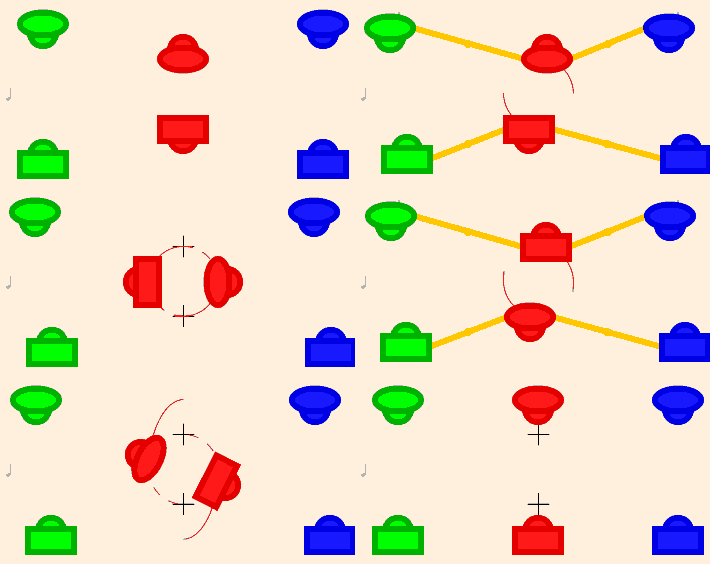
- First couple walks to the couple on the right. First and second ladies join both hands, first and second gentlemen join both hands across and above the ladies'.
- The ladies stoop under the raised arms of the gentlemen, then the gentlemen stoop under the raised arms of the ladies. Still keeping their hands joined, all walk to the left once around.
- First gentlemen and second lady join both hands and swing once around, simultaneously the second gentleman and first lady join both hands and swing once around.
- First couple repeats 1,2 and 3 with the next couple on the right.First couple continues in this manner until it has danced with all save the last couple, with whom it dances Do si do (No. 1) (see page 7 for description).
- When the first couple moves on to the fourth couple the second couple simultaneously walks to the couple on its right and repeats 1, 2, 3 and 4.Repeat this figure until all couples have danced.
- See page 5 for description.
- First couple out to the right
- And eight hands over.
- Ladies bow and the gents bow under,
- Round you go and go like thunder.
- Break and circle four in a ring,
- Docey-doe and a docey-ding.
- On to the next—
- First couple advances to second couple
- The two ladies join both hands across rights to lefts, and the two gentlemen likewise join their hands together over the ladies' hands.
- The two ladies bow low and pass in under the gentlemen's joined arms which are raised and swung back so as to rest around the ladies' shoulders. The gentlemen then bow and pass their heads under the ladies' joined hands, which now rest behind the gentlemen's necks.
- The ladies break their holds and crook their elbows tightly around the gentlemen's necks. (This is very important, or there may be an accident.) The gentlemen also let go of each other, and with their arms crossed over the ladies' shoulders, each takes a hold as securely as possible under the ladies' armpits. They all four throw their heads back as far as possible and circle to the left. the gentlemen lifting the ladies. The centrifugal force is so great that if the gentlemen spin fast with short steps and their feet close together, or even sometimes interlaced through each other, the ladies feet will come off the floor and they will spin around flattened out at a level with the men's shoulders. The men often dip slightly as they spin them, raising and lifting so that the ladies' bodies swing up and down like the wings of a butterfly, their feet often almost touching above the gentlemen's heads.This last should not be attempted until the hold is completely mastered and they know what they are doing. I have seen an improperly held lady urled clear across the room and against the wall. I have seen arms broken from falls in this dance. And the whirling feet of the ladies may do much damage if they hit anyone, or be severely hurt themselves if they hit any hard object
- The four dancers break holds, and separating, join hands in a regular circle of four. See page 160 for directions for the docey-doe.
- First couple advances to the third couple and repeats, then to the fourth couple, and returns to place in the square.
- Cecil Sharp's The Kentucky Running Set, 1918
- Ida Levin's Kentucky Square Dances, 1928 (No. 1)
- Ida Levin's Kentucky Square Dances, 1928 (No. 2)
- Neva Boyd & Tressie Dunlavy's Old Square Dances of America, 1932
- Lloyd Shaw's Cowboy Dances, 1939
- David Hendrix's Smoky Mountain Square Dances, 1941
- Claude Chadwick's Let's Square Dance, undated, presumably late 1940s
- Patrick Napier's Kentucky Mountain Square Dancing, 1949
- Modern Western Square Dancing's "Do Paso"
- Out to the right and circle four once around.
- Partners join left hands and swing half around.
- Give opposite your right hand and dance all the way around.
- Promenade, both hands joined.
- First couple walks to the last couple, all four join hands in a circle and walk to the left completely around.
- Partners then join left hands and change places.
- Each gentleman joins right hands with the opposite lady and swings her completely around.
- Each gentleman takes his partner on his right and joins both hands crossed with the right above the left. The visiting couple passes to the right of the other one, around behind that couple's place and back to its own place in the circle. Simultaneously the other couple describes a circle following the visiting couple and finishes by turning into its own place.
- First couple go to the couple on the right.
- Circle once around.
- Swing opposite clear around.
- Partner by the left and swing clear around.
- On to the next.
- Next couple out to the right.
- Swing home, corners too.
- First couple walks to the couple on the right.
- These four make a circle as follows: the first man gives his left hand to his partner and his right hand to the second lady. The second gentleman gives his left hand to his partner and his right hand to first lady, which bings both gentlemen with their back s to the center of the circle. In this position they walk to the gentlemen's right completely around.
- First gentleman, joining right hands with the second lady swings her completely around. Simultaneously the second gentleman joining right hands with the first lady swings her completely around.
- Partners, joining left hands swing completely around.
- First couple repeats 2, 3 and 4 with the next couple on the right.
First couple continues in this manner until it has danced with all save the last couple, with whom it daces Do si do (No. 1) - When the first couple moves on to the fourth couple the second couple simultaneously walks to the couple on its right and repeats 2, 3, 4 and 5.
Repeat this figure until all the couples have danced. - Each gentleman, joining both hands with his partner swings her once around, then joining both hands with the corner, that is, the lady on his left, swings her once around.
- Circle left; now right.
- Hens in the bread tray,
Picking out dough.
Lefts to your partner
And Do si do. - Gents you know.
- Swing your corner,
- Now your own and go.
- 1-4 The heads, hands joined, walk three steps into the center, drop hands, and turn to face their partners; while the sides walk three backward steps away from their partner and turn to face their opposites.
- 5-8 The heads take hands with their opposites and back three steps from their partners, drop hands with opposites and turn to face them; while the sides walk three steps toward their opposites and turn to face the center
- 9-12 The heads back 3 steps away from their opposites, and turn to face their partners; while the sides take hands with opposite, walk three steps into the center, drop hands with opposite and turn to face them.
- The heads take three steps back to original places and turn to face in; while the sides take hands with partner, walk backward three steps into original places and waste a beat.
- Duval, Duval of Dublin's Second Set, London, 1817 (republished 1857)
- Henry Ford/Benjamin Lovett, Good Morning, Dearborn MI., 1925
- Gallini, A New Collection of Forty-four Cotillons, with Figures Properly Adapted, London, 1772
- Thomas Hillgrove, The Scholar's Companion and Ball-Room Vade Mecum, New York, 1857.
- Elias Howe, Complete Ball-Room Hand Book, Boston, 1858
- Hurst's The Cotillons, Made Plain and Easy, London, 1769
- Landrin, Potpourri François des Contre~Danse Ancienne, Paris, ~1760
- Messrs. Lowe, Ball-Conductor and Assembly Guide, Edinburgh, ~1831
- Joseph Lowe, Lowe's Selection of Popular Country Dances, Edinburgh, ~1850
- Malpied, Les Caracteres des Contre~Danses, Paris, 1785
- Bob Osgood, Sets in Order Los Angeles, Dec. 1959
- John Playford, The Dancing Master, 3rd Ed. London, 1657
- Cecil Sharp, The Country Dance Book, Part 5, London, 1918
- Siret, A Set of Cotillons or French Dances, London, ~1770
- John Sweeney, Website UK, Current.
- Taminations, Website, US, Current.
- Thomas Wilson, The Quadrille and Cotillion Panorama, London, 1822
- Celtic Reel
- Circular Hey
- Courage Reel
- Dolphin Hey
- Hey for Three
- Hey for Four
- Intersecting Reel
- Interwoven Hey
- Mirror Heys
- Morris Heys
- Parallel Heys
- Progressive Hey
- Reflection Reel
- Sheepskin Hey
- Snowball Reel
- The first was used by Pat Shaw in Prince William, by Keller & Sweet in A Choice Selection of American Country Dances of the Revolutionary Era, and by the RSCDS in The Bonniest Lass in all the World, in it the 1s meet in the center, take hands and lead out between the women, cast away from each other, looping around the corner, meet again in center, lead out between men cast away, loop corners and return home.
John Young describes the figure, though he does not name it in Audenard Battle, and Eccles's Maggot, first published in ~1710, he uses it again in Albarony, 1726. Kynaston also describes this movement, though he also does not name it, in The Merry Salopians in 1718. And Walsh used it in a number of dances including Athol Brays in 1731.
Sometimes there is a two hand turn half in the middle so that the woman is always on the right during the leads.
Johnson in his 8th volume appears to use this meaning as he juxtaposes "Lead out sides" with "Lead out bottom & top" (which is the same thing rotated 90°).
- The second is defined by Wilson in his An Analysis of Country Dancing, page 51, in it the 1s again meet in the center, lead to between the men, turn around, lead to between the women, turn around, lead back to center, where Wilson leaves them.
- Nicholas Dukes defines "Lead out sides and turn in the middle" which seems to involve having the 1s cross to their first corners, leading them out and turning them, going back to partner, turning them, and finishing 2nd place proper. I think.
- Dukes also defines "lead out sides & in again", and, honestly I can't make head nor tail of his diagram. His description is "The two first Men & two first Wo: finish in their own places."
- The next involves having everyone face out, lead out, turn and lead back. (This seems more like a 4 bar figure rather than the 8 bars usually allocated to it). In the dance The Last New Vagaries, Playford describes these movements, though he does not give them a name.
- Tom Cook in The Fairy Prince has the 1s cross to improper sides, lead out (M1 with the two corner women, W2 with the two corner men), turn, lead back, 1s cross to proper, lead out (M1 with men, W1 with women), turn, lead back.
- The last meaning was used by Bernard Bentley in The Happy Pair where the 1s start between the women, lead out in a line of four with them, turn and lead back, the 1s two hand turn moving to the men's line, stand between them and lead out with them in a line of four with them, turn, and lead back.
- Hey
- Grand Chain
- Right and Left 4
- Right and Left Through
- Diagonal Rights and Lefts
- Three Couple Rights and Lefts
- Wilson's Right and Left
- Circle—(page 18) swing six hands round
- Two hand turn—(page 27) swing to place with both hands
- Hand turn—(page 31) all balance and turn partners to place — first four lead to the right, balance and swing round to place
- Right hands across star—(page 34) four ladies cross right hands and swing half round
- pull-by—(page 38) First lady swing the right hand gentleman with the right hand, next with the left hand — and so with the others, swinging partner last
- Place someone—(page 45) the gentlemen... swing your partner to the centre
- Modern Swing?—(page 85) — first four cross hands half round, swing partners —
- The first figure was "Up a double", meaning take hands with partner, face up (toward the presence), lead up a double (three steps and close), and fall back a double (for a total of 4 bars). Then repeat (for 8 bars). Often there will be a set and turn single either following each up a double and back, (up a double, back, set and turn single) or two up a doubles and back followed by two set and turn singles (for a total of 16 bars)
- The second figure would be siding. First right shoulder siding, then left shoulder siding. If set and turn single where included in the up a double, then they will be here too, and in the same way.
- The last figure is arming. First right arming, then left arming. Again set and turn single will appear if it did in the up a double.
Index
Warning: The list of dances for each figure is generated programmatically by regular expression matching and may be in error. Also for old dances this reflects the figures used by the interpreter, which may not match those of the deviser.
Allemande
Bars: 4.
"Allemande" just means "German", and an "Allemande" thus means a figure imported from Germany... which is not very precise. From its inception the term "Allemande" has been ambiguous.
And modern interpreters have come up with various ways of expressing this:
History
 |  | 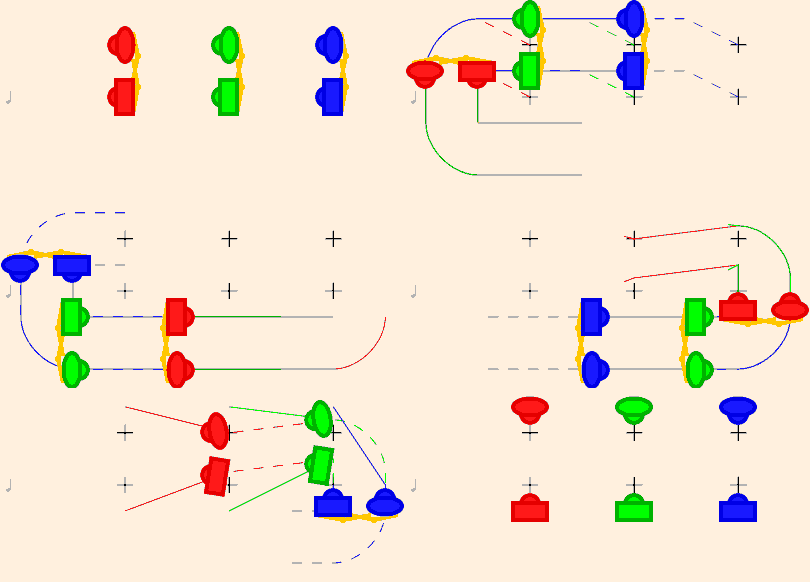 |
| Cooper's Crossed Allemande | Cooper's Pirouette Allemande | The Lowes' Promenade Allemanda |
The Regency Dance Site has a nice paper giving the history of the allemande in English dancing.
Nicholas Dukes does not define allemande in his book of Country Dance figures, published 1752.
In ~1769 in Paris in his Contredanse, Dubois appears to call for a pirouette allemande:
6. l'Hom. va en avant vis-à-vis de la f. lui fait fair l'Allemande revient à sa fem. lui fait aussi faire l'Allem. pour se remettre à leurs Place
The earliest use of "Allemande" (in English) which I have found is in Marli Water Works by Matthew Welch in perhaps ~1767 (though this date is debatable). After that Longman uses a pirouette in 1768 in a cotillion, and an unspecified allemande in 1772 in a country dance (The Herefordshire Lasses), Sancho in 1770 Thompson in 1779 (The Barley Mow), and Budd in 1781 (Miss Sayers' Allemand), etc.
In Sancho's Twelve Country Dances for the Year 1779, the dance Cutford Heath Camp uses allemande in a corner/partner, corner/partner sequence:
Allemande with the Corners with the Right hand & with your Partner with the Left hand Allemande with the opposite corners & your Partner
Across the Atlantic, in the US, Saltator, 1802 says:
ALLEMANDE, is to put one hand behind and reach the other out side-ways, turning both palms backwards matching another person's presented in like manor, and the arms interweaving with them.
There were two common styles of allemande in this period. One involved standing beside your partner right (or left) shoulder to partner's shoulder, then linking proximate arms with partner and connecting with partner's other arm behind their back. While the other allemande involved the man raising their joined arms (sometimes right, sometimes left, sometimes both) above his partner's head while she twirls beneath.
Wilson, in 1808, defines "allemande" and shows two people dancing around each other in circles, but does not say if they take hands, nor how they face. His description might be for a two hand turn, a back to back, a shoulder round, or half a dozen other possibilities and so isn't much help.
A later edition of this work, from 1815 says explicitly that people go round each other back to back.
On the other hand, his book on Quadrilles (1822) is the linked arm allemande, and points out that this is different from his country dance allemande.
The Lowes, in their Lowes' Ball-Conductor and Assembly Guide, ~1831, provide yet another version in their section on Spanish Dances and in it they define:
Allemanda, (allemande,) the same figure as promenade, only the hands joined behind backs.
The meaning of Allemande in modern Square Dancing (and Contra Dancing), and the meaning in Scottish Country Dance do not seem to match any of these
Bentley Allemande
Bars: 4.
 This figure is for two people, a man and a woman. Both start by walking forward to meet, then they take right hands, joined above the woman's head, and the man walks around the woman, they drop hands and both return to place.
History
I have always heard this called the "Bentley Allemande", and yet I know of no dance either written, or interpreted by Bernard Bentley which actually uses it. The earliest use of the name that I've found is in Tom Cook's interpretation of Trip to Castle Howard, from 1980 as found on Colin Hume's website.
This is a variant of the pirouette allemande.
Some dances which (probably) use this figure
See Also
Linked-Arm Allemande
Also known as: Turn in Tullock Hold, Turn in Hullachan Hold.
Bars: 4.
In this style of Allemande, partners stand right shoulder to right, facing in opposite directions, they interlace their right arms, and put their left hands behind their backs, taking their partner's right hand in their left, and so linked turn around in a small circle.
History
The Regency Dance Site has a nice paper giving the history of the allemande in English dancing.
Nicholas Dukes does not define allemande in his book of Country Dance figures, published 1752.
The earliest use of "Allemande" (in English) which I have found is in Marli Water Works by Matthew Welch in perhaps ~1767 (though this date is debatable), and Pat Shaw interpreted it as a linked arm allemande.
In the US, Saltator, 1802 gives a clear description:
ALLEMANDE, is to put one hand behind and reach the other out side-ways, turning both palms backwards matching another person's presented in like manor, and the arms interweaving with them.
(And he goes on to use it in the dance Constancy).
According to the Fletts' Traditional Dancing in Scotland (page 148) The Reel of Tulloch (and hence Tullock Hold) was current subsequent to about 1880. Given the lack of an Allemande tradition in Scotland, it seems more likely that this way of turning evolved independently rather than being a copy of the linked arm allemande from a hundred years before.
Some dances which (probably) use this figure
See Also
Pirouette Allemande
Bars: 4.
In a pirouette allemande, a couple approaches each other, then they take right (or left) hands, raise them above the woman's head, as she pirouettes around underneath, and then they retire.
History
The Regency Dance Site has a nice paper giving the history of the allemande in English dancing.
Longman uses a pirouette in 1768 in a cotillion.
Some dances which (probably) use this figure
See Also
Scottish Allemande
An online definition may be found here.
Bars: 8.
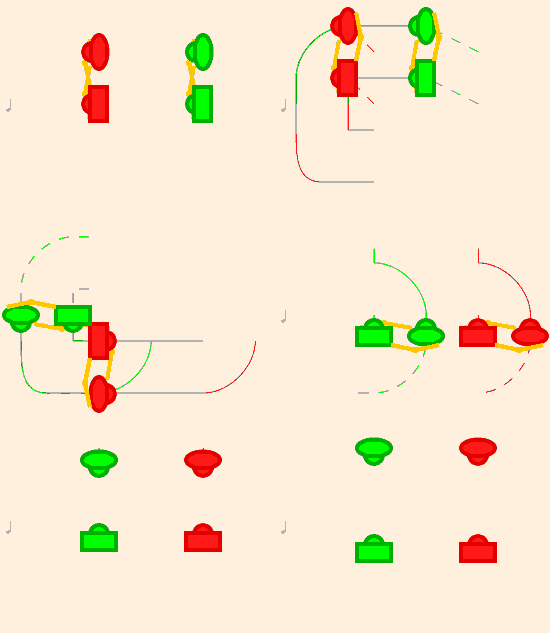 This is a figure for two couples (later extended to more) who start on the center line, beside partner, facing up, in either allemande or promenade hold. On the first bar they step out toward the woman's line and up and change from promenade to allemande hold if they need to. The first couple pivots about the man to face the men's line, and dance to it, then again pivot about the man to face down, then move down. The 2nd couple follows the first. By the end of bar 4 both couples should be facing down, the 1s in 2nd place, and the 2s in first. On bar 5 the couples pivot to face in (so now everyone is on the men's line M2 at top, W1 at bottom). On the sixth bar everyone dances in and the women move to stand across from and facing their partners, raising arms above the woman's head. Then release hands and fall back over the next two bars.
History
None of the books (I've found) printed by 19th Scottish dancing masters use the term "allemande". So I don't think there was any history of an "allemande" figure in Scotland prior to the (R)SCDS". The first use of "allemande" is in the interpretation of William Campbell's Delvine Side, interpreted in (R)SCDS Book 2 in 1925. Campbell was a London publisher, and at that time an "Allemande" probably meant the Linked Arm Allemande which took four bars, involved one couple, and was not progressive.
The (R)SCDS replaced this with something that involved at least two couples, took eight bars, and was progressive.
Murrough Landon has pointed out to me that Miss Milligan had more books of old dances than she did of old figures, and probably didn't know what an allemande was. She may have seen a description in Lowes' Ball-Conductor and Assembly Guide, ~1831, where they define a Spanish figure called allemanda:
Allemanda, (allemande,) the same figure as promenade, only the hands joined behind backs.
Which has some resemblance to the Scottish version, except that a promenade is not progressive.
(Note the Lowe's define this figure, but none of their dances actually uses it. It doesn't seem to have been a Scottish figure at that time.)
The original (R)SCDS allemande was for two couples. The first dance I know of to use a three couple version is Balmoral Strathspey, devised by John A. Charles and published in RSCDS Book 22 in 1963.
Some dances which (probably) use this figure
See Also
Arming
Bars: 4.
Arming is very like a hand turn, except that you lock elbows, or grasp further up the forearm, or put the top of your hand under your partner's elbow.
History
Arming appears in the Lovelace MS, and later in Playford's Dancing Master. It died out early in the 18th century.
Some dances which (probably) use this figure
See Also
Axum Reel
An online definition may be found here.
Bars: 8.
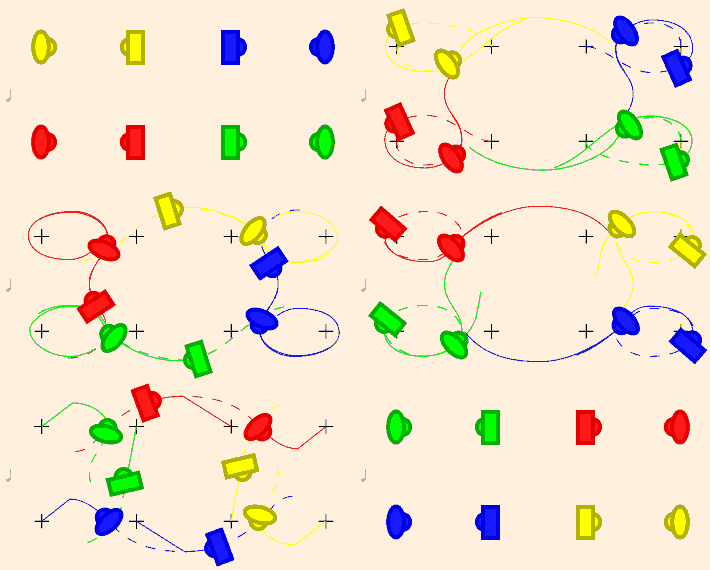 The Fletts say that the RSCDS description of this reel is inaccurate, so I am using their definition see Traditional Dancing in Scotland, pages 191-197.
The Fletts say that this is a squashed version of two diagonal reels of four from a square with the women at the vertices of the square and their partners inside the square facing them.
History
The Fletts do not give a date for the figure, but one of their comments implies that it was in use before 1882.
Some dances which (probably) use this figure
See Also
Back To Back
Also known as: Do-Si-Do, Do-Sa-Do, Docey-doe, Dos à Dos.
Bars: 4.
 In a back to back you start facing the person you are doing the back to back with and you continue facing that same way throughout the figure. Do not turn around. You walk forward, passing the other person by the right shoulder, go a little further, cross behind their back, and then back up (passing left shoulders this time) until you are back where you started.
Variants
Left back to backs by themselves are rare but do happen. Mirror back to backs also pop up from time to time. In the example the 1s are doing a right back to back and the 2s are mirroring this and doing a left back to back at the same time. The call for this would be something like “Partner mirror back to back women in the middle at start”.
History
In 1651, Playford says in Cuckolds all a Row: goe about the Co. We. not turning your faces, which seems a reasonable description of the figure.
In the Lovelace MS's description of the same dance, things are not quite so clear: each man shall goe round about his owne woeman but it certainly could be describing a back to back. Neither says what the woman does, that's normal for this period. It could be just the man doing the figure, or both.
The first use of "back to back" for this figure may be in Mulberry Garden, Playford, 1670: Go back to back with your own wo. the 2. cu. doing the same.
In 1752, Nicholas Dukes defines back to back with Feuillet diagrams.
When this call was translated into French it became “dos à dos” and when that came back into English it was “do-si-do”.
In Western Square Dancing of the 1940s the term "do-si-do" was reserved for what I call "do-si", while "do-sa-do" meant the standard back to back figure.
Some dances which (probably) use this figure
See Also
La Baratte
An online definition may be found here.
Bars: 6.
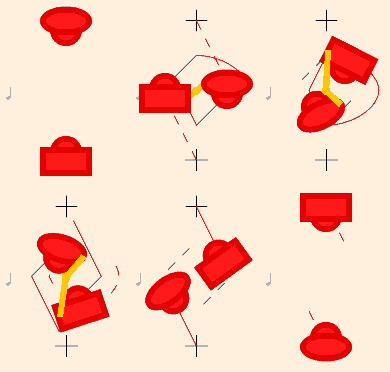 This figure is for a facing couple. They change places by the right hand, and retain that hand hold. Then join left hands too, then change places again with the woman turning under the joined hands (facing away from the man). The dropping the right hand they cross by the left.
History
The earliest dances with this figure that I could find were Micmac Rotary and The Haggis Tree, both published by John Drewry, 1982.
Some dances which (probably) use this figure
Basket Swing
Also known as: Swing like Thunder, Pivot Ring, Harlem Rosette.
Bars: 8.
 In a basket swing with 2 facing couples, the women take both hands with each other. Then the men bow under the women's hands and take both hands with each other. Then then women duck under the men's hands. And then you circle left.
When I was a teenager the goal was to spin so fast the girls' feet left the ground.
History
The first "Baskets" appear to use all 8 dancers in a square, and although the dancers intertwine themselves they don't circle round or make the ladies fly, they just balance. In the US this became a very standard quadrille figure in the 19th century, and it is found in almost every dancing manual of the period. (It was called a "Promiscuous Figure" which meant (in this case) that The figure was repeated with all four couples leading, and 3rd and 4th times through the gentlemen would form the center circle with the ladies outside.
Hillgrove (New York, 1863) calls it a "Promiscuous Figure" because it could replace either the second or the fifth figure of the standard quadrille.
In 1847 a variant pops up in London for what was called a "German Cotillion" which was danced in a large circle. It involved only 6 dancers.
In the 1890s a variant appears, probably again in a "German Cotillion", where the set may contain an arbetrary number of couples, and has all the ladies form a circle in the middle with all the gentlemen on the outside.
The first basket to involve only two couples seems to be in Cecil Sharp's Running Set, in which he studied Kentucky "Square Dances", published 1918.
John Cole in Selection of Favorite Cotillions, No. 1 (Baltimore, ~1822) published a dance called Basket Cotillion
Forward two _ cross over _ chasse de chasse _ cross to place _ Four ladies forward join hands half round and back and retain position _ Four gentlemen forward join hands half round and back _ The whole form a wreath ballancez and turn partners to place.
(The same words are used in John Klemm's publication from Philadelphia in ~1823)
Huestis & Craft's The Ball-Room Instructer; Containing a Complete Description of Cotillons and Other Popular Dances (New York, 1841) describes a Basket-Dance.
LADIES ROUND THE CENTRE.— Four ladies advance and take hands in the centre—go half round, back, and remain still.GENTLEMEN ROUND.— Gentlemen take hands forming a ring outside of the ladies; gentlemen half round—back to places—all raise hands, and ladies step back from the centre, and pass under the hands of the gentlemen—each lady taking care to be on the right of her partner; all balance and turn partners.
Henri Cellarius's The Drawing-Room Dances (London, 1847, later republished in New York, 1858) is the first example I've found from the UK, with his dance The Basket
Setting out of the first couple. The gentleman chooses two ladies, and places himself between them; the lady chooses two gentlemen and does the same. They advance during four bars, retire during four others, and advance for the last time. The gentleman, who holds the two ladies, raises his harm, and makes the two gentlemen pass underneath, without letting go the hand of the lady of the first gentleman, and give their hands to each other behind the latter. The two ladies, chosen by the first gentleman, join hands behind the conductor's lady, which form the basket. In this position they describe a tour to the left, and at a given signal, without letting go of hands, the gentleman in the middle passes under the arms of the two other gentlemen, and the lady under the arms of the two other ladies. The six have then their arms intwined. At another signal, they disengage their arms, and form an ordinary circle. The describe a round, and the gentleman, who is on the left of the first lady, begins a chaine plate by the right hand, which continues till the first gentleman has recovered his partner. He conclusion is made by promenade at pleasure.
Elias Howe published a quadrille called Basket Set in his Complete Ball-Room Handbook of ~1858:
No. 4. (2 strains) First two forward and back, cross over — chassee across, back — balance and turn partners — four ladies forward and back, join hands and swing quite round, keeping hold of hands — four gentlemen balance, join hands and swing quite round outside of the ladies. Here the music makes a while the basket or wreath is formed, then all balance in that position and turn partners to places next two the same, and so on.
The balance in the basket becomes a circle in the basket in Reilley's The Amateur's Vademecum, A Practical Treatise (Philadelphia, 1870) — but no one else follows this inovation for another 70 years or so:
Leads forward and back 4 bars Half right and left through 4 bars Leads forward and back 4 bars Half right and left to places 4 bars Four ladies to the centre 8 bars All glisse round, and turn partners to places 8 bars
Cecil Sharp came to the US around 1918 and wrote down what he saw of the Square Dancing in Kentucky (which he called the Running Set). In it he describes a figure called The California Show Basket which is the first example I can find with only two couples involved. It also involves a circle after the basket is formed, rather than a balance.
First and second couples hands-across once round clockwise, men joining both hands, and women joining both hands, the men's hands being above the women's.The men raising their hands over the heads of the women and lowering them to waist-level, enclose the women and all four go once round clockwise.The women lift their hands over the heads of the men and rest them on the men's shoulders; while the men raise their hands to the level of the women's necks. In this position all move round once clockwise.First man turns second woman into her place; while first woman turns second man into his place.The first couple repeats these movements with the third couple.The first couple repeats these movements with the fourth couple.It is suggested that the second circuit (i.e., when the men are enclosing the women) should be executed counter-clockwise.
In Kentucky Square Dances, 1928, Ida Levin describes a figure called "Ladies Bow, Gents You Know How"
The Call
Description
Ralph Page describes a figure he calls "Form a Basket" in his The Country Dance Book, 1937 (page 38)
With ladies in the center... facing each other, the men walk forward, so as to stand at the left hand of their partners. Gents now join hands, the ladies bow slightly forward, allowing the men to raise their joined hands over the ladies' heads, the ladies now step back one step and join hands.
He later (pages 75-78) provides a dance which uses the figure along with diagrams, and variations.
BASKET QUADRILLEFirst couple lead to the right, four hands roundCross eight hands, gents bow the ladies know how and around you goRight hands half around, left hands backSwing the opposite ladyAll swing partnersAll promenade.The same couple now repeats the changes with the other two couples. Then the second couple goes through the changes, then the third couple, and then the last. In some localities it is the custom for the second couple to start as soon as the first two begin the changes with the last couple.If you're husky enough, you will perform Gents bow, ladies know how this way:As the gents swing arms over the ladies' heads, they lower them back of the ladies' knees and lift their partners off the floor, basket-seat fashion. The ladies must be taken by surprise and spun violently to get the full effect of this figure.
Lloyd Shaw (in Cowboy Dances, 1939) uses it in the dance "Eight hands over" (pp. 200-203):
THE CALL:Shaw's Cheyenne Mountain Demo team, going like thunder
Copyright (C) by Bob Osgood, Reprinted from Sets in Order, Nov, 1948THE EXPLANATION:
Shaw goes on to remark:
Most dancers prefer avoiding the dangers and being less strenuous. They execute this figure in the old form of the California Show Basket. Both ladies' and gentlemen's arms are lowered in part (d) to the others' waists. All four lean back as far as possible, held at the waist, and form a basketlike group, flaring wide at the top. In this position the turn ver slowly to the left. This can be very graceful and beautiful, although the footwork feels awkward to the dancers.
And he provides a third variant full of good comedy:
The men in this case sweep their arms down below the ladies' knees and literally lift them up, so that the ladies are sitting on these intertwined arms at the height of the men's shoulders. If they lean back and out they can form an awkward-looking Etruscan-vase effect, but I laugh more when they lean over and pound the men on the head and squeal, "Let me down! Let me down!"
Despite appearing in Cowboy Dances, being on the front cover of the first issue of Sets in Order, and being the butt of several cartoons (Feb, 1949; and Jan, 1950), this figure never made it onto any of the standardized lists of square dance figures published by Sets in Order or by CALLERLAB. Perhaps they found it too dangerous.
Northern Junket published a dance with the figure in 1955, and Richard Kraus used it in 1956, but I haven't found any later references to it in the Square Dance world.
A toned down version occasionally spilled over into contra dance. It is not mentioned in 1956 (The Contra Dance Book), nor in 1993 (CDSS 75th Anniversary GEMS) but is present in 1983 in Zesty Contras.
In the 10 years of contra dancing in Santa Barbara I can recall only one dance with a basket swing in it (a three person basket).
John Sweeney also has an article on this figure. And rather to my surprise (given the paucity of UK descriptions) provides a quadrille collected in Cumberland in 1939 which uses the figure — not the US quadrille figure, nor the UK cotillion figure, but the 2 couple square dance figure. The initial publication from 1939 calls it a "pivot ring", but a later publication for 1949 calls it a "basket."
Some dances which (probably) use this figure
Bend The Line
An online definition may be found here.
Bars: 2.
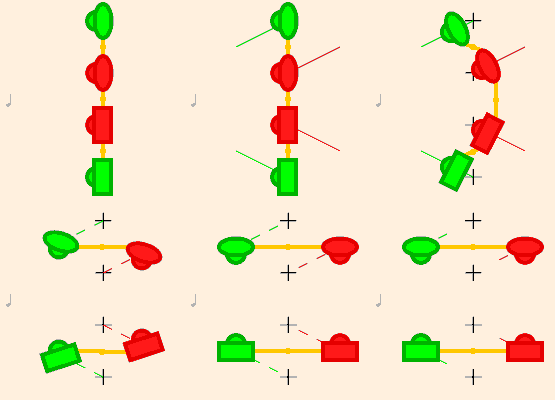 In ECD and Contra dance, starting from a line of four all facing up or down the hall, the dancers move in to reform the minor set.
In Square dancing, many more starting positions are possible, see Taminations.
History
Bend the line is a Square Dance call that has been applied (at least in the US) to a far older phenomenon. In My Lady Cullen, 1651, Playford does even bother to mention the behavior; he goes from a line of four moving up and down the hall to right hands across. Clearly the line needs to bend to get into position for the hands across, but this is so obvious it doesn't even get mentioned:
According to Vic Ceder's website this call was created by Bill Hansen in 1957.
First cu. cross over and fall on the outside into the 2. place, and change places The first four hands all abreast, and lead up to the Presence, and fall back Right hands across and go round all four Left hands across and go round, back again
As is usual with square dance calls, I cannot track what happened between 1939 (when Lloyd Shaw doesn't mention it in Cowboy Dances) and 1975 when CALLERLAB published the mainstream list.
Northern Junket, Feb, 1972, page 25, uses the term "bend the line".
Some dances which (probably) use this figure
Bourrel
Also known as: Birl.
An online definition may be found here.
Bars: 8.
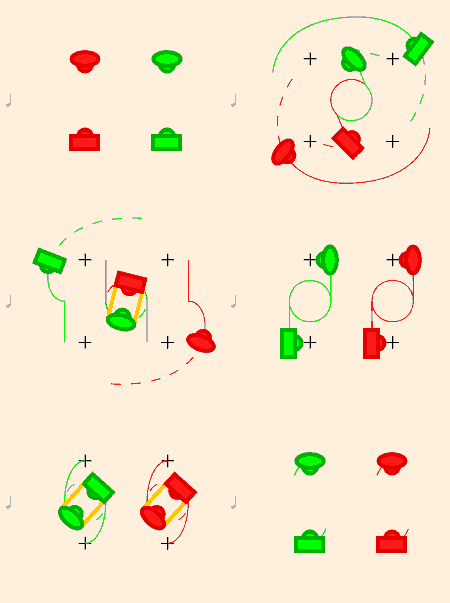 This is a progressive figure for 2 couples. Man 1 and Lady 2 set advancing to each other, and two hand turn (about 5/8ths) ending on the center line, L1 facing up, above M1, facing down. Meanwhile, their partners chase counter-clockwise about 5/8s to end facing their partners on the center line.
Everyone sets to their partner and two hand turns them three quarters to progressed places on their own sides.
History
The first use of this term comes from Robert Campbell's Campsie Glen, 1966. According to the SCDDB which has a note for this dance, he wrote that Bourrel is also known as The Birl.
The first example of a 3 couple bourrel that I can find comes from Kitty Rae Strathspey, by Sue McKinnell, 2004.
Some dances which (probably) use this figure
Box Circulate
Also known as: Split Circulate.
An online definition may be found here.
Bars: 2.
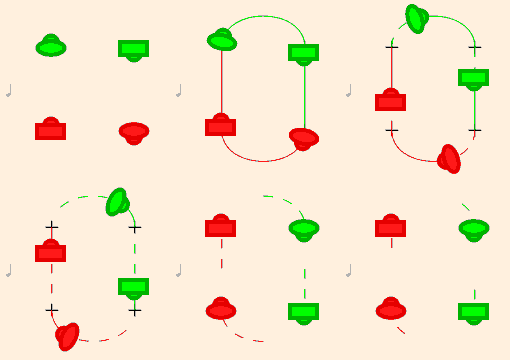 Box circulate is usually called from a square of four dancers, two looking in, and two looking out. The ones looking in move forward to take the place of the dancer in front of them, the ones looking out loop to take the place of the person beside them.
History
According to Vic Ceder's website box circulate was invented by Jim Stewart in 1968.
Some dances which (probably) use this figure
Box The Gnat
An online definition may be found here.
Bars: 2.
 This figure involves a facing couple, they join right hands and raise them, then they trade places. The woman turning left 180° as she passes under the raised hands, the man turning right 180° as he walks around her. The right hands remain joined afterward.
History
Box the Gnat is a figure in Cecil Sharp's Running Set from 1918. However that box the gnat has very little to do with the modern figure.
First man turns his partner half-way round with the right hand and once round with the left.
Lloyd Shaw does not mention it in his Cowboy Dances from 1939.
In Sept 1949, Sets in Order published a list of standardized calls agreed at a recent callers' meeting. It describes box the gnat as:
BOX THE GNAT—Opposite right, opposite left, opposite right and pass her behind him to his left side. Partner left, Partner right, Partner left and pass her behind him to his right side. It is suggested that other words be used for Partner to avoid confusion, e.g., Box the Apple, Box the Pear.
In March of 1951 Sets in Order published how box the gnat was danced in California, and in Texas. In the California version there is both a dance called "box the gnat" and a figure inside the dance, also called "box the gnat", but the figure inside the dance looks like the modern figure:
Now you box the gnatGive right to corner and exchange places, walking past each other, the lady turning with a left-face turn under the man's right arm.Box the fleaPertains to the left hand with the same person, girl walking forward does a right-face turn, back to original position.
Note that this figure is very different from the standardized figure published a year and a half before.
In June of 1951 there's another dance where a left handed box the gnat is still called box the gnat (nothing about a flea).
In Northern Junket, June, 1970, page 29, there is a reference to "box the gnat". I presume that means it had reached the East Coast by 1970.
Recently I have seen the term "Twirl to Swap" used to mean a non-gendered version of "Box the Gnat".
Some dances which (probably) use this figure
See Also
Butterfly Whirl
Bars: 4.
At the end of a star promenade, the dancers drop hands in the center and then couples twirl around their common center to progressed places.
History
The term "Butterfly Whirl" was used in Lloyd Shaw's Cowboy Dances, 1939, page 194, both as the name of a dance and a figure in that dance. The figure consisted of the dancers twirling on the spot with their hands above their heads to look like butterfly wings. Needless to say, this is completely different from the modern meaning.
The earliest example I know of comes from Erik Hoffman's There Is No Way To Peace; Peace Is the Way from 1992. But I don't know that that's the earliest.
Some dances which (probably) use this figure
See Also
California Twirl
Also known as: California Whirl, Frontier Twirl, Twirl to Swap.
An online definition may be found here.
Bars: 2.
 This figure involves a couple, standing side by side, with the woman to the right of the man and inside hands joined. They change places, and end facing the other way (with the same hands still joined. The man walks forward outside the woman in a semicircle turning right, while the woman twirls under their joined hands 180° to the left.
History
Lloyd Shaw does not mention it in his Cowboy Dances from 1939.
The first use I can find is from the report of the "Southern California Square Dance Standardization Subcommitee" which was published in the January 1951 issue of Sets in Order.
California Whirl (Turn-back or around after an arch)
Although the modern California Twirl is invariably done with the man on the left and woman on the right, this does not seem to be the case in 1951 with more examples where the man is on the right:
It's Corners California Whirl, and see-saw round with your own sweet girl"California Whirl": holding his corner's right hand in his left, the gent twirls the lady in a CW spin under his left arm while he walks a half CCW turn, ending up at arm's length, each facing in proper grand-right-and-left direction. Then passing corner girl by left shoulder, see-saw round partner, also passing left shoulderCalifornia, Here I Come by Bob Hall, published in the Nov, 1951 issue of Sets in Order
By 1953, the term "California Twirl" appears in Easy Key Handbook of Square Dance Fundamentals, Clarke Kugler. And his definition now says that the woman is on the man's right.
In a glossary printed in the May, 1957 issue of Sets in Order, both "California Twirl" and "California Whirl" appear and are mirror images of each other. In a "California Twirl" the man's right hand connects to the woman's left, while in "California Whirl" the woman's right hand connects to the man's left.
Things were different on the East Coast: in Northern Junket, Aug, 1970, page 22 there is a dance which uses the term "Frontier Twirl" (with a comment saying it's a new term for an old figure) in a context where I'd use a "California Twirl", so I suspect the two are the same. Although published in 1970, the dance itself dates to 1968.
CALLERLAB published the first standardized list of calls in 1975, and California Twirl was on that list.
Recently I have seen the term "Twirl to Swap" used to mean a non-gendered version of California Twirl, and, occasionally, "Box the Gnat", and "Star Through".
Some dances which (probably) use this figure
See Also
Cast
Also known as: Brisé.
Bars: short cast: 2, long cast: 4.

 A cast involves turning outside the set, traveling along the outside a certain number of places (usually 1) and then coming back into the set at a new position. Casts are usually up or down the set but can also be across. In a cast down, assuming the people involved are facing in to the set, they will turn over their shoulder nearest the band, and move down the set into the place below. Sometimes casts are described as right or left, then people turn over their right (or left) shoulders and continue moving clockwise (or counter-clockwise) around the set to the next place.
Casts may be long or short. A long cast takes twice as long and involves the people casting coming in to the center to meet and touch hands before casting out to the sides. The short cast simply involves turning and going down the sides.
Styling: as you cast outside the set you have a good chance to catch the eye of your partner as s/he also casts.
Often there will be someone else in the spot that you are moving into, so while you are casting this other person must move out of the way.
In the example on the left the 1s cast down one place while the 2s lead up one place (to make room for them). In the example on the right the women will lead between the men and then cast back to their place (in this case the cast is across the set rather than up or down).
Variants
In Scottish Country Dancing, the dancers moving out of the way usually do not meet in the middle but simply slide up (or down) the sidelines. If two adjacent couples have to move up simultaneously they take hands along the sidelines.
In American Country Dancing of the early 20th century, the cast was usually an assisted cast (which is rather like the English gate figure, and commonly followed a down the middle and up figure: 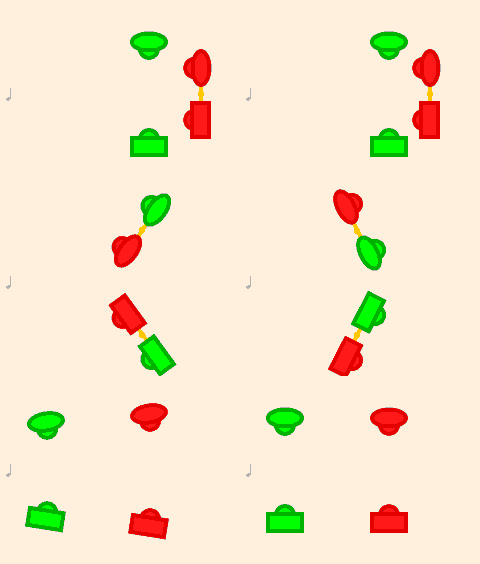
In Modern Square Dance, a cast is similar to the assisted cast above.
Some dances which (probably) use this figure
Celtic Reel
An online definition may be found here.
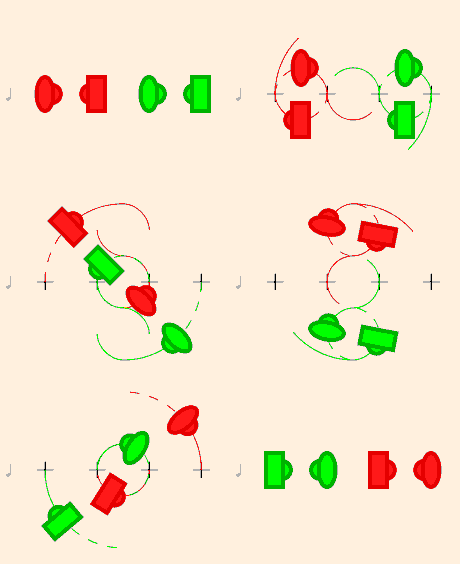 The Celtic Reel starts set up for a reel of four, with the center dancers facing the nearest ends, and the ends facing in. They pass right shoulders and do one change of the reel. Then the new centers right shoulder round three quarters and face out, while the new end dancers chase clockwise a quarter, and face in.
This leaves the dancers ready for another reel of four at right angles to the first, each dancer facing the same person as at the beginning, but now those who started on the outside are in the center and vice versa.
The process repeats, one change by the right, centers round three quarters while ends chase a quarter.
This is halfway through the reel, everyone is rotated 180 degrees
The full reel would repeat this until everyone is where they started.
History
The earliest use of this figure that I can find is Barry Skelton's The Celtic Reel published in his book The Celtic Book, 1994.
Derek Haynes published an earlier dance with that name in 1972, but it is a 3 person dance and can't use this figure.
Some dances which (probably) use this figure
See Also
Chain Progression
An online definition may be found here.
Bars: 8.
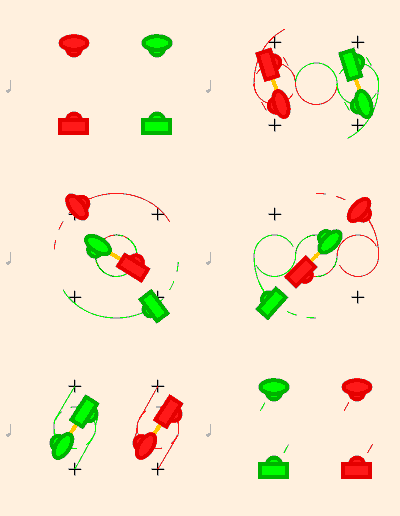 Two couples exchange places by turning partner three quarters by the right hand to end on the center line, then those on the ends chase clockwise half round the set while those in the middle left turn once and a half, finally turn partner right three quarters to return to the sidelines.
History
The first use I can find of this figure is in Eric Forbes' Glen Mor which was published in 1973.
Some dances which (probably) use this figure
Chaperoned Chain Progression
An online definition may be found here.
Bars: 8.
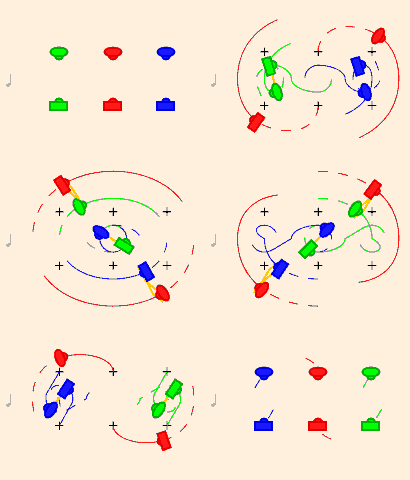 For three couples. The middle couple casts clockwise to end on the center line above or below the set, while the others partner right turn three quarters, also ending on the center line. The very centers turn left once and a half, while the others join hands with the person beside them in promenade hold and chase half round the set. The original middle couple continue the momentum of the chase, ending where they started, while the others partner right turn three quarters to end progressed on their own sides of the set.
History
The first dance to use this figure is Linnea's Strathspey, by Tim Wilson in 2001.
Some dances which (probably) use this figure
Chevron
Bars: 4.
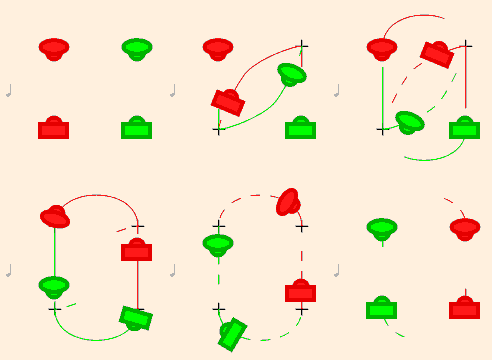 In a chevron one set of corners (here the first corners) will cross the set, then second corners cast into the first corners’ positions while the first corners back up into the second corners’ positions.
The cross may be by either the right or left shoulder. If right the other people will cast right, if left the others will cast left. (the example shows a right cross and right cast).
History
The Chevron was invented by Fried de Metz Herman, and the earliest dance I have found using it is Astoria Lass which was written in 1992.
Some dances which (probably) use this figure
See Also
Circle
Also known as: Circinate, Hands Round, Hands 4, Hands 6.
Bars: depends on the size of the circle, 4 bars for 4 people.
 A circle involves joining hands with other people in the set and turning in a big circle.
If you move to your left shoulder (clockwise) you are said to be circling left. Moving to your right shoulder (counter-clockwise) is circling right. If no direction is specified assume you are to circle left.
A full circle will return you to where you began. Circles can be fractionalized, and a half circle will move you half round the minor set.
Often a circle in one direction is followed by a circle in the other direction (Circle left, circle right), in which case you circle until the end of the phrase of music and then change directions and circle back. It doesn’t matter how far you get, but you are expected to end the second circle where you began.
Circles may be of any number of people more than two (a two person circle is usually called a two hand turn).
History
I presume circling is as old as dancing.
Some dances which (probably) use this figure
Closed Star
Bars: 4.
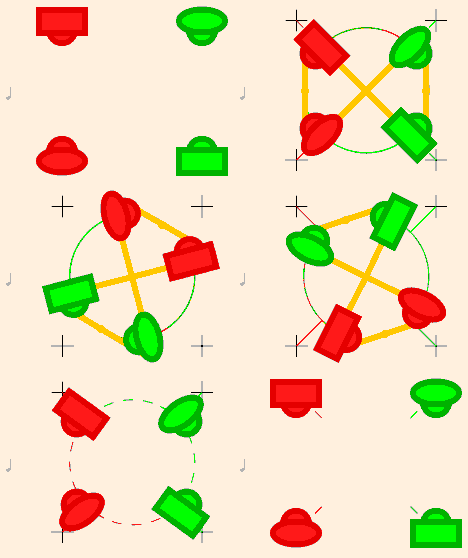 This is like a normal hands across star, except that not everyone uses the same hand. If the 1st corners join right hands, then the 2nd corners will join left hands, then all join free hands with the person you are facing, and 2nd corners back up while 1st corners dance forward.
History
This was invented by Fried de Metz Herman. The earliest dances I could find using it come from 2002, At Rainbow's End is one.
Some dances which (probably) use this figure
See Also
Congee
Bars: 2.
The Lovelace MS uses the term "congee" in four dances, and I'm not sure what it means. In the dance Greenwood, where Lovelace says "congee", Playford says "set and turn single", but Lovelace uses "sett" when he means set. Lovelace does not use the term "honour", nor "bow" and I suspect the meaning might be close to that.
If you look at Orchésographie (page 26 or Arbeau's numbering, page 53 of the pdf) he defines congé as leave Elle signifie le congé qu'il fault prendre de la Damoiselle, en la saluant, la tenant tousjours par la main pour retourner ou l'on a commencé, or That signifies a leavetaking, which you must take of the demoiselle, ¿kissing/bowing/saying goodbye to? her, and taking her, still by the hand to where you began, I find this confusing. Why are you taking leave of someone whose hand you still hold? And as this isn't the last figure in the dance, just the last figure in a section of the dance, why are you saying good-bye at all? I assume "back to where you began" means to your home position in the dance?
Some dances which (probably) use this figure
Contra Corners
Also known as: Swing Corners (Wilson).
Bars: 8.
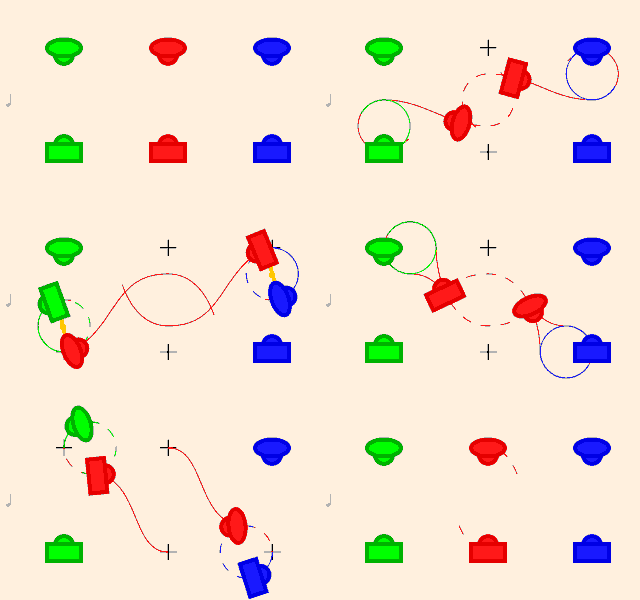
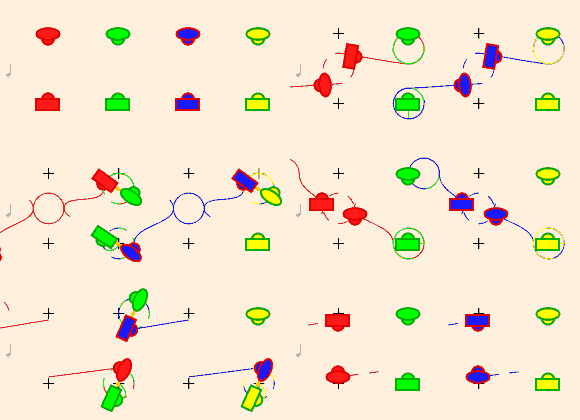 In this version of the figure you pull-by right with your partner, turn your 1st corner left, pull-by right with partner, turn you second corner left.
In a modern contra dance this can be unexpected because one of your corners will be outside your minor set.
History
Early examples of this figure are not very explicit, and it is not always clear which hand you use to turn whom, thus in modern dancing styles we have two different versions of what is basically the same figure.
In US Contra Dancing you turn your partner right, your 1st corner left, your partner right again, and your second corner left. The first description I can find that explicitly says to do this is in Thomas Wilson's An Analysis of Country Dancing from 1808.
Most other styles have settled on: turn your first corner right, partner left, 2nd corner right, partner left.
By 1918 Burchenal's version of Chorus Jig has squashed the original triple minor into a duple minor, meaning that all corners are always active.
Some dances which (probably) use this figure
See Also
Corner Chain
An online definition may be found here.
Bars: 8.
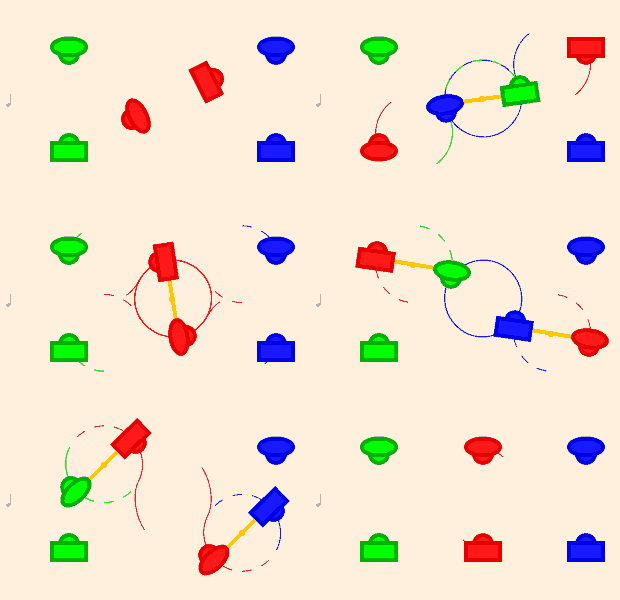 The 1s start in the middle facing 1st corners. 1s+1st corners turn half right (putting the 1st corners in the middle). 1st corners turn left all the way. 1st corners turn the 1s half right (putting the 1s in the middle). Then the 1s turn left once and a quarter to face 2nd corners.
Usually the 1s will then repeat the figure with the 2nd corners, and the 1s cross left to 2nd place own sides at the end.
History
This first appeared in The Laird of Milton's Daughter devised by Lord Craigmyle in 1950 and published in RSCDS Book 22.
Some dances which (probably) use this figure
Corners Pass And Turn
An online definition may be found here.
Bars: 4 or some multiple thereof.
 The middle couple start facing their 1st corners and loop around them as the 1st corners come together and right hand turn and return to places. The middle couple pass right to face 2nd corners and loop around them as they turn. The middle couple pass right to finish in 2nd place on their own side.
Variants
Many dances have the corners turning with both hands.
Some dances have the right hand turn replaced by a right shoulder round.
The dance City Lights has a "Corners Pass and Allemande Turn", where the middle couple behaves normally but the corners meet and the man turns the lady under his arm, whereupon he backs, and she goes forward to original places.
History
The first dances I can find with this figure are The Black Black Oil and Tommy Ford's Fancy, both devised by Drewry in 1971. A note on the SCDDB says that Tommy Ford's Fancy, and The Misses Farrell of Alloa are the first dances to use it. But the Misses Farrell wasn't until 1977.
Some dances which (probably) use this figure
See Also
Corners Pass And Twirl
Bars: 4 or some multiple thereof.
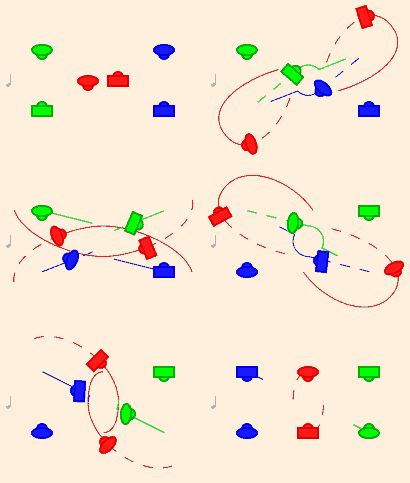 Similar to Corners Pass and Turn except the corners only do a half turn by the right (not a full one) and pull back their right shoulders to the sidelines.
The middle couple start facing their 1st corners and loop around them as the 1st corners come together and right hand turn half and pull back right shoulders to change places. The middle couple pass right to face 2nd corners and loop around them as they turn and twirl. The middle couple pass right to finish in 2nd place on their own side.
History
The earliest example of this figure I can find is from John Drewrey's dance Get Weaving, from 1994.
Some dances which (probably) use this figure
See Also
Corners Set And Turn
Also known as: Set to and Turn Corners.
Bars: 8.
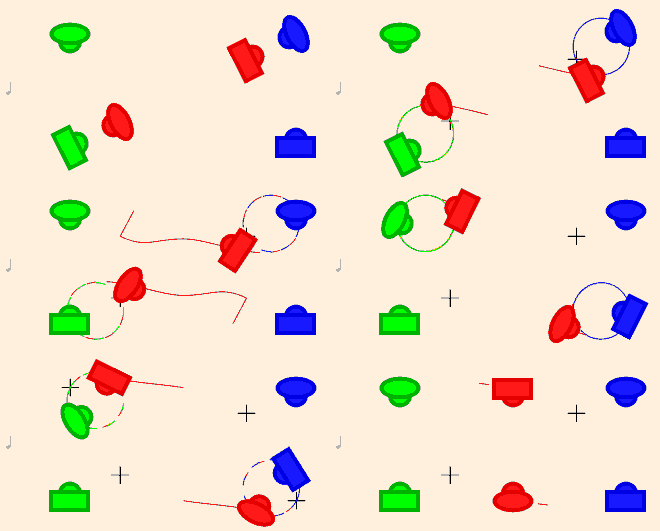 The active couple starts facing their 1st corners, with whom they set for two bars, then they turn them (which may be either a two hand or right hand turn) and dance (passing left shoulders) to their 2nd corners in the next two bars. Again, they and the 2nd corners set for two bars, and turn for two bars.
History
In the Fletts say: The first Country Dance figure which seems to have originated in Scotland is the figure 'set and turn corners', which appeared about 1720. Sadly they don't give an example of a dance in which it appeared.
The first use of this figure that I know of is from London, in Johnston's Willie with his Tartan Trews, 1750. (The (R)SCDS says Rutherford, but Johnson published it first.)
Some dances which (probably) use this figure
Courage Reel
Also known as: Dance to each corner and set, Marigold Reel.
An online definition may be found here.
Bars: 6 or multiples thereof.
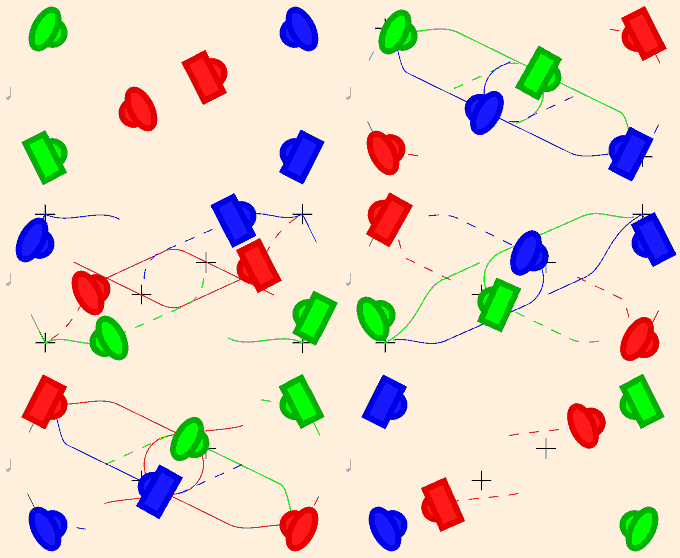 The active couple starts facing their 1st corners. They and their 1st corners cross by right shoulder, the active couple pulls back their right shoulder to face in, while the 1st corners pass each other right shoulder in the center and turn to face 2nd corners. And the 2nd corners set facing toward the center. This then repeats as many times as called for: those in the center pass the corner they face by right shoulder, these corners also pass each other and turn to face the next corner, who has been setting.
Variants
There is a variant of this figure in the dance Marigold where the corners do not set.
History
The earliest example of this figure that I can find is John Drewry's The Courage Reel, 1977.
Some dances which (probably) use this figure
See Also
Cross
Also known as: Change, Pass Through.
Bars: 2.
Two facing dancers change places, usually passing by the right shoulder (except in Scottish, where they usually take right hands briefly). In a cross (or pass through) they usually end facing out in the direction of travel, in a change they usually face back in to the set.
Some dances which (probably) use this figure
Cross Go Below
Also known as: Cross and Cast down.
Bars: 4.
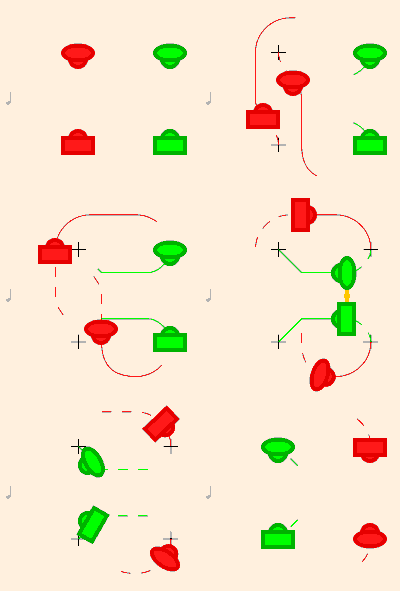 The active couple crosses by right shoulders (in Scottish by right hands) and then casts down one place while the 2s lead up (or move up along the sidelines).
History
In Jog on, my Honey from 1651, Playford says: The first cu. cross over, go below the 2. cu.
Some dances which (probably) use this figure
Crossover Mirror Hey
Also known as: Crossover Reflection Reel.
Bars: 8.
 A Crossover Mirror Hey is like a normal Mirror Hey except that the 1s cross over at the top before passing between the 2s. This means the 1s end improper.
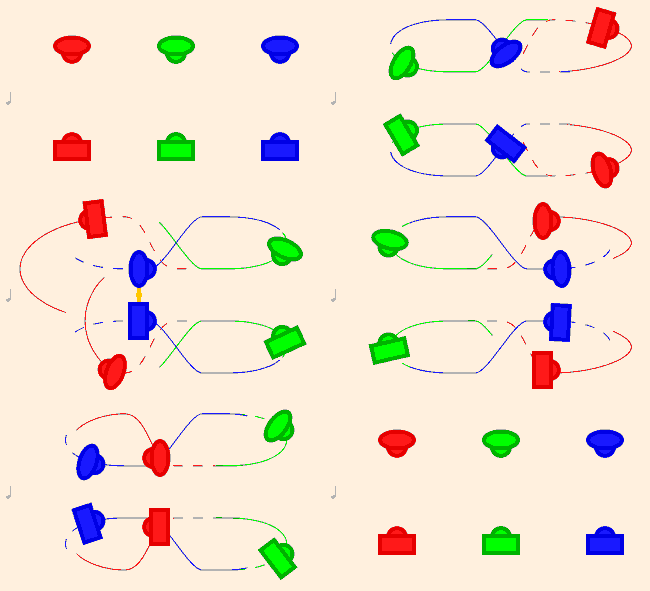 Often one crossover hey will be followed by a second one so that everyone ends proper.
History
The earliest dance I know of with a crossover hey is Grimstock, 1651. But this dance has the 1s crossing both at the top and bottom of the set, so it is not quite what is usually meant by a crossover hey (closer to an Inveran reel). The next dance is probably Henry Playford's Caries Maggot from 1701. Both of these are subject to some interpretation. I think that's what's going on there, but not everyone will agree, however John Young's Soho Square, 1718, is less ambiguous:
The first Man Heys on the We. Side, and his Partner on the Mens Side at the same Time Then both Hey on their own Sides
Some dances which (probably) use this figure
See Also
Crown Triangles
An online definition may be found here.
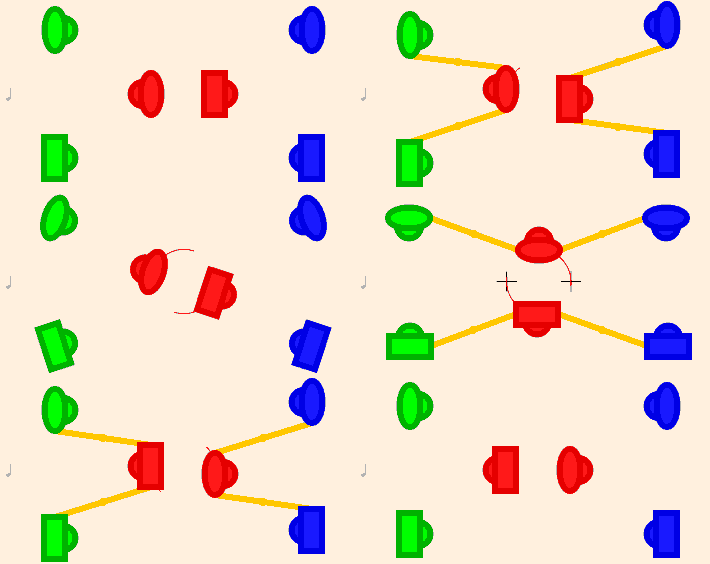 The active couple starts back to back in 2nd place, woman facing up, man down. They take hands with their corners, and set. In the next bar the actives rotate around each other 90 degrees to face out on their own sides while the corners turn in place by 90 degrees to face into the set. Take hands and set for 1 bar. Then the actives rotate 90 degrees clockwise (active man facing up) as the top corners face down and the bottom face up. Take hands and set for 1 bar.
History
The first use I could find of this figure occurred in various dances by Douglas Henderson, published around 1960. One is Baldovan's Reel published in Baldovan Set Dances, 1960
Some dances which (probably) use this figure
See Also
Diagonal Rights And Lefts
An online definition may be found here.
Bars: 8.
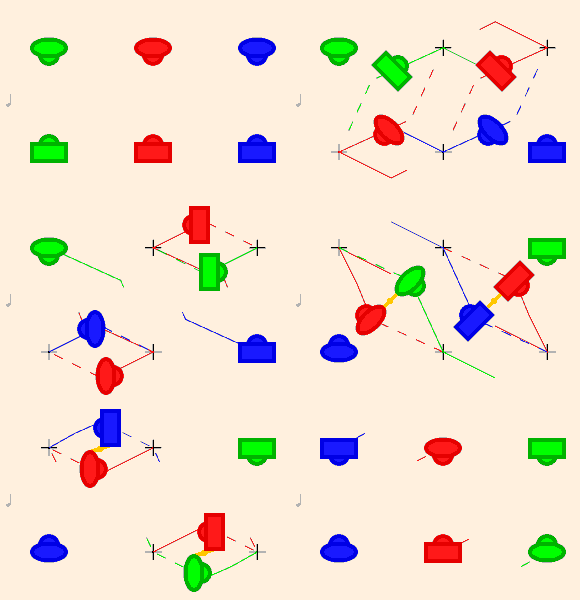 A diagonal rights and lefts is a figure for a 3 couple minor set where the middle couple interacts with either their first or second corners.
I've never seen a full diagonal rights and lefts, usually you will find two half diagonals one with first corners, and one with second. This leaves the middle couple where they started, but the corners diametrically opposite.
In a half diagonal rights and lefts with first corners, the middle couple turns to their first corners and does a right hand cross, then turns to their partner's original position (3rd corner person) and does a left hand cross.
History
The first dance I know which has something like a diagonal rights and lefts is the Contra dance Becket Reel, Herbie Gaudreau, 1957, which has a diagonal right and left through.
The next dance I know of is John Drewry's Bratach Bàna, from 1964.
Some dances which (probably) use this figure
See Also
Do-Si
Also known as: Do-Si-Do, Do-Paso, Docey-doe.
Bars: 8.
Do-si-do Variations
Do-si-do is a call that is integral to the early square dances of the southern Appalachian Mountains and the midwest. Oddly these calls had very little in common with the simple back-to-back movement most of us associate with "do-si-do". Equally oddly, every area seemed to have a completely different interpretation of what "do-si-do" actually meant.
"Do-si-do" is a two couple figure. Usually it starts with a circle, and ends with the two couples promenading around each other. But the movements in the middle vary wildly.
Sharp, Levin, and Napier did their research in Kentucky. Hendrix, and Chadwick from Tennessee. Dunlavy collected her dances from "southern Iowa". Shaw from the Midwest.
Lynn Rohrbough published American Folk Dances in 1939 and gives a description of do-si-do. But since she follows Sharp's description precisely I do not include it as a variant.
Frank Smith published Square Dances of the Great Smoky Mountains, also in 1939, and his version of do-si-do seems to match Shaw's (except Smith has the arms held high, while Shaw doesn't mention this). There is a difference in usage, however, Shaw has a do-si-do at the end of every figure, while Smith says it may be used as a figure itself or thrown in "at the leader's discretion" to any figure.
An article of the Square Dance History Project by Lee Owens (1954) claims that this (Smith's) was the original do-si-do, or at least the original one which wasn't just a simple back to back. I have my doubts about this claim, as it looks nothing like what Sharp reported — perhaps he is only talking about western "do-si-do"s and this is the original form to migrate west?
Cecil Sharp's The Kentucky Running Set
The first description I know of comes from Cecil Sharp.
In 1917 Cecil Sharp (who spent his life rediscovering old tunes and dance styles) came to the US and traveled through the Appalachians looking for folk tunes. To his surprise he found square dancing too.
In his book The Country Dance Book, Part V he gives detailed descriptions of how to dance this style of dance. Most of his dances are what we'd now call traveling couple dances and in these, after the couple has danced the figure with the last stationary couple, they will then do a "do-si-do" with them before promenading back home.
Sharp describes the "do-si-do" as follows:
Two couples face. Men turn their partners half-way round with left hands, pass each other by the right (moving sideways, right shoulders forward, back to back), turn their contraries half-way round with right hands and return to places, passing each other by the left (back to back, left shoulders forward). This movement, which is known as the Do-si-do or the Do-si, is then repeated.
At the conclusion of the repetition, men turn their partners once round with left hands, cross hands with them and dance round a small circle, counter-clockwise, each couple breaking off and proceeding to its original station.
The half turns in the Do-si-do must be executed at great speed and with bent arms, each performer describing as small a circle as possible. In crossing over between the turns the men should arch there backs and pass as closely to each other as they can.

Look at the dance Figure Eight (Running Set)
Ida Levin's Kentucky Square Dances (No. 1)
Ida Levin actually published two slightly different versions of "Do-si-do". The first is designed to be danced when the traveling couple reaches the last stationary couple, while the second is the main figure of its dance.
Ida gives both calls and an interpretation of those calls:
Which means...
Note that when Ida says "swing" she does not mean the modern partner swing in ballroom position, but a simple hand turn.

Look at the dance Figure Eight (Kentucky Squares)
Ida Levin's Kentucky Square Dances (No. 2)
Ida Levin actually published two slightly different versions of "Do-si-do". The first is designed to be danced when the traveling couple reaches the last stationary couple, while the second is the main figure of its dance.
Ida gives both calls and an interpretation of those calls:
and meaning...
Note that when Ida says "swing" she does not mean the modern partner swing in ballroom position, but a simple hand turn.

Look at the dance Do Si Do (Kentucky Squares)
Neva Boyd and Tressie Dunlavy's Old Square Dances of America
This "do-si-do" is also designed to be danced when the traveling couple has finished with a stationary couple and is ready to move to the next.
Two couples join hands in a circle and walk to the left (4 counts). They pass through as in Right and Left Through, (2 counts). Partners then join left hands and walk past each other, releasing their hold as they pass, but do not turn (2 counts). Each gentleman joins right hands with the opposite lady and turns her completely around (4 counts). He then joins left hands with his own partner and turns her round onto his right (4 counts).
If the couples will practice walking through this slowly at first, they will soon be able to dance the figure without consciousness of the number of counts
Boyd adds a comment that instead of the final promenade to places, the dancers may choose to do a (modern) partner swing to get to places.

Lloyd Shaw's Cowboy Dances
Lloyd Shaw has the traveling couple dance do-si-do after every encounter with another couple (rather than just the last one).
At the end of a circle the hands break, ladies pass between neighbor and the other lady (ladies passing dos à dos), back to her partner who takes her left hand into his left then she turns round behind him, eventually dropping hands. He remains facing the other gentleman as she circles counter-clockwise around him.
Now each takes his/her neighbor of the opposite sex by the right hand and the ladies circle clockwise around their neighbors (the gents continue to face and drop right hands when they need to).
Then each takes partner left in left ending in a courtesy turn hold. The traveling couple can move on to the next this way.

An article of the Square Dance History Project by Lee Owens (1954) claims that this was the original do-si-do, or at least the original one which wasn't just a simple back to back.
Look at the dance Him and Her
Smoky Mountain Square Dances
Hendrix lived in Tennessee; his booklet Smoky Mountain Square Dances was published in 1941. He describes do-si-do as:
DO-SI-DO
LADIES DO-SI-DO
This figure is executed by passing your partner through the circle 4 to the left and all the way around the gent, counterclockwise, holding his partner with his right hand and raising it to pass his arm over his own head. Each of the gents pass their partners around simultaneously. Each gent will be facing his corner lady as she comes around ... he gives the corner lady his right hand, turning her halfway round clockwise. This faces each gent back in the direction from which he started.
"GENTS YOU KNOW"
Gents give each other their left hand and turn each other halfway round counterclockwise to face in the other direction again. Gents are now facing their corner ladies -
"SWING YOUR CORNER, NOW YOUR OWN"
The gents each make half turn to the left and swing the "CORNER" lady by placing his right arm around her and swings her clockwise one and one-half times. "This is very important" because, if they swing exactly one and one-half turns, each gent and lady will face right at the end of the swing and they will each be facing their partner and read to execute the next part of the call.
Each gent then swings his partner clockwise in exactly the same manner as before; the even numbered couples will now be on the inside of the circle facing counterclockwise to the grand circle and they promenade (dance) ...
This figure implies that it starts from a circle and ends with a promenade, though the two appear to be considered separate calls.
I find the turn "turn halfway" a little confusing. To me it means that the two people turning halfway should end up in each other's places, but Hendrix seems to mean that the two should end where they started but facing in opposite directions.

Let's Square Dance
Chadwick was a professor at Vanderbilt (Tenn); his booklet Let's Square Dance! is undated, but presumed by the square dance history project to be late 1940s. He describes do-si-do as:
Calls:
Description: At the call "do-si-do" each gentleman drops his corner's hand and joins lefts with his partner. He hand-swings her half around and as he releases her he grasps his corner lady's right in his right. After swinging their corner ladies half around the two gentlemen swing with lefts. The latter is done at the call gents you know. The change figure now completes the performance.
"The change figure" is just swing corner, swing partner (and this I think is a waltz position swing, not a hand turn).
I assume when "the two gentlemen swing with lefts" that they also do a half swing, though he doesn't say so.
Note that this version does not include a promenade afterward.

Kentucky Mountain Square Dancing
Patrick Napier describes two styles of "Do-si-do" in his booklet Kentucky Mountain Square Dancing; one of these is simply reprinting Sharp's description, but the second is different:
After a figure is danced by two couples the call "do-si-do" is given by the caller. The two couples face. The gent's partner is on is right with her left hand in his right hand. The gent allows the lady to pass in front of him, around behind hime and back to her place (both couples do this at the same time). The partners hold hands through part of this figure and drop hands when the lady is passing behind the gent. The gent then swings his corner (opposite) lady with a two-hand swing once around and then swings his own partner once around. The leading couple goes on to the next couple while the other couple (the "second" or "number two", or "even" falls back into their original place in the set.
Note that this version does not include a circle beforehand, nor a promenade afterward.

Modern Western Square's Do Paso
This is a version of "Do-si-do" which Lloyd Shaw found in El Paso, so he named it Do Paso. It's the only form that has made it Modern Western Square Dancing, I'm not sure how accurately the modern call reflects the original from El Paso.
For a description of this I refer you to Taminations

Look at the dance This Old Riverboat
Some dances which (probably) use this figure
See Also
Double / Single
Bars: 2.
A "double", and a "single" are specific steps which made their way into English Country Dancing from French predecessors. A "single" consists of a step forward and then a close, while a double consists of three steps forward and a close. I've also seen people go up on tip-toes for the close.
The phrase "up a double and back" was probably the most common usage, part of the "up a double/siding/arming" trio. When doing an "up a double and back" a couple would turn to face up, take hands, dance up a double, fall back a double, and turn to face. Even if you do two up a doubles in a row, take a moment to face and acknowledge your partner between the two.
History
Arbeau uses these terms in his Orchésographie (page 26 or Arbeau's numbering, page 53 of the pdf), and defines them over the next few pages: first the single (page 27, or 55 in the pdf)
CapriolDeux simples suyuent le branle, comment fault-il les faire?ArbeauVous marcherez en auant du pied gauche pour la premiere mesure: Puis mettrez le pied droit ioinct auec ledict gauche pour la deuxieme mesure: Puis auancerez le piel droit pour la trosiesme mesure: Et à la quatrieme mesure & battement ioindre le pied gauche auec ledict pied droit
CapriolTwo simples follow the branle, how must I do them?ArbeauYou step forward with the left foot for the first beat: Then place the right foot to join it for the second: then advance with the right foot for the third and on the fourth join it with the left.
Then the double (page 27, or 56 in the pdf)
Le double se faict en quatre mesures & battements du tabourin: Sur la premiere mesure, fault auácer le pied gauche. Sur la seconde mesure, il fault aduancer le pied droit. Sur la troisiesme mesure, il fault encor auancer le pied gauche: Et sur la quatrieme mesure, il fault ioindre le droit auec ledit gauche. Et ainsi en 4. mesures sera complet le double: Et s'il y a deux doubles: L'aultre double suyuant se faict au contraire du premier, auanceant le pied droit, puis le pied gauche, puis encor le pied droite: Et à la quatrieme mesure fault ioindre le pied gauche auec le droigt:
The double is done in four beats (or raps on the tambor) On the first beat advance your left foot, on the second the right, on the third the left again, and on the fourth beat you must join the right to the left. Thus 4 beats complete a double. And if there are two doubles, the other double is done opposite to the first: advancing the right foot, then the left, the right again, and then close with the left.
The Lovelace MS does not seem to use the term "up a double", instead it just says "Lead up".
Some dances which (probably) use this figure
See Also
Double Triangle (Wilson)
An online definition may be found here.
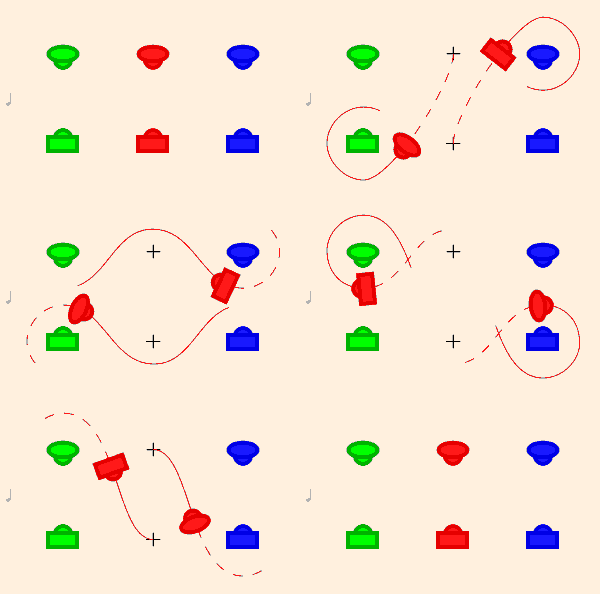 The middle couple loop first corner, pass right shoulder outside partner's original place, then loop 2nd corner right shoulder and return to place.
History
Thomas Wilson devised this figure in his 1811 edition of An Analysis of Country Dancing. As far as I know he was the only person to use it — except for Elias Howe who republished six of Wilson's dances in his The Complete Ball-Room Hand-Book, and used double triangles in one.
In 1935 Miss Milligan tried to guess what the term meant and replaced it with finishing reels. In 1949 she made up the modern (Scottish) version of double triangles.
Some dances which (probably) use this figure
See Also
Double Triangles
An online definition may be found here.
Bars: 8.
 The active couple starts back to back in 2nd place, facing out, they take hands with their corners (who may need to dance in slightly to do so) and set for two bars. Then all drop hands. The corners continue to set, as the actives pas-de-basque around each other clockwise (always back to back with partner) until they are facing out the other side. The actives take hands with new corners, and all set for two bars. Again the corners continue to set, while the actives pas-de-basque back to their starting positions (usually facing in now).
History
Miss Milligan found the term "Double Triangle" in Wilson's dances, but (according to Murrough Landon, personal communication) she had not found any of the books where he defined what his terms meant (Double Triangle is defined in his An Analysis of Country Dancing, 3rd ed. 1811 on page 113). So she appears to have guessed.
The first dance she interpreted that contained this figure was There's Nae Luck Aboot the Hoose (Wilson spelled it There's Nae Luck About the House) published in (R)SCDS Book 10, published 1935. In it she replaces Wilson's figure with finishing reels, which is reasonably close to the original and gets the corners involved too.
She next approached the figure in (R)SCDS Book 15, published in 1949. Three dances in this book use the figure (Lord Rosslyn's Fancy, My Mother's Coming In, and Waverley), and for these she invented the modern figure.
After that she consistently used the modern figure.
Some dances which (probably) use this figure
See Also
Down the Middle and Back
Also known as: Lead Down the Middle and Back.
Bars: 4,8.
 The active couple joins hands. In English usually inside hands, in Scottish usually right hands in right, and leads down. After 4 bars they turn and lead up to places.
Variants
Often this is part of "lead down the middle and back and cast off". The timing of this is handled slightly differently in Scottish than in English. English dancers will generally lead down sedately for 4 bars, then skip up more quickly in two bars, and cast off in two, while Scottish dancers will lead down for 3 bars, lead back up for 3 bars (at the same pace) and cast off.
History
The earliest dance I can find that uses this figure is Playford's Black Jack from 1670: The 1. cu. leads down the middle and back again.
Playford was more likely to have the 1s lead down and cast around the 2s and return to place, rather than just leading down and back.
During the 18th century the simple lead down and back became more common while the lead and cast back faded.
Some dances which (probably) use this figure
See Also
Down the Outside and Back
Also known as: Take A Peek.
Bars: 8.
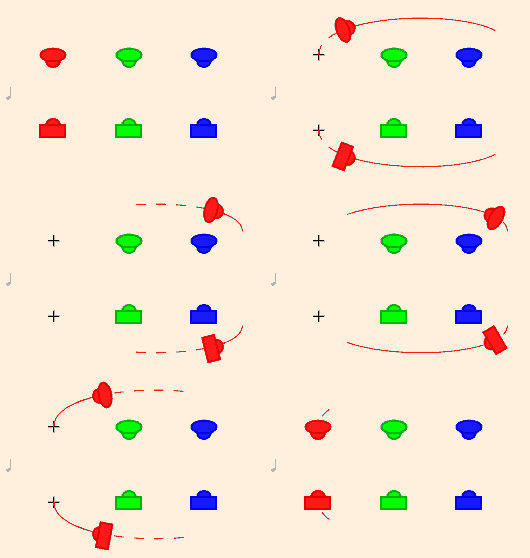 The active couple casts off, goes down at least to the bottom of the minor set, acknowledges each other, and casts back up to the top.
History
The earliest example I can find is from Preston's Trip to Tunbridge from 1793. but I wouldn't be surprised if there were earlier ones.
This figure was very common in Elias Howe's contra dances from ~1860.
Some dances which (probably) use this figure
See Also
Dutch Crossing
An online definition may be found here.
Bars: 16.
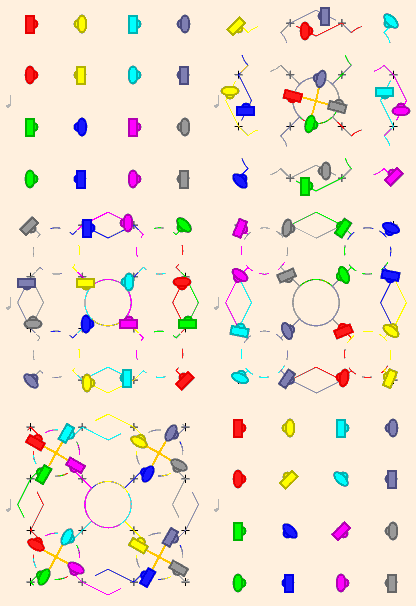 The Dutch Crossing requires 16 dancers arranged in 4 lines with 4 dancers on each line. It consists of two intersecting reels, which in turn intersect a right and left figure. The eight dancers on the diagonals dance the intersecting reels, while the other eight dancers give right hands and left as they travel round the edges of the square.
The figure begins by dividing the big square into 4 little squares of 4 dancers in which everyone does half right hands across (in two bars). In the next two bars the center four dancers do half left hands across, those at the corners of the big square set, while the others face out of their original little squares and do a left pull-by with the nearest dancer in the next little square.
The figure then repeats, after which everyone is diametrically opposed to where they started.
The figure repeats two more times, and everyone is back where they started.
History
Dutch Crossing is also the name of the dance which contains this figure. It was written by Ernst van Brakel and published in Colin Hume's Dances with a Difference, vol. 3, in 1990.
Some dances which (probably) use this figure
See Also
Espagnole
An online definition may be found here.
Bars: 8.
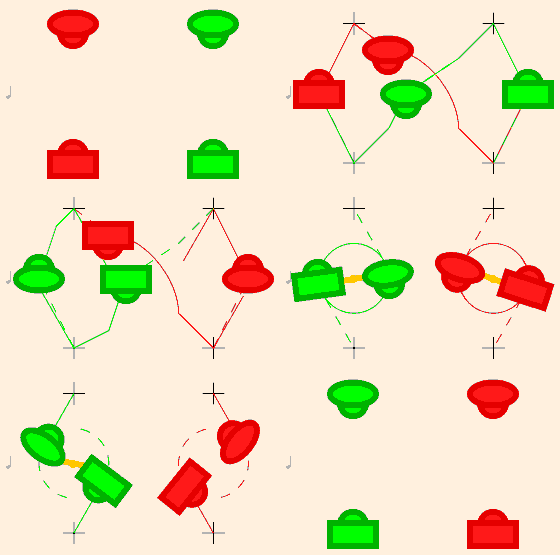 Espagnole is a progressive figure for two couples: the men cross the set to the woman's line, as the women lead between them and then cross right (2nd woman in front of 1st). Then the two women cross the set back to their own side, while the two men lead between them and cross right (2nd man in front of 1st). The 2s are now above the 1s.
Each couple does an easy hand turn, 2s right, 1s left back to progressed places.
History
The first use of Espagnole that I can find is in John Drewry's Ardgilzean, 1975.
Some dances which (probably) use this figure
Face To Face
Also known as: Face en Face.
Bars: 4.
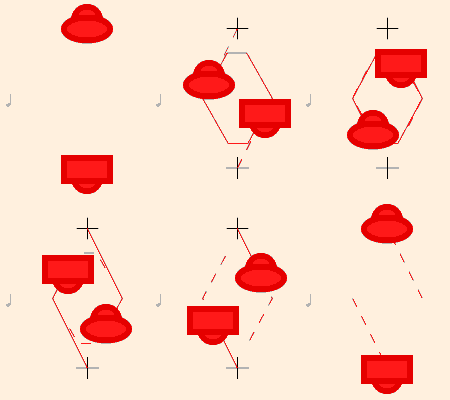 Face to face is almost the same as a back to back except you start facing away from the person you are doing the face to face with and you continue facing that same way throughout the figure. Do not turn around. You walk backward, passing the other person by the right shoulder, go a little further, cross in front of them, and then go forward (passing left shoulders this time) until you are back where you started.
History
The earliest use of this figure that I know of is in Fried's dance Fireflies, 1987.
Some dances which (probably) use this figure
See Also
Figure Eight
Bars: 8 for a full, 4 for a half.
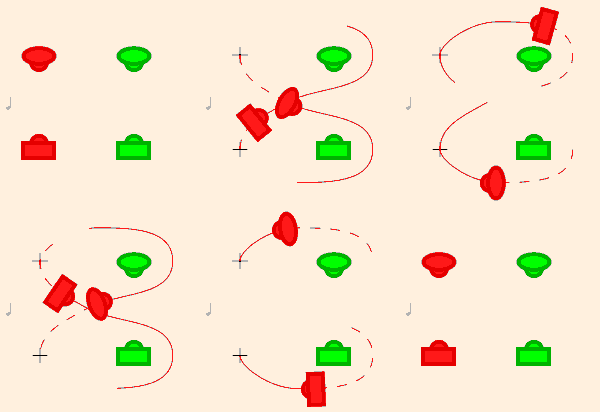 In the example the 1s cross down between the 2s, loop around them and come back up, then cross down between the 2s again, and loop around them again, returning to original places.
There is also a half figure of eight, where the active couple crosses between the inactive couple, loops around them and finishes in their partner's place.
Variants
Henry Playford also published dances where the men figure eight through the women (and vice versa): in Juice of Barley, 1689, he describes the movements of a figure of eight across (but does not name it), while in Easter Eve, 1701 he does use the name.
Nathaniel Kynaston published several dances with figure of eights on the side lines (as opposed to through another couple), see Love and a Bottle, 1710 where M1 figures through the men, and W1 through the women. The Canary's, a dance published by John Young in 1726 also has each sex doing a figure eight on its own side.
Kynaston also published dances where the first corners figure eight though the second corners (or vice versa). See Jockey's Jigg, 1711. Cook's Humour, published by Young in 1718 (so perhaps devised by Kynaston also) has the corners doing half figures of eight.
History
Playford uses a figure of eight in his dance What You Please, from 1651:
1. man go in the Figure of 8 about the 2. man and 1. wo. go int the Figure of 8 about the 2. wo.
As far as I can tell, the figure died out in the US in the nineteenth century — except for the dance Figure of Eight but even this dance does not use the term, it has to spell out the movements of the figure because no one was expected to know it.
As with many other figures, this started reappearing in the 1970s when Contra reimported many English figures which it had lost over the years.
Some dances which (probably) use this figure
See Also
Double Figure Eight
Bars: 8 for a full, 4 for a half.
 Everyone is involved in this figure eight, but the 1s and the 2s are out of phase. Initially either the 1s will cast down as the 2s cross up, or the reverse with the 1s crossing down and the 2s casting up. Here, the 2s start by doing a normal figure eight, while the 1s cast down, and then from second position continue to follow the figure eight track. Everyone ends up at home.
As with a normal figure eight, one can also do a double half figure eight, which leaves both couples crossed over.
Variants
In Scottish Country Dancing, the 1s and 3s will sometimes do a double figure eight while the 2s, between them, remain stationary.
History
There are a few old dances which seem to use a double half figure of eight: Devonshire-House from the 10th Ed. of the Dancing Master, and The Scotch Measure by Thomas Bray, 1699, but neither names it a "double half figure", they just describe the movements.
There are roughly 15 dances where Henry Playford or John Young do use the term "double figure" (Maid's Morris, 1688 is one), but in many of them the modern meaning of a double figure does not work, they seem just to have meant a full figure of eight. Usually.
See Colin Hume's analysis.
The first use of a double half figure eight (in the modern sense) occurs in Pat Shaw's interpretation of Thomas Bray's The Scotch Measure. The original describes a double half figure eight, but does not name the figure.
Pat uses a full double figure eight in his interpretation Burlington House in 1965. The first use in a Scottish Country Dance comes in John Drewry's Jennifer's Jig from 1968.
Some dances which (probably) use this figure
See Also
Forward and Back
Also known as: Lead In and Fall Back, Advance and Retire, En avant en en arriere.
Bars: 4.
Move in to the middle, and fall back. Usually taking neighbor's hand.
History
Playford was using this as early as 1651, in Cuckolds All A Row: Meet all forward and backe.
Playford tended to say "Lead in and fall back", but in Scotland this figure was called "Advance and Retire" in the Castle Menȝies collection (1749). The French figure En avant en en arriere was used in cotillions and quadrilles and was translated as "Advance and retire" when they arrived in England.
Something very interesting happened in Contra Dancing between 1956 and 1983. In Rickey Holden's The Contra Dance Book, 1956, he uses the call "forward four and back again" (or "forward six" for triple minors), but in Larry Jennings' Zesty Contras, 1982 these two calls have completely vanished and been replaced by "Long lines forward and back".
Somewhere between these two publications the integrity of the minor set ruptured and people reached to take hands with those in other minor sets.
Now Chorus Jig had become a duple minor by Holden's day, so it's contra corners figure reached outside the minor set, but nothing else did. Perhaps it was Becket Reel, 1957 which made people look outside the minor set?
Some dances which (probably) use this figure
See Also
Gate Turn
Also known as: Gate, Assisted Cast.
Bars: 4.
 Two adjacent dancers join inside hands then one walks forward, the other backward turning in a circle about their joined hands. The one backing up is said to be "gating" the one going forward.
History
This appears to be a modern figure. Douglas & Helen Kennedy describe it (but do not use the term "gate") in their interpretation of Abergenny, though they do not name it. (Colin Hume has a different interpretation of this dance which does not use a gate figure.)
Porter, Heffer, & Heffer also describe a gate figure in their interpretation of The Bishop from 1931, but again they do not name it. They use it again in their own dances The Happy Clown, and The Northern Lass, published in 1932.
In the mid 1970s, Pat Shaw uses the figure in The Amazed Geneticist but still doesn't call it a gate.
The first use of "Gate" that I can find comes from Fried de Metz Herman's Yola's Invitation devised 1978.
Some dances which (probably) use this figure
See Also
Grand Chain
Also known as: Grand Right and Left, Right and Left 6, 1st. 2d. & 3d. Cu: Right and Left, Chain Figure of six.
An online definition may be found here.
Bars: 8.
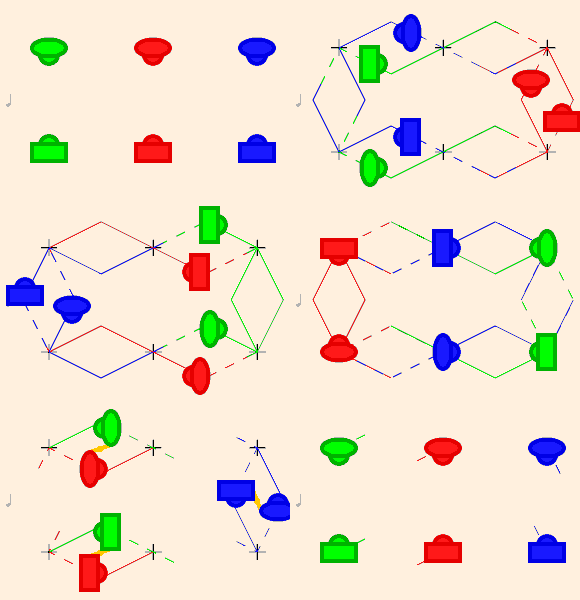
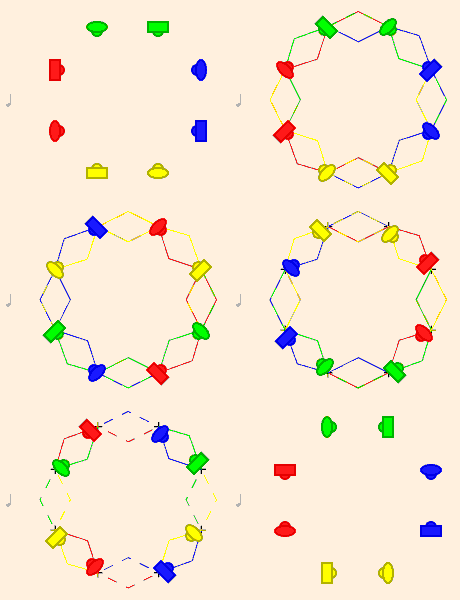 A "grand" chain is a chain that involves everybody in the set (A chain here means right and left). It is most often applied to square sets, and minor set with 3 couples in them.
In a square set you face your partner, pull-by with the right hand, face the next person, pull-by with the left hand, and so on until you get back to your original position. At 2 bars per change, this takes 16 bars to return home (8 bars to end diametrically opposed but still with partner for a half chain)
In a three couple set, the top (or bottom) couple face their partners, and everyone else their neighbors then pull-by right with the person you face, and left with the next, and so on until you get home. This is normally allotted 8 bars, but it takes 6 changes. In Scottish Country Dance the first two changes take 1 bar each and the third takes 2, then the 4th and 5th changes take 1 bar each, and the last takes 2.
History
John & William Neal call for a grand chain in their dance Rossmore published in 1726 when they say: 1st. 2d. & 3d. cu: right and left. They make it clear that the right and left applies to all three couples.
In 1752, John Johnson uses Right and Left 6 in Lord Anson for Ever.
The first use of the term "grand chain" I can find is in Cent Contredanses en Rond by d'Aubat de St. Flour, published ~1757: La grande Chaine contient 16. mes. & la grand demi-chaine 8. mes. This is a book of cotillions, so this figure is for a square set.
Thomas Wilson in his Complete System of English Country Dancing, 1815 gives a diagram and description of a three couple grand chain, though he calls it a "chain figure of 6". He reserves the term "grand chain" for quadrilles, see his other book The Quadrille and Cotillion Panoramma, 1822.
Some dances which (probably) use this figure
See Also
Grand Square
An online definition may be found here.
Bars: 8 without a reverse, 16 with one.
 Sides Face, Grand Square
 Boys Face, Grand Square
 Heads Star Thru, Sides Face,
Grand Square
In its simplest form the Grand Square is a figure taking 16 counts. It normally starts from a squared set where either sides or heads are facing their partners (instead of the center).
In Modern Square Dancing the call "Grand Square" is actually a 32 count figure where the figure described above is followed by its reverse (with the heads starting out facing and moving backward, while the sides go forward into the center. For CallerLab's definition (and for some unexpected variations) see Taminations.
It is worth noting that you and your corner trace the same small square. Both of you must be going in the same direction (clockwise or counter-clockwise) or you will collide. This means you never interact with your corner (only your partner and opposite).
In a normal sides (heads) face grand square you will be moving in the opposite direction to your partner (one clockwise, the other counter). But in a boys face grand square everyone in the set moves clockwise, and in a girls face everyone moves counter-clockwise (until the reverse, of course, then everyone moves in the opposite direction.
Brooke Friendly & Chris Sackett's dance Chocolate is the Answer runs through several variants of the Grand Square — but to a waltz tempo.
Variants
On a diagonal
One day Vic Cedar called "Head boys and corner into the middle and back/ Side boys and corner into the middle, and back, and face/ Grand square." And we promptly were confused. But it does work, as does "Boys (or Girls) face corners, grand square".


4 Couple Longways
The grand square is always done from a square. But it could be done from a four couple longways set, I don't think anyone has however. The end couples face their partners (that's normal in a longways set) and the middle couples turn to face their nearest middle neighbor. Alternately, the end couples face in and the middles face partner. If you have a longways set with 1s+3s (or 2s+4s) improper you could do something like men face or women face, but describing it would be difficult (because it's not always facing your partner).

The four face four contra dance called Grand Square Contra expands itself into a square, and then does a grand square.
Duple Minor
In his dance Mary K. Gary Roodman adapted the grand square to a duple minor format. Essentially it's "2s face, grand square" with no reverse. There are only 2 couples active of course. Gary calls it petit fours.
It has some similarities to the old petit quarré (except that the 2s are 90º out of phase with the 1s in the petit fours, whereas the corners are 180º out of phase in petit quarré).

In G.M.S. Chivers' The Modern Dancing Master, London, 1822, he defines a "Small Square" in his section on Ecossoises (page 70):
The first couple advance, join hands, and pass sideways between the second couple, the each retire, the lady moves behind the second gentleman, while her partner moves behind the second lady to their places, each forming a square.
Essentially a grand square with only one couple active and no reverse.
Square with an extra couple in the middle (5 Couples)
In 1998 Wendy Crouch devised Winter Solstice with (half) a grand square for this configuration.

Square with two extra couples in the middle (6 Couples)
Then Vernal Equinox built on this by adding an extra couple. While The Merifest Central Square has the central couples moving against the main flow and arching backwards over the heads.


6 Couple Rectangle
It is possible to do a grand square from a 6 couple rectangle, I know several ways, some use the definition as written, another involves the head couples acting in tandem (as if each couple were an individual). I got this one from Michael Kellogg, a caller from Northridge, CA.


Double Square
In a double square (with two couples on a side) a simple "sides face, grand square" will lead to people bumping into one another; but the same three options that work for a rectangle will work here.


Hexagon
And, of course, in hex squares, you can warp the small squares of the grand square into diamonds:

History
John Sweeney also discusses the origin of the grand square, and has tracked down an earlier example of the figure.
The first example of the Grand Square figure (that I know of) comes from the dance Hunsdon House in John Playford's 3rd edition of The Dancing Master, London, 1657. The figure had no name, but Playford describes the movements:
First and 3. cu. meet and taking the cu. wo. fall back into the 2. and 4. place, whilst the 2. and 4. fall back each from their own, and meet the co. wo. in the 1. and 3. place As much again
John Sweeney has found an older version of this dance in the Lansdowne Manuscript dating to about 1648.
But dances in square formations were falling out of favor in England at this time (Playford published his last square dance in 1670), and there were no more uses of the grand square figure for a hundred years (in England).
Cotillions
In Gand (which is the French spelling of Ghent, Belgium) in ~1757 it was called Le grand quarré alternativement (alternativement meaning (I think) that you started it with heads, and then did the move with the sides, or it included a reverse) in d'Aubat de St. Flour's Cent contredanse en rond. d'Aubat is inconsistent in his spelling and sometimes spells "quarré" and sometimes "carré".
In Paris in ~1760 it was called Le Carré de Mahoni in Landrin's Potpourri François des Contre~Danse Ancienne, and in Dubois. I don't really have the references to explore its evolution further in France, but I can't help wondering if M. Mahoni were a dancing master who (re)invented it. The French knew about Playford and they might have rescued the figure from the obscurity of Hundson House, or they might have developed it themselves, or perhaps the figure predated Playford and both he and they may have copied it from an earlier source.
It next pops up in England when Cotillions were imported from France in about 1770 or so.
The first example I can find is in La Fracas des Medecin from Hurst's The Cotillons, Made Plain and Easy, London, 1769 (page 19). Again he does not name the figure merely describes it:
then the 2d. and 4th. Couples advance to the middle with the 1st. and 3d. Couples separate to the sides, 2d. Man leads 4th. Wom into the 3d. Couples places where separating each falls back to the Corner on their own sides the 4th. Man in like manner leads 2d. Wom into the 1st. Couples place where they separate allso and fall back into their respective Corners; During this time the 1st. Man and 3d. meeting together take hands and advance into the middle with the 3d. Man and 1st. Wom on the Oposite side do the same
In La Brunette from Siret's A Set of Cotillons or French Dances, London, ~1770 (page 10-13) we have the first example of a reverse (and he draws little pictures of the movements to be sure you understand his words). In a Cotillion it is probably better to think of this as doing the movement for the heads and then for the sides, but it has the effect of a reverse:
VII. VIII. The repetition of the same figure in a contrary movement.
In 1772 Gallini published A New Collection of Forty-four Cotillons, with Figures Properly Adapted, wherein he defines a figure named Le grand quarré (which translates to "the grand square").
Les QuarrésAre of two kinds, Le grand Quarré is when all the Dancers move in form of a square 'till they get to their places; Le Petit Quarré is performed by four Dancers only.
Then Malpied (Paris, 1785) calls it Les quarrés de mahony and describes it with Feuillet diagrams in Les Caracteres des Contre~Danses, page 24 (digitized page 30). On the next page he describes Contre-Partie des quarrés de mahony, which appears to be the reverse figure.
Quadrilles
Quadrilles inherited many figures from Cotillions (indeed, the two words were later considered to refer to the same thing), and Le Grand Quarré was one of them. Thomas Wilson's The Quadrille and Cotillion Panorama, London, 1822 describes the figure both in French and English:
 This reads more like an aide-mémoire than a description. If you know the figure you might see how it applies, but it's hard to use it to figure out what to do. I think Wilson is saying that you and your corner trace the same small square. Luckily Wilson also provided a picture.
Le premier Cavalier et sa Dame avec la Dame à gauche et le Cavalier à droite, passent l'un autour de l'autre, en forme de quarré The first couple describe squares with the Lady and Gentleman on the right and left
Chivers gives a very different definition of "Le Pettit Quarre" on page 7 of his The Dancer's Guide, 1822:
The top and bottom couple advance, the top gentleman join hands with the opposite lady, and passes through the fourth couple, and (at the same time) the top lady and bottom gentleman perform the same through the second couple, then all four retire, and move sideways to places, each forming squares round the side couples.
 Wilson also has a picture for a "double square".
The first use of the Grand Square in a quadrille (that I know of) comes from Les Lanciers in Duval of Dublin's Second Set (of Quadrilles) (published 1817, reprinted 1857), again in both French and English (this is also the first use of the English term "Grand Square" that I know of):
... et la danse finit avec le grand quarré Conclude with the grand square, vis: 1st & 3rd couple chassez forward, while the side couples chassez open; 1st & 3rd couple chassez open, while the side couples chassez forward; 1st & 3rd couple chassez back, while the side couples chassez close; 1st & 3rd couple chassez into places, while the side couples chassez backward into places.

This figure is slightly different from the modern one in that the sides do not face, they simply chassez sideways out to their corners.
In ~1831 the brothers Lowe published Ball-Conductor and Assembly Guide in Edinburgh and they define "Le grand carre" using the same description as above, word for word. Their version of Les Lanciers Quadrille finishes with 10. The mahoni square twice. In ~1850 Joseph Lowe brought out his own booklet Lowe's Selection of Popular Country Dances and his version of The Lancers Quadrille ends with Then the Grand Square twice over. (16 Bars)
Now in a quadrille, when you do a figure twice you usually mean once for the heads and once for the sides, which is essentially a grand square followed by a reverse.
A little earlier J. P. Boulogne's The Ball-Room, or the Juvenile Pupil's Assistant; Containing the Most Fashionable Quadrilles, with Les Lanciers of Sixteen, As Danced in the Public & Private Assemblies in Paris, Glasgow, 1827 calls it Grand Square, on page 10, and Mahoni's Square on page 37 (but doesn't describe the figure).
In the US
The first reference I have found to the Grand Square in the US come's from Lancers' Quadrilles in Elias Howe's Complete Ball-Room Hand Book, Boston, 1858. He merely says "Grand Square" and assumes you know what that means, so, presumably it was a common figure (and therefore this is not the first example in the US).
Howe says it should be done four times (once for each couple), and he goes on to explain how these four figures start:
first time first four forward, sides separate — second time sides forward, first four separate — third time first four forward, sides separate — fourth time sides forward, first four separate
This means you are effectively doing two modern grand squares (with reverse) in succession.
In this same book, Grand Square also shows up Royal Victoria Set and The Lancers' Third Set.
Hillgrove (who published in New York at approximately the same time) also describes The Lancers Quadrille but his version does not contain a grand square.
Square Dance
Cecil Sharp does not mention a "Grand Square" in his running set (1917), nor does anyone else who described Appalachian "Squares" from that time period. But further north, Henry Ford (Benjamin Lovett)'s Good Morning, 1925 describes a grand square with a reverse. However the sides do not face, they turn their backs on each other, so this is neither the modern version, nor what was used in quadrilles.
GRAND SQUARE — (16) All couples are moving at the same time. Call, "First four forward, and sides separate" — sides turn backs to each other, walk four steps to corner, and make quarter turn; walk four steps to head and make quarter turn; and advance four steps to center, meet partners, and take four steps to places. At the same time first four advance four steps to center, meet new partners, and make quarter turn; walk four steps to side and make quarter turn; and walk four steps forward, make quarter turn, and walk four steps to places. Movement is reversed by call, "Sides forward, first four separate" — each dancer will thus make a complete square, four steps on each side.

Summary
The grand square figure has been around since at least 1657, and the name since 1817 (probably). Initially the figure was only eight bars and did not include a reverse, however it was so often followed by the sides doing the reverse figure (because that's what cotillions and quadrilles did), that by 1925 the reverse had merged into the original figure.
Lloyd Shaw's Cowboy Dances from 1937 does not use the figure. The first reference I have found for it in Western Square Dance comes from the December 1959 issue of Sets in Order.
Playford appears to have the sides facing to start, but cotillions and quadrilles have the sides start by chaséing out to the corners (which I presume means everyone always faced the same direction for the entire figure), while Ford has the sides turning their backs on their partners so that everyone always walks forward
References
Some dances which (probably) use this figure
Half Reel Progression
Bars: 8.
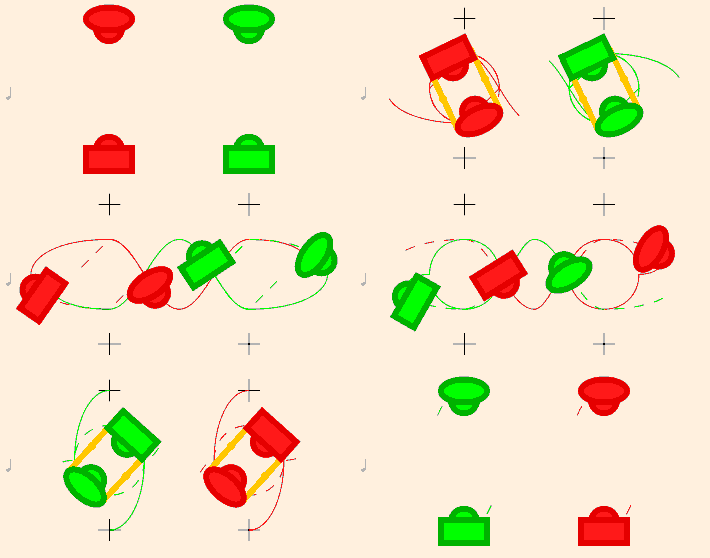 Two couples exchange places by turning partner three quarters to end facing partner up or down on the center line, then a half reel of four in the center, then turn partner three quarters to return to the sidelines. Both two hand turn, and right hand turn have been used. Left would work too.
History
The first example I can find of this figure is in Bonnie Stronshiray by Robert M Campbell, in 1963.
Some dances which (probably) use this figure
Hand Gesture
Also known as: Point, Beckon.
Bars: 2.
Occasionally a dance will call for a hand gesture. Pointing, beckoning, waving, saluting (in the modern sense).
History
Walsh has dancers pointing at each other in Her Killing Eyes, 1716.
Thomas Bray uses "beckon" in The Woman's the Man, 1699.
Some dances which (probably) use this figure
Hand Turn
Also known as: Allemande, Single Circle, Swing, Birl.
Bars: 2 for a half turn, 2 or 4 for a full turn, 4 or 6 for a turn and a half.
 A hand turn involves two people who walk toward each other, take either left, right, both hands, or crossed hands, turn round in a circle, release hands and go back to place. Right turns go clockwise, left turns counter clockwise. Two hand turns are usually clockwise but occasionally are specified to be counter- clockwise. (I suppose you could have a right hand turn where the dancers backed up, to make it go counter-clockwise, but I've never seen that).
The figure may be fractionalized, with a half turn (or turning once and a half) leaving the dancers in each other's places.
The way hands are held varies. A handshake grip is common, but sometimes a forearm, or elbow grip will be used. When spinning rapidly the elbow is usually bent and the hand held close to the body to reduce torque, with more time, the arm is extended.
When the turn is extended to more than two people it becomes either a Hands Across (Star) for right and left turns, or a Circle for a two hand turn.
Variants
In the 19th century the term "turn" usually meant a two hand turn, while "swing" usually meant a right hand turn.
In Scottish the term "birl" ("burl", "burrle", "birrel", etc.) is used to mean a very fast turn, usually gripping elbows, in a Scottish dance.
In Square Dancing and later Contra Dancing the term "allemande" is used to mean a hand turn. In the 18th century the term "allemande" was quite ambiguous, having at least three different meanings, but none of them was a hand turn. The first publication I know of to use "allemande" in this sense was Henry Ford's (Benjamin Lovett's) Good Morning published in 1925.
I have often been told that this "allemande" comes from a corruption of the French à la main (to the hand), but I'm pretty sure that it actually means a figure that came from Germany (Allemande being the French adjective meaning German).
Modern Square Dance rarely uses a two hand turn, but when it does the call is "single circle".
History
I presume the hand turn is as old as dancing itself
Some dances which (probably) use this figure
See Also
Hands Across
Also known as: Star, Cross, Le Moulinet, Mill.
Bars: 4.
 Like circles, hands across (or stars) come in both left and right varieties.
To make a right hand star you turn so your right shoulder is toward the center and take the hand of whoever is diagonally across from you. You do not take hands with the other people in the set; instead they will join hands and the two clasps should rest one above the other — this is called a “hands across star”. (In Scottish Country Dance the convention is that the 1st lady and whomever she is clasping will have their hands on top, but I have never heard any rule for English). You then turn the star clockwise until you are back where you started.
In a left hand star, of course you clasp left hands instead and turn the other direction.
Stars may also be fractionalized. “Left hand star half” is a common call.
Sometimes a star in one direction is followed immediately by a star in the other, in which case the distance you travel in the first star is irrelevant as long as you are back where you started at the end of the second.
Occasionally you will have a 3, 5, or 6 person star. You can’t really clasp hands across in this case, just grab into the knot at the middle. A 2 person star is just a hand turn.
Variants
In Contra Dancing, instead of taking hands with the person diagonally across from you, stars are usually made by grasping the wrist of the person in front of you.
Square dancing uses this wrist star when everyone in it is male, but for mixed stars, or stars with all women you simply put your hand in toward the center and touch the other people.
History
The Lovelace MS, 1621~1648, uses the term "hands acrosse" in the dance Bobbin Jone, as does Playford, 1651, and everyone after up to Wilson, 1808.
Cotillions called it Le Moulinet (which means little mill, or little windmill) when they started arriving from France in the 1760s.
In the US: Howe, 1858, page 116, (Boston) still describes a quadrille figure called "Le Moulinet" as "hands across", but he goes on to say that it can also be called a "cross" and a "star". Burchenal, 1918, describes a figure she calls "The Mill" (not using "hands across" or "star"). Modern Square dancing and Contra dancing (and to a lesser extent modern English dancing) call the figure a "star".
Some dances which (probably) use this figure
See Also
Hello Goodbye Poussette
An online definition may be found here.
Bars: 6 or 8.
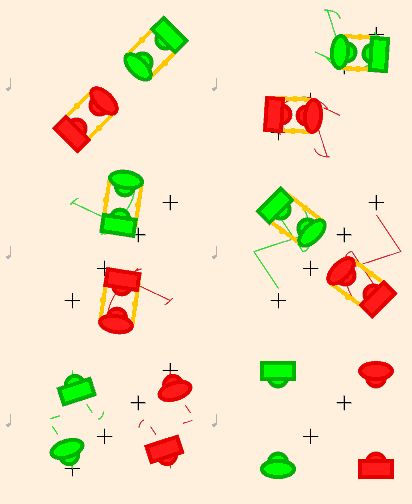 This is a progressive figure for two couples. It starts with M1 in his normal place, W2 in her normal place and their partners between them on the 1st diagonal. W1, M2 with backs to each other, facing partners. All in poussette hold with partner.
Those in the center do a normal hello-goodbye setting sequence (in a 2 couple minor set) while maintaining poussette hold. Those in the corner positions also set on the right foot and travel on the left foot, arranging to be facing partner.
After two bars the dancers will be across the set, midway between 1st and 2nd positions, M1 on the Men's line, then W1, M2, and W2 on the women's line.
After two more bars everyone will be on the 2nd diagonal (M1 in M2's place)
After two more bars everyone will be on the center line, M1 at bottom, W2 at top. All drop hands.
The original description of the figure then has everyone doing a petronella turn to progressed places.
History
According to the Scottish Country Dance Dictionary, this figure was devised by Rod Downey, 2013 in the dance The Prince of Sutton ColdField, but is based on an earlier figure by Barry Priddey in Lang May your Lum Reek, which did not involve taking hands.
See Also
Hello Goodbye Setting
Also known as: Set to Corners and Partner.
An online definition may be found here.
Bars: 6,8.
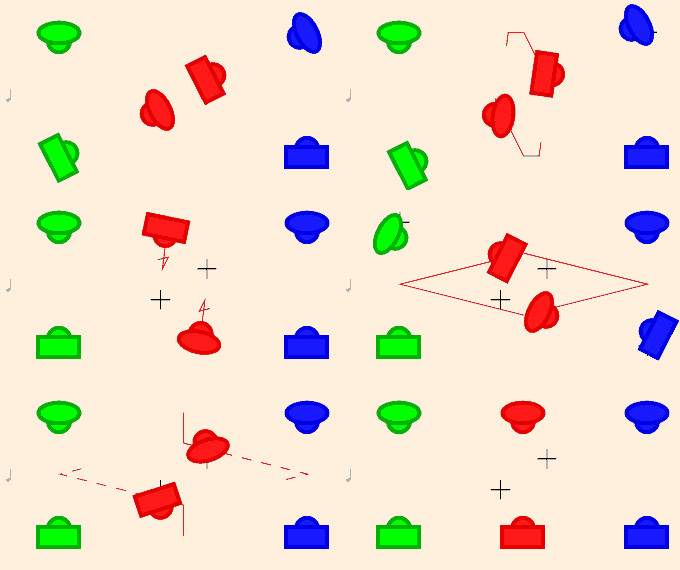 In this figure the 1s start back to back near 2nd place facing one of their corners, usually their first corners. They then perform one bar of setting to that corner, and on the next bar dance to 2nd place opposite side facing their partners. During this the 1st corners set back to them. Then the 1s set one bar to their partner, and use the next bar to dance to their second corner. They then set one bar to their 2nd corners, and on the next bar dance to the center line (either at top or bottom of the set) facing their partner, while the 2nd corner sets back.
Initially this was an eight bar figure and the final 2 bars were a petronella turn into home places, but may other ways of using those last two bars are also possible.
History
This figure was invented by the (R)SCDS for the dance Lady Susan Stewart's Reel (Book 5). The source of this dance has been lost, but I assume the figure is based on the old figure "set contrary corners" which does not have the 1s setting to their partners (other dances containing that figure were later given hello goodbye setting by the (R)SCDS).
Johnson, in his dance Highland Man kiss'd his Mother (which is not the same as the (R)SCDS dance of the same name) names a figure set contrary Corners and not turn but set Partners. It isn't clear to me exactly what this means, but it might be similar (the "and not turn" seems a reference to "set to and turn corners", I think Johnson was so used to this figure that if he only wanted people to set, he felt he needed to tell them not to turn). I don't think the (R)SCDS had access to Johnson in its early days, but maybe the figure pops up elsewhere.
Some dances which (probably) use this figure
See Also
Hey
Also known as: Hay, Reel, Weave, Olivette.
Bars: depends on the number of people and complexity. 8 bars for a full straight hey with 3 or 4 dancers.
 |  |  |
| Hey for three | Hey for four | Circular hey |
The hey, or reel is a weaving pattern where dancers pass first by one shoulder, and then by the other. Some heys are in straight(ish) lines, with dancers turn back when they reach the end of the line, some are in circles. Heys may be up and down, or across the set or on diagonals. Sometimes dancers take hands when they pass, often they don't.
Heys may be for any number of dancers but heys for three or four are most common in country dance. In square dances you may see circular heys for eight.
History
The OED (1982) says the phrase haye d'allemande was used in "15th c. Fr in Marot".
In his The Playford Assembly, Graham Christian's introduction quotes Hay the gy of thre in English from 1529. In Thoinot Arbeau's (Jehan Tabourot) Orchésographie, 1589, a book about French dancing, he describes a dance called "Branle de la Haye" (page 90 (his numbering is unexpected, he only numbers every other page, most would call this page 180) where he gives a very clear definition of a hey that is essentially the same as what we do today (it's a progressive hey, so not the most common form but recognizable).
In Christopher Marlowe's Edward II, 1594,
My men, like satyrs grazing on the lawns,
Shall with their goat-feet dance the antic hay;
The OED (1982) says that the word "reel" in the sense of "to whirl around" first appeared in the 13 hundreds, but dates its use as a type of dance in 1585. (The OED also says that such use was chiefly Scottish). The OED does not have a separate entry for the figure called a "reel" (There are many dances which are called "reels" which do not, in fact, contain a "reel" — The Virginia Reel in the US, and Crummy Reel in Scotland are examples).
The Fletts suggest that the first known use of "reel" comes from "Douglas's Virgil, c. 1525:
And gan do dowbill brangillys and bambatis,
Dansys and rowndis traysings mony gatis
Athir throu other reland, on thar gys:
Rather a different spelling of the word, but here it seems to refer to a type of dance and not a figure (if I'm understanding the quote correctly, which I may not be).
They go on to say that a "threesom reel" is first mentioned in 1710 (again as a dance, but since modern threesome reels include the reel figure, this probably also referred to the figure too).
According to the Fletts, Thomas Wilson, of London, was the first to describe the movements of a Reel of Three (or four, or five). But he defines the figure by saying "they then hey", so he is using "reel" to mean the type of dance, not the figure. Contrariwise, Chivers in The Modern Dancing Master, London, 1822, defines hey as Is to reel.
The Register of Dances at Castle Menzies, 1749 uses the term "reel" both as a type of dance, and a figure.
The dancing masters and publishers of London from John Playford to Thomas Wilson to Cecil Sharp seem to have used the word "hey" almost exclusively when talking of country dances (Some, Kynaston for one, tended to spell it as "hay" though). But elsewhere the term "reel" can be found. Colin Hume describes the Dorset Four-Hand Reel on his website, which he says is "A traditional English dance, though it could be traditional Scottish if Dorset weren't at the other end of the British Isles!". In The Community Dances Manual, Book 3, Peter Kennedy collected "The Progressive Six Reel" which uses the word "reel" rather than "hey" for the figure.
Even in Scotland the term "hey" is occasionally found. In the Lowes' Ball-Conductor and Assembly Guide, (Edinburgh, ~1831) in the first Ecossoise:
...The first Lady hies, or makes a reel of three with the second and third Gentleman;...
John Sweeney and Colin Hume also discuss the origins of the hey.
In the early years of the US, the hey figure was part of country dancing; Saltator (Boston, 1802) even goes so far as to give a definition for it:
OLEVETTES, is to interchassè, as in the common reel of three, with three persons on one side of the choir, and employ as much time in doing it, as in right and left.
But, he's about the last US dancing master to publish a dance using it until about 1970 or so — except for the Scottish Reels — those dances which consist of alternately reeling and setting.
Ricky Holden's The Contra Dance Book, 1956, defines what a hey was, but he doesn't use it in any of his contra dances, only in two Scottish imports dance in Sicilian Circles.
Some dances which (probably) use this figure
See Also
Hey For Four
Also known as: Reel For Four.
Bars: 8.
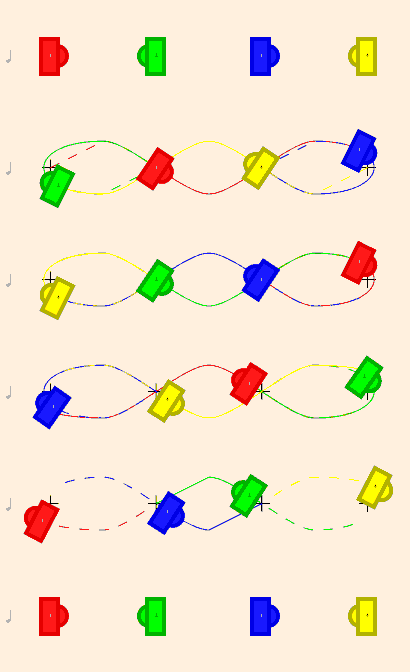
 Heys or reels of four can start on the sidelines, across the set, or on a diagonal. Either all the dancers face the center of the reel, in which case the center two dancers pass each other to start, or the dancers on each end face each other and pass each other. The initial pass may be by the right or the left. In Scottish Country Dancing reels of four almost exclusively start by passing right.
History
Saltator, 1802, has a hey for four across the set in Gordian Knot.
Some dances which (probably) use this figure
See Also
Hey For Three
Also known as: Reel of Three.
Bars: 8.
 Heys for three dancers are the most common type of hey. Often there will be three dancers on the side of the set, and the top two will pass right, and then the one that started at the top will pass those at the bottom by the left, while the original middle dancer (now at top) loops around. And so on until everyone is back where they started.
Often the dancers on the men's line and the dancers on the women's line will do the same thing at the same time. This is called a parallel hey.
Sometimes the dancers on the men's line will mirror the dancers on the women's line and this is a mirror hey.
If there are only two couples in the minor set (Scottish: a 2 couple dance in a 4 couple set), then one dancer from one line will cross over into the middle of the other line to start a hey for three there.
 Heys can run across the set, as well as on the sides, or diagonally.
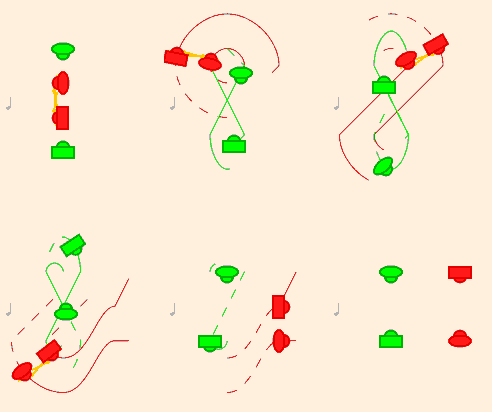 Sometimes two dancers can stand in promenade hold and act as a single unit in the hey. Or two can stand one behind the other and act as a unit.
Some dances which (probably) use this figure
See Also
Hole In The Wall Cross
Bars: 2 or 4.
 The Hole in the Wall cross is a variant of a simple cross, in it the people crossing approach one another and just as they would bump they sidle around each other in a semicircle and then back away into the other person’s place.
History
When I started dancing I was told that a "hole in the wall cross" came from the dance "Hole in the Wall". But it doesn't.
If you look at Playford's description of the dance he says simply:
The 1. Man cross over with the 2. Wo. and the 1. Wo. with the 2. Man, so all four Hands half round, and so cast off into the 2. Place, the rest do the like.
The dance "Hole in the Wall", as published by Playford, contains two perfectly ordinary corner changes as part of a standard sequence.
Then I assumed that Douglas and Helen Kennedy put it in when they interpreted the dance in 1929. But, again, they didn't. They say:
B 1-2 First man changes places with second woman. 3-4 First woman changes places with second man.
As far as I can tell Pat Shaw is the first to have used the term "hole in the wall cross" in his interpretations and dances. In 1960 his interpretations of both The Lover's Luck and Whimbleton House call for a "hole in the wall cross" (at least as transcribed in Another Look at Playford). While his own dance Miss Avril's Delight from 1971 may be the first modern dance to use the figure.
I assume he used it when he taught the dance "Hole in the Wall", but I have no record of that.
The next person to use it seems to have been Tom Cook with his dance Belgia Retriev'd in 1979.
Some dances which (probably) use this figure
See Also
Honour
Also known as: Honor, Bows and Curtsies.
An online definition may be found here.
Bars: 2.
Bow or curtsy. Playford occasionally uses this as a separate figure, and with Cotillions, Quadrilles, etc. the first 8 bars of the dance were given over to honours (even though the dance description did not mention them)
History
Playford used "honour" as a figure from the first. In Graies Inne Mask, 1651 he says: Honour all, salute. But the use died out with very few after 1700.
Cecil Sharp added quite a lot of extra honours not called for by Playford in his interpretations.
Cecil Sharp says:
This a formal obeisance made by partners to one another at the conclusion, and sometimes in the course, of the dance. The man bows, head erect, making a slight forward inclination of the body from the hips; the woman, placing her left foot behind the right, makes a quick downward and upward movement by bending and straightening the knees.
Some dances which (probably) use this figure
See Also
Interlocking Reel
Also known as: Interwoven Hey.
Bars: 8 bars for a interlocking reel with 3 or 4 dancers.
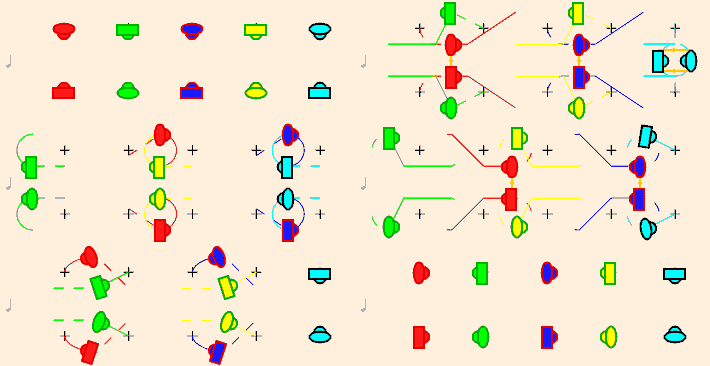
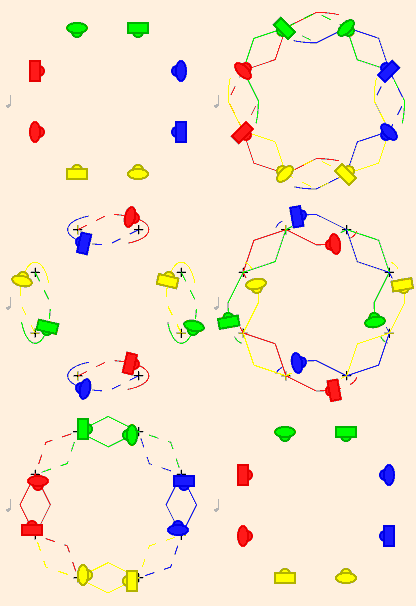 In an interwoven hey/interlocking reel everyone acts as if they are at the end of the hey. They pass the requisite number of people, turn, and come back. However, no two dancers' personal reels will contain the same set of people. These heys may be linear, or wrap around a circle.
The number of people in each hey is arbitrary; I've only seen heys for three and four, but there's no reason one couldn't do it with more people.
In a duple minor dance, you can have heys on the sidelines which could in turn be either mirror or parallel. In a triple minor you couldn't have two heys on the sidelines, but you could view the minor set as a 6 person circle...
History
The first such hey I've found comes from Pat Shaw's Freda's Fancy which was written in 1949. In duple minor dances these heys go outside the minor set and so you would not expect to find them before the modern era.
In circles (or squares) they could have evolved earlier, but I haven't found any. John Drewry used one in a square set in his dance 1314 written in 1967.
Some dances which (probably) use this figure
See Also
Intersecting Reels
Bars: 8.
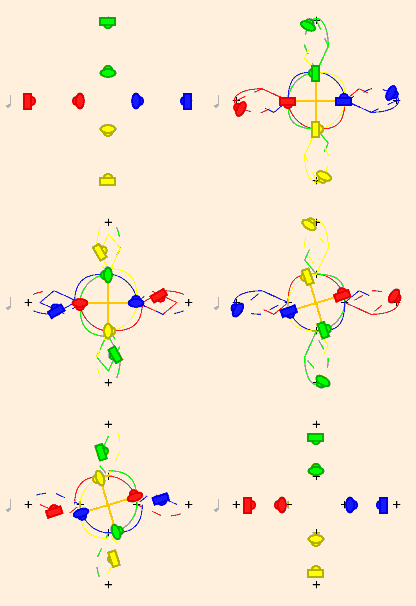 In an intersecting reel you have two reels of four which meet at right angles to one another. Outer dancers face in, inner face out. You pass the person you are facing by the right, the dancers in the center do a left hands across half (twice as fast as usual, you've only got one bar), and then pass the next person right.
Variants
It should be possible to modify this figure to work from parallel reels of four. Dutch Crossing (1990) has an interesting variant from a 16 person square (4 lines of four dancers) with right hands across half for the four small squares at the corners of the big square, the left hands across half for the center square of four, and so forth
History
I found two dances using this figure in 1964, and none before that. One is a John Drewry dance called Bonnie Lass of Bon Accord, and the other by Hugh Thurston called Strathtummel.
Some dances which (probably) use this figure
See Also
Inveran Reel
An online definition may be found here.
Bars: 8.
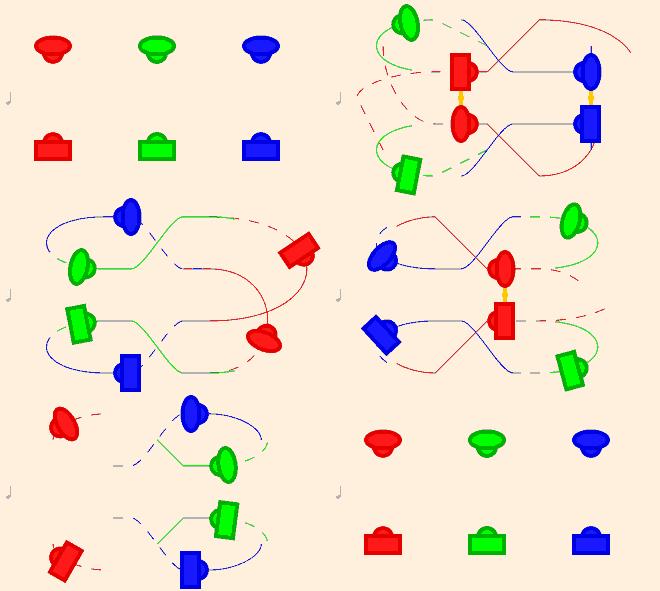 An Inveran Reel is like a Crossover Mirror Reel except that the 1s cross over at the bottom, as well as at the top.
History
The first use of the figure, that I know of, is in Grimstock, a dance Playford published in 1651. Playford did't use the word "Inveran", he just described the movements.
The first use of the name that I have found is Mrs MacPherson of Inveran by John Drewry in 1964.
Some dances which (probably) use this figure
See Also
Jump
Also known as: Leap, Hop, Caper, Saltation.
Bars: 2.
Many dances call for jumps, hops, leaps, etc. Indeed a latin word for "to dance" is saltatio which also means "to jump".
History
Playford uses "jump" in Althea, 1657, "leap" in Mr. Lane's Maggot, 1695, and "hop" in Granny's Delight, 1702.
John Essex, in For the Further Improvement of Dancing,, 1710, said the dancers should jump at the end of every phrase of music:
As it is ordinary that every figure of a Dance ends at every cadence or end of the Aire, it will be proper to make a small Jump upon both Feet.
In the patter for one of his Square Dance introductions, Lloyd Shaw said:
All jump up and never come down, Swing your honey around and around.
 Copyright (C) by Bob Osgood.
Some dances which (probably) use this figure
Kiss
Also known as: Salute.
This figure is a little awkward in the modern world, and modern interpretations rarely include it. Sometimes a continental peck on the cheek is appropriate, or a right, left peck if two kisses are called for. Sometimes I will kiss the lady’s hand. In Kiss me quick, my Mither's coming I find there's only time to blow a kiss… but if you have an understanding with the person in question do what seems best.
History
In the 16th century when a gentleman led a woman out to dance he was expected to kiss her in greeting. You can see an example of this in Shakespeare's Henry VIII I.iv.128-129 when the king leads Anne Boleyn for a dance:
I were unmannerly to take you out
And not to kiss you. (He kisses Anne.) A health, gentlemen!
Both Lovelace and the early Playford dances occasionally have kissing as a figure in the dance, but its use dwindled, and 1710 is the last example I know of in Playford. Kynaston in Doctor Sa__lls Jigg, 1711, has both the 1s kiss their corners. Walsh in The Second Book of the Compleat Country Dancing-Master, ~1740 uses it in the dance Kiss Quick, Mother's a'Coming. And Johnson copied this dance a few years later.
Exactly what was kissed is usually not spelled out, but in Paul's Steeple, Playford says the man kisses the woman's hand.
According to the Fletts, the custom popped up again in the Shetland Islands in the nineteenth century, though only at the end of a dance.
The custom of kissing one's partner at the end of a dance was fairly common in Shetland in the old days, and is still not unknown at weddings. According to a description of a Shetland wedding written in 1859 (271), the custom was at that time observed at the end of each dance, but within living memory it took place only two or three times in an evening's dancing, generally at the end of a Shetland Reel. In Walls and Skeld the fiddler sometimes signalized the kisses by running his bow backwards and forwards over the high strings, but elsewhere it was usual for one of the men to shout `kiss the lasses' just as the Reel was coming to an end. The reaction of the girls to this custom is nicely described in an account of a wedding which took place in Scousburgh district in 1837 (275).`Now the reel ends. "Kiss the lasses," exclaims the lad with the hairy bonnet, and four loud smackes are instantly heard, the lasses giving a twist or two in the arms of their partners, just for appearance sake, . . . this piece of hypocrisy is no fault of theirs, but arises from the tyranny of fashion. Poor things, why should they not like a kiss as well as the other sex? and when we all know so well that they do, how absurd that fashion should force them to appear as if they didn't.J.P. Flett & T.M Flett Traditional Dancing in Scotland, 1964
Some dances which (probably) use this figure
See Also
The Knot (Scottish)
An online definition may be found here.
Bars: 8.
 Dancers usually start on the sidelines, and turn partner right half and end facing DOWN, in allemande hold. The bottom man pivots and he and his partner face the women's wall and dance out to it, as the other couples move down one place. The man again pivots to face up, and moves up to 1st position, as the following couple moves to the sidelines. The leading couple pivots a quarter, and the following one pivots half facing the men's wall (at the end of bar 5). Dropping right hands, the women move in front of the men, as the men move in. Then left turn half to end on their own sides.
History
According to a note in the Scottish Country Dance database the knot was devised by Mina Corson for the dance Miss Milligan's Strathspey
Originally it was for two couples, but Roy Goldring was using a three couple version by 1977 in the dance Cuillins of Skye.
Some dances which (probably) use this figure
Ladies' Chain
Also known as: Chaîne des dames, Ladies' Change.
Bars: 8.
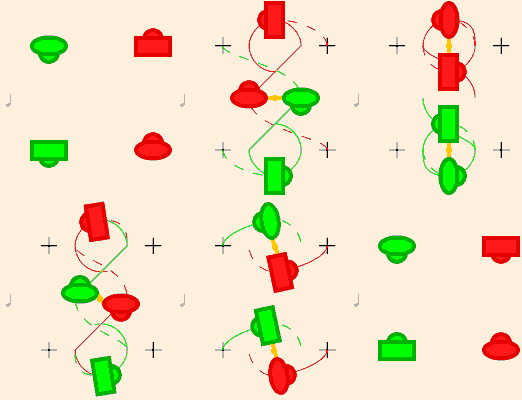 In the original version of the ladies' chain, two couples are facing each other (lady on man's right). The ladies move into the center and take right hands briefly as they pass by right. Meanwhile the men cast into a small counter clockwise circle. After two bars the ladies are approximately where the opposite man started, while the men are approximately where their partners started, they take left hands on the side lines and turn around counter-clockwise for 2 more bars until the ladies are again facing in. Then the process repeats, the men doing essentially the same thing (except with their partners now), and the ladies going back to their original sides and turning their original partners.
Variants
In a Grand Ladies' Chain then all the ladies in the set will form a right hand star, turn it half, and then turn the opposite man left, and cross back the same way.
In a Gents' chain, two men will cross by the left hand and then turn right half with the opposite lady, and cross back the same way.
In Square and Contra dancing, the figure has mutated so that it ends with a courtesy turn. Also, somewhere between 1960 and 1980 the term "ladies' chain" in these two styles, came to mean what originally would have been half a ladies' chain. (This seems to have happened first in Square dancing, and later in Contra).
History
Nicholas Dukes, 1752, does not describe a ladies' chain.
The first use I know of a Ladies' Chain occurs in Ignatius Sancho's Cotillions &c. published 1776, in the dance L'Bon Ton. He uses neither the French nor the English name for the figure, but simply describes it:
The top and bottom Ladies give Right hands in the Centre and turn contrary Partners with the Left hand give Right hands again in the Centre and turn their own Partners with the Left hand
Wilson does not mention Ladies' Chain as a Country Dance figure in his Complete System of English Country Dancing from 1815, but he does in his book on Quadrilles from 1822:
8.—CHAINE DES DAMES ENTIERE
Les deux Dames de vis à vis se donnent la main droite, tournent les Cavaliers de vis à vis avec la gauche, se donnent la droite au milieu, et tournent leurs Cavaliers avec la gauche aux places.8.—LADIES' CHAIN.
The two opposite Ladies give right hands, swing the opposite Gentlemen with the left, join right hands in the centre, and swing their partners with left to places.
Chivers, in his The Modern Dancing Master, 1822, uses Ladies' Chain in his Circassian Circle dances (page 184), and I think that's the first use in something like a Country Dance.
In the US, Schell's book Prompting: How to Do It, Boston, 1890, defines:
Ladies' Chain.—(8.) Danced by opposite couples at the same time. Opposite ladies cross, give right hand, in passing, join left hand with opposite gen, and turn half round. Repeat, swinging partners with left hand to place.
Henry Ford's (Benjamin Lovett's) Good Morning was still using this version in 1925:
(Ladies cross to opposite sides, giving right hands as they pass each other. Give left hands to opposite gentlemen and turn half around. Give right hands back, left hands to partners, and turn to places.)
Some dances which (probably) use this figure
See Also
Ladies' Chain (Courtesy Turn)
An online definition may be found here.
Bars: 4.
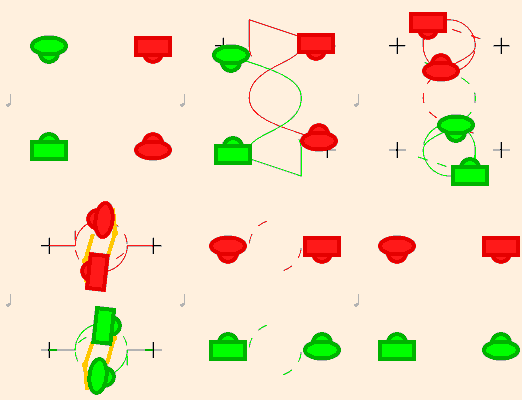 The ladies' chain used in Square and Contra dancing starts from two facing couples. The ladies move into the center and take right hands briefly as they pass by right. Meanwhile the men move over to where their partners had been. The ladies join left hands with the opposite man's left hand, she puts her right hand behind her back and he puts his right arm around her so that his right hand is now in hers. Then they turn in a circle, she going forward, he backing up until both are facing in.
Variants
In Square Dancing a Reverse Ladies' Chain would send the men into the middle to pass by left hands and be reverse courtesy turned by the opposite lady. While Four Ladies' Chain has all four ladies in the square form a right hand star, turn it half, and then be courtesy turned by the opposite man.
History
The first source for a ladies' chain with a courtesy turn is Burchenal's American Country Dances from 1918:
Ladies' Chain
This is danced by two couples facing each other, with the women on the right of their partners. The two women advance toward each other and join right hands; passing each other, they release right hands and join left hands with the opposite men. Without releasing her left hand, each man puts his right arm around the woman's waist and swings her half around, so that they face the dancers on the opposite side. All this is done in eight steps (4 measures). During the next four measures the same is repeated, so that the women return to their own partners, who swing them around in the same manner, so all finish in their original positions (8 measures).
Burchenal's ladies' chain does not quite end in a courtesy turn, as there is no indication that the ladies' right hands should receive the gentleman's hand on her waist.
Henry Ford's Good Morning, 1925, however still gives the open ladies' chain.
Lloyd Shaw's Cowboy Dances, 1937 (republished at least through 1948), defines on pages 127-131:
In the ladies chain two couples face each other. Each gentleman passes his lady toward the other lady. The two ladies take right hands in passing each other and then give their left hands to the left hands of the opposite gentlemen. The gentlemen put their right hands behind the ladies' waists and turn them completely around to the left as they themselves pivot in position. Each gentleman now passes his lady toward the other. The two ladies take right hands and pass again, giving their left hands to their partners this time, who again pivot and turn them to place. It is more graceful if the lady, when she gives her left hand to the gentleman, places her right hand well back on her hip, palm outward, so as to receive the gentleman's right hand when he turns her around.
In Sept 1949 Sets in Order published a short list of standardized calls, and in it define ladies' chain as just half what Lloyd Shaw said:
LADIES CHAIN—Chain back on call only. Hand clasp or hold recommended.
Rickey Holden's The Contra Dance Book, 1956, defines ladies' chain as an over and back movement.
The CALLERLAB publication The Basic Movements of Square Dancing, 1979 defines it as:
(14) TWO LADIES CHAIN Start with two facing couples. The two ladies advance, give a right hand to the other lady, pull by, then give a left hand to the partner of the lady with whom she is chaining. The men Courtesy Turn them around in place. The movement is completed when the couples are facing. The two ladies will have changed partners.STYLING: The two ladies take regular "handshake" holds as they start, then release hands immediately as they move by each other and give a left to the man. Men, anticipate the approach of the lady you are to receive. In a standard Ladies Chain, starting from two facing couples, the man, after releasing his lady will move about two short steps to his right and will maneuver (turn slightly) one-quarter counter-clockwise (left face) so that his right shoulder is in toward the center of the square and he is then ready to turn the lady coming toward him.
This version is the first to use the term "courtesy turn", and the first for which the chain is not over and back.
Larry Jennings's Zesty Contras, 1983, does not define ladies' chain but he uses it in his dances, and since he says "½ W ch", one presumes that his ladies' chain is still over and back.
Some dances which (probably) use this figure
See Also
Lead
Also known as: Brisé.
Bars: depends how far you go, 2 bars to lead down one place.
 When a couple leads they join hands and dance in the direction indicated.
In the example above the 1s lead down the set, turn and lead back up.
History
In Playford's day when a couple led up they probably took inside hands, which seems natural to do:
The 2. and 3. on each side lead to each wall, while the first cu. lead up, and the last lead down; change hands and meet;Broom, The Bonny, Bonny Broom,
John Playford, 1651
By the end of the eighteenth century dancers tended to hold right hands in right, which is a little more awkward, but has the advantage that you don't need to drop hands when you turn (if you take inside hands, and then turn alone to face back the way you came, your other hand is now inside).
Cecil Sharp said that when leading:
In linking right hand with right, or left with left, the hands are held sideways ... The hands should be joined in this manner in leading
However, as time went on more people noticed that this was not what Playford said to do, and the English groups I've been involved with mostly join inside hands.
In Scottish Country Dance, however, the term "lead" means right hand in right, while the term "dance" is used for inside hands.
Some dances which (probably) use this figure
Lead out Bottom and Top
Bars: 8.
The active couple leads out through the bottom couple, casts back through the middle, leads out through the top couple and casts back to the middle.
Occasionally the figure is done in the other order (lead out through the top first, and then the bottom).
History
The earliest example of this figure I can find is Woodycock (Playford, 1651).
He doesn't name the figure, only describing it: The 2. cu. lead up between the first, cast off and come to your places lead down between the last cu. and as much
Johnson is the first I've found to give the figure a name: "Lead out Bottom and Top" (and once lead out top and bottom).
Nicholas Dukes also names it in his list of figures at about the same time: The middle man & wo: leads thro' the bottom, & Casts up, & lead thro' the top and Cast of.
Wilson also describes it in 1808, through he calles it simply: Through Bottom and Top.
I know of two dances that juxtapose "lead out bottom and top" with Lead out sides which leads me to believe they are similar figures, just rotated 90° from one another: Linnen Hall by Thompson, 1779, and Spithead Fleet, Johnson, 1752.
Some dances which (probably) use this figure
See Also
Lead Out Through The Sides
Bars: 8.
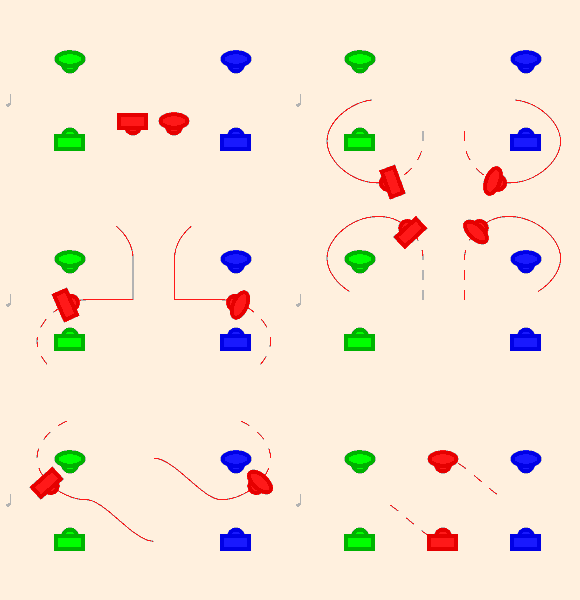 I know of too many very different meanings for "lead out sides" in modern usage.
History
John Young describes (but does not name) a figure that might be lead out sides in Sham Doctor, 1718: and lead through the one side, and meet and clap Hands, and lead through the other cu., or might just be lead out top and bottom.
John Young uses the turn "lead outsides" in The Whirly Gigg, in 1726 then The Register of Dances at Castle Menzies uses this term in Montgomerie's Rant in 1749, and Johnson is using it by 1758 in The First of January. What they meant by it is unclear.
Dukes, 1752, defines at least three figures which contain the words "lead out sides"
Some dances which (probably) use this figure
See Also
Long Lines Forward And Back
Bars: 4.
Move in to the middle, and fall back, taking hands with neighbors both inside and outside the minor set.
History
Something very interesting happened in Contra Dancing between 1956 and 1983. In Rickey Holden's The Contra Dance Book, 1956, he uses the call "forward four and back again" (or "forward six" for triple minors), but in Larry Jennings' Zesty Contras, 1982 these two calls have completely vanished and been replaced by "Long lines forward and back".
Somewhere between these two publications the integrity of the minor set ruptured and people reached to take hands with those in other minor sets.
Now Chorus Jig had become a duple minor by Holden's day, so it's contra corners figure reached outside the minor set, but nothing else did. Perhaps it was Becket Reel, 1957 which made people look outside the minor set?
Some dances which (probably) use this figure
See Also
Mad Robin
Bars: 4.
 A mad robin is like a neighbor back-to-back except that instead of facing your neighbor you face your partner (and gaze into his/her lovely eyes).
Sometimes one couple does the figure around an other, who are stationary, and sometimes both couples do it (this used to be called a double mad robin).
History
The modern version of Mad Robin, at least as used in Contra Dancing, has the two partners staring into each other's eyes. So they are always facing their partners. But that's not what Playford says:The 1. wo. cast up above the 2. man and slip down the middle, the 1. man go up between, and then cast off below and turn handsWhen someone casts, they turn to face out of the set. If you look at Sharp's interpretation of the dance:
B1 1-4 First woman moves up the middle and casts down to the second place; while the first man casts up and moves down the middle into the second place.
Again someone is casting (Sharp has reversed to order with the man casting and the woman moving up, don't know why), so again partners are not facing.
The movement of the modern figure is described in "The Saucy Sailor", from Maggot Pie, 1932; but they don't name it "Mad Robin", nor do they suggest staring into your opposite's eyes.
Jim Kitch, in his dance "The Lover's Knot", 1993 describes the figure and in a note says which is similar to the end of Mad Robin. This wording suggests that he might be inventing the modern figure there.
Some dances which (probably) use this figure
Mirror Heys
Also known as: Reflection Reels, Grimstock Hey.
Bars: 8 bars for a full straight hey with 3 or 4 dancers.
 In a mirror hey the men usually do a right shoulder hey on the sides, while the women do a left shoulder hey. This means the men and women are mirroring each other. When a woman comes into the center, so does her partner, when she moves away from the center, so does her partner. People often take hands with partners when they are in the center. In the most common version of a mirror hey, the 1s lead down between the 2s who move out.
In a Morris Mirror Hey the men pass left shoulders and the women right. In this version, the 1s cast out while the 2s lead up.
In latter half of the 18th century many dances started with the 1s crossing into a mirror hey on opposite sides, and then crossing again when they got back to the top to dance another mirror reel on their own sides.
Some people call this a Grimstock hey. I find this slightly confusing myself, because, although Grimstock does contain a mirror hey, it also contains two others.
History
Trenchmore from the Lovelace MS may be the first example of a mirror hey:
They shall weave apace bethwene the man, and woeman, one on the one side, and the other on the other, and having weaved downe to the bottome the alone shall turne and then weave up agayne to theire places, and turne both forewards, and backwards;
Though this may be just a mirror figure eight on the sides
However Playford's version of this same dance (from 1652) is clearer (and different):
First cu. go down under the 2. cu. arms, the 3. cu. come up under the first. Do this forward and back
Though this seems to be a dip and dive variant.
While Playford's Adson's Saraband, 1651, is exactly what is meant by a mirror hey:
First cu. go down betwixt the second, they coming up, the third comes up between the first, then the second come to their places between the third
Some dances which (probably) use this figure
See Also
Morris Hey
Bars: 8.
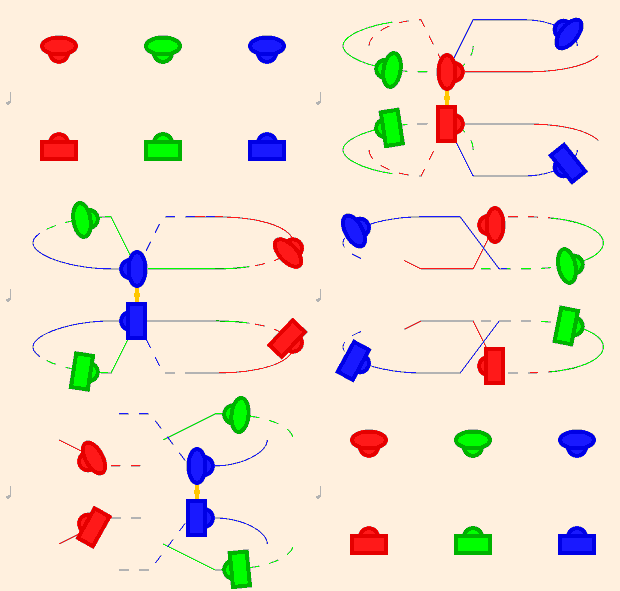 A Morris Hey is a variant of a Mirror Hey except that most mirror heys have the top couple dancing in between the middle couple to start while the middle couple moves out, in a morris hey the top couple cast out, while the middle couple dances up and in.
Scottish Country Dancing uses the figure, but doesn't seem to have a term for it, just calling it a mirror reel.
Variants
Mirror heys can be done with any number of couples. A three couple hey is the most common, but there are also dances with 4 couple mirror heys. I haven't seen any for 5 or more dancers, but there could be.
History
Henry Playford probably describes half a morris hey in Twelfe Eve, in 1702. There are a number of dances after that where John Young or Walsh have the 1s doing a Hey with the 2s+3s on the sides, followed by the 1s casting down. A modern interpreter who looks at this will call for a morris hey (because it will flow nicely into the cast), but it's not clear that's what was originally intended. An example of this is Kynaston's Tomson's Whim from 1718.
The first use of the term that I can find is from Porter, Heffer & Heffer's interpretation of A Trip to Highgate (a dance written by Thompson in 1777 and the original does not include any heys at all).
Some dances which (probably) use this figure
See Also
Noise
Also known as: Clap, Stamp, Stomp, Snap Fingers.
Bars: 2.
There are various ways of making percussive sounds with the body, clapping is the most common, stamping feet, snapping fingers, etc.
History
Playford uses clap in Gathering Peascods of 1651.
Playford uses stamp with the right foot in The Cuckow #1 of 1657.
Playford uses snap their fingers in Bobbing Joe of 1651.
Modern square dancing does not use clap, but in 1951 the Texas version of the dance Box the Gnat did.
Some dances which (probably) use this figure
Ocean Wave
Also known as: Pass The Ocean, Pass through to an Ocean Wave.
An online definition may be found here.
Bars: 2.
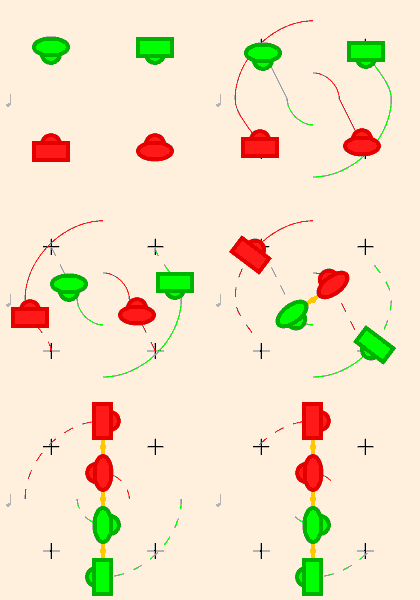 This call starts from two facing couples. They pass through, the women grab left hands in the middle and turn a quarter, while the men chase a quarter outside, and grab right hands with nearest woman.
History
Ida Levin published a figure called Ocean Wave in her book Kentucky Square Dances of 1928, then Lloyd Shaw published a dance called Ocean Wave in his 1939 book, Cowboy Dances. However neither figure is anything like the modern one.
The first example I can find of a right hand wave called an ocean wave is in the dance "Riptide" by Bob Hall and published in the Sept 1951 issue of "Sets in Order", however this wave is formed from a do-si-do, not a pass through.
But the "pass through to an ocean wave" call came later, Vic Ceder's website says it was created by Holman Huspeth in 1965.
Some dances which (probably) use this figure
Parallel Reels
Also known as: Parallel Heys.
Bars: 8 bars for a full straight reel with 3 or 4 dancers.
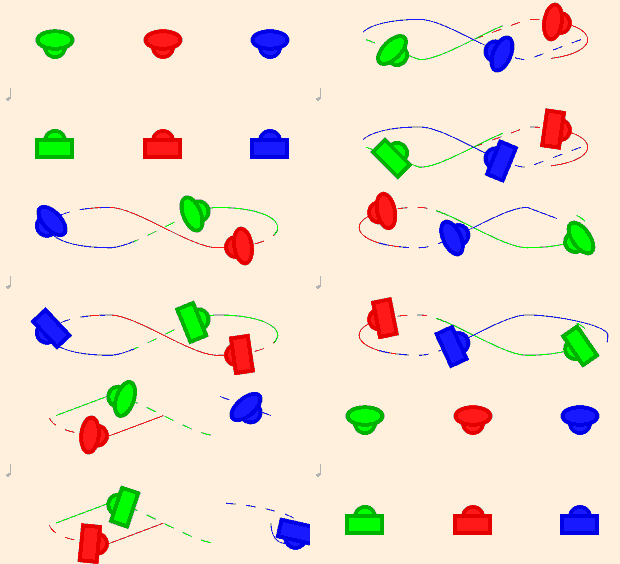 Parallel reels are usually done with three people on each side of the set. The men's line and the women's line will do the same moves in parallel, the reels start by having the top two couples pass each other by the right (sometimes left) shoulders.
History
In Cheerily and Merrily, 1651, Playford may be calling for parallel heys, or he might mean mirror heys:
Men the S. Hey, while the we. do as much
In Adson's Saraband (from the same edition) he is very careful about spelling out exactly how the mirror hey is done. But here he is much briefer. My guess (and Cecil Sharp's) is that both men and women should do a right shoulder (single) right shoulder hey on the sides, but Charles Bolton thought differently (and uses mirror heys).
The (R)SCDS first uses parallel reels in Book 5 (1929) in Dunbarton Drums. However the term "parallel reels" isn't used until Book 19 (1957) for the dance Rakish Highlandman.
Some dances which (probably) use this figure
See Also
Petits Fours
Bars: 8.
Petits Fours interacts with the two couples in the current minor set, and then with the two couples in the next minor set.
| 1s | 2s | |
|---|---|---|
| 1 | Lead up center | Face each other, fall back |
| 2 | Face, fall back | Face down, move down |
| 3 | Face down, move down outside | Face partner, meet in middle |
| 3 | Face partner, meet in middle | Lead up center |
| With next neighbors | ||
| 1 | Lead down center | Face each other, fall back |
| 2 | Face, fall back | Face up, move up |
| 3 | Face up, move up outside | Face partner, meet in middle |
| 3 | Face partner, meet in middle | Lead down center |
Each of the above motions takes 1 bar at 3 counts per bar.
History
Created by Gary Roodman for the dance Mary K in 2003. It is designed as a version of Grand Square for a duple minor set. It is also set to triple time music rather than duple so the movements are 2 steps and turn, rather than 3 and turn).
Some dances which (probably) use this figure
See Also
Petronella Turn
Bars: 2.
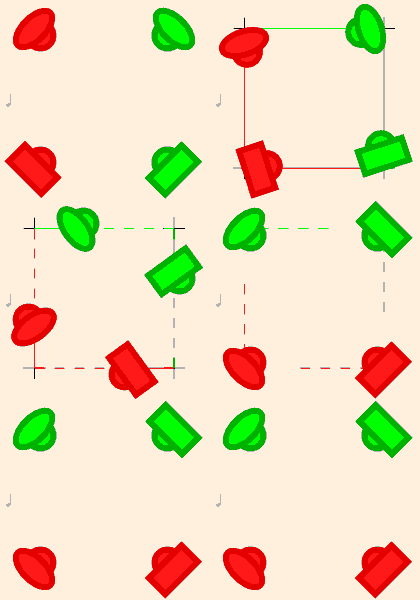
 A Petronella Turn has come to mean two different things, depending on which tradition of dancing you follow. Both come from the same source but evolved differently over time.
In US Contra Dance, a petronella turn means moving one place to the right around the minor set, while spinning over your right shoulder. Usually this takes 1 bar, so the next bar is used up by clapping.
In Scottish Country Dance, the petronella turn is done in pas-de-basque setting. The first step is out to the right and inward, and finishes with the active dancers facing out of the set, on the next bar they pas-de-basque over their right shoulders until they face in.
There is also a petronella figure, which involves 4 petronella turns and setting with the actives returning to places after 16 bars.
In Scottish Country Dance dancers, petronella turn, and set; petronella turn, and set; petronella turn, and set; petronella turn, and set.
But in Contra dance the set comes before the petronella turn, and then became a "balance the ring".
In the US, English Country Dances occasionally borrow the Contra dance version of a petronella turn.
History
The first source for the petronella turn comes from The Ball-Room, or the Juvenile Pupil's Assistant; Containing the Most Fashionable Quadrilles, with Les Lanciers of Sixteen, As Danced in the Public & Private Assemblies in Paris by J. P. Boulogne, published 1827, and he says:
1. The first couple perform the figure of a diamond to their right, setting at the four corners 16
But since he neglects to say exactly how you move to make this diamond figure, the instructions aren't very helpful.
Looking elsewhere, the next earliest description of the figure I have found was published by the Lowes in Lowes' Ball-Conductor and Assembly Guide. of ~1831. The Lowes published in Edinburgh. They describe it thusly:
First couple chassé round to the right, and set in the middle; round to the right again, and set on the sides; to the right again, and set in places
Here the eponymous "Petronella Turn" is spelled out clearly as a chassé, I don't think you can turn while doing a chassé, so this was a much simpler move than it is now.
Also after doing a chassé, the pas-de-Basque setting of the (R)SCDS seems unlikely, the most natural setting would be the step-close-step-close style that English Dancing uses.
By 1853, the Lowes had become just Joseph Lowe, and he published a somewhat different version in his Lowe's Selection of Popular Country Dances:
First couple turn round to the right, and set opposite to each other in the middle of the Dance (4 Bars). Again round to the right, and set on the sides of the Dance, (4 Bars) Again round to the right, and set in the middle, (4 Bars) Again to the right and set in places. (4 Bars) (8 Bars)Courtesy of National Library of Scotland, licensed under:

Here the Petronella turn is no longer a chassé, but has become turn round to the right. I suspect this means just pulling back your right shoulder and turning 270 degrees as you move, since this is way the move is done in the US, and it crossed the Atlantic at about this time.
The first version I've found in the US appears in an anonymous work from New Hampshire in 1858 (where the dance is called Patenella): The Ball Room Guide, A Description of the Most Popular Contra Dances of the Day,:
First couple balance, swing, balance, swing, and so continue four times
This is no help whatsoever on the way the turn was done, but it does show that the set moved before the petronella turn as soon as it crossed the Atlantic.
Then from Boston in Elias Howe's 1868: The Pianist's Matinee: A Collection of Music for the Piano-Forte, writes:
First couple turn round to the right, and balance opposite to each other in the middle of the dance. (4 bars) Again round to the right, and balance on the sides of the dance. (4 bars) Again to the right, and balance in the middle. (4 bars) Again to the right, and balance in places. (4 bars)
This is almost word for word what Joseph Lowe said, except that Howe replaces "set" with "balance".
There are a number of other sources of the dance from Scotland in the latter part of the 19th century, but all the ones I've found read very much like Joseph Lowe's version. Perhaps the way each figure was danced changed in this period, but the words describing them did not.
In 1897 in D. Anderson's Ball-Room and Solo Dance Guide, (Dundee)
Time 2-4Turn to right in centre with two steps facing each other, then set to each other with two steps.Turn into each other's places with next two steps then set with other two steps.Turn to right in centre facing each other with two steps then set to each other with two steps.Turn into places next two steps then set with other two steps (the four quarter turns describe the figure of a diamond).First gent then leads his partner down the centre and back to places, the first and second couples pousette.Repeat from the beginning other three timesCourtesy of National Library of Scotland, licensed under:
Some dances which (probably) use this figure
Philabeg
Bars: 8.
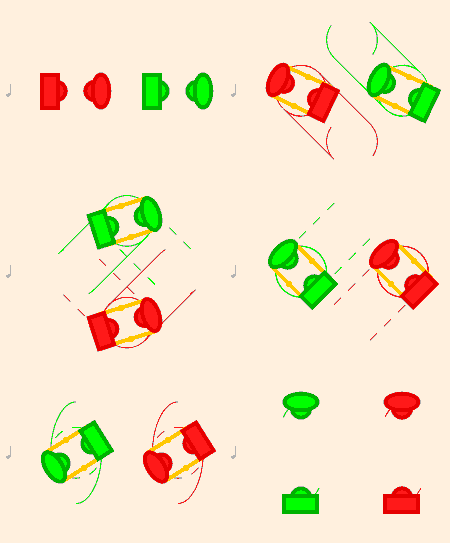 This is a two couple progression which starts with everyone on the center line, facing partners, 1s above 2s, men above women. Two hand turn partner seven eighths in two bars. Still with both hands joined, 1s dance down and toward the men's wall, and 2s dance up and toward the women's wall in one bar. Two hand turn three quarters in one bar. 1s dance down and toward the center line as 2s dance up and toward the centerline in one bar. Partner two hand turn about three quarters to end on the center line women above men. Dance out to own sides.
History
The Philabeg was devised by Robert M Campbell in 1968 for his dance The MacFarlanes' Strathspey.
Polka
Bars: 8.
As waltzing did earlier, polkaing became part of the country dance repertoire of figures.
The earliest reference to polkaing in a country dance that I have found is Seaton's 1852 The Ball-Room Manual from the UK.
Elias Howe published 9 country dances which contain polkaing as one of their figures in The American Dancing Master, 1862.
Some dances which (probably) use this figure
See Also
Poussette
Also known as: Put Back, Draw.
Bars: 8 for a full, 4 for a half.

 Poussette is a French term, originally meaning little push, and now meaning a baby stroller or perambulator.
Poussettes have a direction which may be specified in various ways as “clockwise”, or “1st corners push”, or “man 1 push, man 2 pull”. In a poussette you take hands with the person across the set (often your partner). Then one of you walks diagonally forward (1s down the set, 2s up) while the other backs up for 4 counts, then everything reverses and the one walking forward now backs up while the one backing up walks forward (but still moving the same way up or down). This is half a poussette.
In a full poussette you continue with the same circular motion until you end up exactly where you started.
Variants
 |  |  | 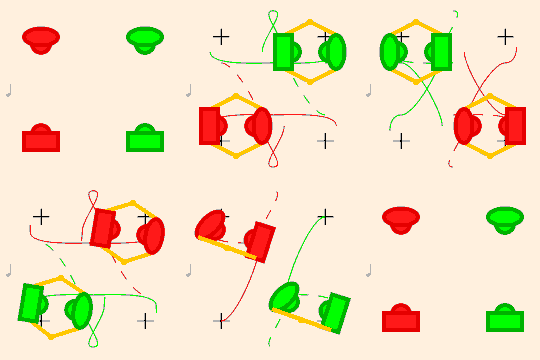 |  |  | 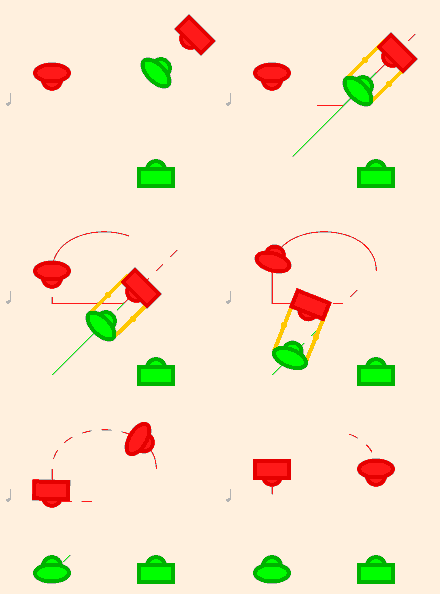 |
| Cooper's Rotational Poussette | Waltzing Turn Poussette | Waltz Poussette? | Old Scottish Poussette? | (R)SCDS Poussette | (R)SCDS Strathspey Poussette | Chevron Poussette |
History
The poussette is an old country dance figure which acquired a French name in about 1770 when Cotillions came over from France. In Playford's day it seems to have been called "put-back" or, "draw" (depending on whether M1 was pulling, or pulling. Note: This is different from the modern "draw poussette", which Colin Hume suggests is a modern misunderstanding).
Playford's The 29th of May (1686) has a nice description of a(n English) poussette:
First cu. take hands, the 2. cu. doing the like at the same time; then the 1. man puts back his wo. and slips down behind the 2. wo. into the 2. cu. place, while the 2. man draws his wo. to him and slips into the 1. cu. place. Do this back again the same way;
While the even earlier Cuckolds all arow (1651) describes a half poussette:
Men put the co. we. back by both hands, fall even on the co. side
The same dance appears in the Lovelace MS which was penned a few years before Playford. It also uses a poussette, though it does not describe it as well:
then each man shall take the woeman, that is right over against him, and the one shall draw her upwards and the other downwards; and presently draw them againe close together in theire places halding hands
The Neals also give a fairly clear description from Dublin in 1726 in the dance A Young Virgin of 15 Years
1st & 2d men take both hands wth their partner's and back to back till in their own places:
The Regency Dance Site has a nice paper by Paul Cooper giving the history of the poussette in English dancing. Most English Country Dances use what Cooper calls a "Rotational Poussette", either going half way round in 4 bars to be progressive, or all the way round in 8 ending back where you started.
Wilson, in his Complete System of English Country Dancing defines a "Half pousette or draw" which is what most people before him called a full poussette, while his "whole poussette" goes round once and a half times.
In William Campbell's 14th book (~1799) is a dance called Lord Nelson's Waltz. The instructions call for a "Poussette" to fill the last 16 bars (at waltz tempo). Both the Regency Dance site and Alan Winston say this should be a "Waltzing Turn Poussette". As yet I have found no contemporary description of this figure, and rely on Winston's description.
The National Library of Scotland has a manuscript (MS 3860), probably written between 1820 and 1830, which contains a description of what "Poussette" meant to them. Dancers take both hands with partners and the couple moves in a large circle around the other couple (like a traditional poussette), but also the couple describes an epicycle about their center point. Each time the couple has moved 90° around the big circle, they have turned 180° around their epicycle.
This manuscript says at another point that waltzing steps should be used for the country dance poussette. I don't understand how one can use waltz steps in a reel or jig though.
By ~1820 something called a "Waltz Poussette" appeared (this may be the same as the waltzing turn poussette?). As far as I know no one ever bothered to define it, so we aren't sure what it entailed. However on page 9 of Lowe's Selection of Popular Country Dances (Edinburgh, 1853) in the description of Spanish Country Dance:
Then pousette, Waltzing round each other. (16 Bars)
This is the final figure of the dance, and needs to be progressive. It suggests to me that the two couples waltzed around each other several times (they had 16 bars) before ending in each others' places. Cooper's paper says that in dances imported from Spain the words "waltz" and "poussette" were used synonymously.
In the US, in 1802, Saltator wrote:
POUCETTE, is to give both hands to partners, by couples and dance round each other, in the time of right and left.
Asa Wilcox was using poussettes in ~1793:
Colledge HornpipeFour hand cross roud back again first & third Couple Draw cross over one Couple - Right & left at top -
As was Saltator in 1802 (see Lasses of Glasgow).
But after that Poussettes died out in the United States, and Howe (who published from 1858-1880 in Boston) did not used them.
Some dances which (probably) use this figure
See Also
Chevron Poussette
 Two people poussette in on a diagonal, and then swing round so both are on the sidelines, meanwhile any people in the way wait and then cast to avoid those poussetting.
History
The Chevron Poussette was invented by Fried de Metz Herman, and the first dance I know to contain the figure was Time for a Little Something, 2000.
Some dances which (probably) use this figure
See Also
Draw Poussette
Bars: 8 for a full, 4 for a half.
 The draw poussette is similar to a normal poussette except that the couple turns through 180° so that the person who was pushing continues to push the entire time. This means that the person who was on the men’s line ends on the women’s line and vice versa.
History
Colin Hume suggests (and I agree with him) that this is a modern misunderstanding.
Cecil Sharp, in his interpretation of Jog On, My Honey describes the motions of a draw poussette (but doesn't not name it), but Playford's original seems to me to describe a normal poussette.
In 1922, Sharp's interpretation of Crosbey-Square again describes a draw poussette, but doesn't name it.
The next use of a draw poussette occurs in 1962 in Pat Shaw's interpretation of Thomas Wilson's Captain MacIntosh (on page 113), and Shaw appears to be the first to name the figure. Wilson defines his figures in The Complete System of English Country Dancing, and calls his poussette a "Half pousette or draw" so that may explain where Shaw got the name. Wilson's figure and instructions are not the clearest, but as his "Whole Pousette" is progressive it can't leave couples improper, so it can't be what we now call a draw poussette.
Some dances which (probably) use this figure
See Also
Scottish Poussette
An online definition may be found here.
Bars: 8.
This is a two couple figure which starts with the couples near the center line facing each other with both hands joined.
The 1s dance out so that the man is on the men's line, while the 2s dance so that the woman is on the women's line, then each couple pivots 90° clockwise around the dancer on the sideline, ending so that both couples are now on the sidelines. The 1s move down one place and the 2s up one place, again pivoting 90° clockwise around the other dancer. They now dance in so that they again straddle the centerline, they do a two hand turn half to get on the right sides, and then spend 2 bars falling back to progressed places.
History
In William Campbell's 14th book (~1799) is a dance called Lord Nelson's Waltz. The instructions call for a "Poussette" to fill the last 16 bars (at waltz tempo). Both the Regency Dance site and Alan Winston say this should be a "Waltzing Turn Poussette". As yet I have found no contemporary description of this figure, and rely on Winston's description.
Around ~1820 something called a "Waltz Poussette" appeared. As far as I know no one ever bothered to define it, so we aren't sure what it entailed. However on page 9 of Lowe's Selection of Popular Country Dances (Edinburgh, 1853) in the description of Spanish Country Dance:
Then pousette, Waltzing round each other. (16 Bars)
This is the final figure of the dance, and needs to be progressive. It suggests to me that the two couples waltzed around each other several times (they had 16 bars) before ending in each others' places. Cooper's paper says that in dances imported from Spain the words "waltz" and "poussette" were used synonymously.
Almost all the other dances in Lowe's book use poussettes, but none of them is a waltz, none takes 16 bars, and none says the dancers should waltz around each other. Now if you have to remind people to waltz in a waltz then that suggests to me that normally the poussette took a different form. At least in Edinburgh, in ~1850
Looking back from the 1960s, the Fletts say:
The Pousette. This figure, which is performed by two couples starting from adjacent positions, is one of the principal figures used to achieve the progression down the set. It occurs only in dances in quick tempo and occupies eight bars of music.In the form of the pousette used in Scotland within living memory, the two couples essentially just waltz round each other. The dancers take ordinary ballroom hold or some similar hold with their partners and use a simple waltz-type step, and the two couples move around each other in a counter-clockwise direction to exchange places, each couple at the same time rotating on its own axis in a clockwise direction, making two or more complete turns in the performance of the figure. The two men place their partners in position on the ladies' side, and fall back to their own side with one or two pas de Basque while their partners dance pas de Basque on the spot.
To my mind this is glossing over something important. How do you waltz to a reel or jig? Surely the footwork, at least, is going to be different? Or was "waltz" a broad enough a term to encompass a "partner swing", which can be done with a different traveling step than a waltz step?
In J.F. Wallace's The "Excelsior" Manual of Dancing, Glasgow, 1872, he describes "The British Grenadiers" (a reel). In it the poussette needs to be progressive. He describes it as Pousette, (using Galop step, making a half turn with each, (and breaks off without finishing his sentence or closing his parenthesis). In his publication from ~1900 he does close his parenthesis but we are no closer to knowing what "each" might modify. My guess is "step", and that this is a variant of a waltz poussette, turning halfway on each Gallop step — but remember this dance is a reel, not a waltz — indicating that the "waltz poussette" had extended to other types of music by 1872 (in Glasgow).
In Wallace's book, as in Lowe's, the poussettes used with waltz music are usually 16 bars, and the first one has the comment "still using the waltz step" as if this were unusual in a poussette.
Anderson (Dundee, 1897) also has to mention that a poussette in a dance with waltz music should be just waltzing.
Note that in 1964 the Fletts said It occurs only in dances in quick tempo. And a waltz is not a quick tempo dance. Does this mean that the "waltz poussette" wasn't used in waltzes in the Fletts' "living memory"? or that no one was doing country dances to waltz music by then? Except Anderson suggests that there were waltz country dances in 1897 which used waltz poussettes...
Anyway according to the Fletts, prior to the (R)SCDS, poussettes consisted of just waltzing around the other couple, suggesting that the (R)SCDS invented their poussette, and dances using it would, therefore, not be danced in a traditional way.
So, I'm pretty sure that the first use of this poussette was in the first book published by the (R)SCDS in 1924. And the first dance in that book is Petronella.
Some dances which (probably) use this figure
See Also
Strathspey Poussette
Also known as: Diamond Poussette, Roundabout Poussette.
An online definition may be found here.
Bars: 8.
This is a two couple figure which starts with everyone on the sidelines. It is non-progressive
W1 and M2 take a large step toward their partners to end inside them, facing partners on the right diagonal, while their partners take a small step to face them on the same diagonal (men above their partners).
Take both hands with partner and step out so that M1, W2 are again on their respective sidelines. Each couple pivots clockwise about M1 or W2 with their partners end up outside the sidelines.
Each couple moves diagonally, with M1, W2 passing back to back, to end straddling the centerline (2s above 1s).
Then two hand turn most of the way around, ending on the original diagonal, but with the 2nd couple above the 1s (men again above their partners).
Then stepping out so that W1,M2 are on the sidelines, pivoting clockwise slightly about W1,M2 until their partners are outside the sidelines.
Each couple moves diagonally, with W1,M2 passing back to back, to end straddling the centerline (1s above 2s).
Both couples two hand turn until each has their back to their proper walls, and release hands.
And fall back to original places.
History
In William Campbell's 14th book (~1799) is a dance called Lord Nelson's Waltz. The instructions call for a "Poussette" to fill the last 16 bars (at waltz tempo). Both the Regency Dance site and Alan Winston say this should be a "Waltzing Turn Poussette". As yet I have found no contemporary description of this figure, and rely on Winston's description.
Around ~1820 something called a "Waltz Poussette" appeared. As far as I know no one ever bothered to define it, so we aren't sure what it entailed. However on page 9 of Lowe's Selection of Popular Country Dances (Edinburgh, 1853) in the description of Spanish Country Dance:
Then pousette, Waltzing round each other. (16 Bars)
This is the final figure of the dance, and needs to be progressive. It suggests to me that the two couples waltzed around each other several times (they had 16 bars) before ending in each others' places. Cooper's paper says that in dances imported from Spain the words "waltz" and "poussette" were used synonymously.
Almost all the other dances in Lowe's book use poussettes, but none of them is a waltz, none takes 16 bars, and none says the dancers should waltz around each other. Now if you have to remind people to waltz in a waltz then that suggests to me that normally the poussette took a different form. At least in Edinburgh, in ~1850
Looking back from the 1960s, the Fletts say:
The Pousette. This figure, which is performed by two couples starting from adjacent positions, is one of the principal figures used to achieve the progression down the set. It occurs only in dances in quick tempo and occupies eight bars of music.In the form of the pousette used in Scotland within living memory, the two couples essentially just waltz round each other. The dancers take ordinary ballroom hold or some similar hold with their partners and use a simple waltz-type step, and the two couples move around each other in a counter-clockwise direction to exchange places, each couple at the same time rotating on its own axis in a clockwise direction, making two or more complete turns in the performance of the figure. The two men place their partners in position on the ladies' side, and fall back to their own side with one or two pas de Basque while their partners dance pas de Basque on the spot.
To my mind this is glossing over something important. How do you waltz to a reel or jig? Surely the footwork, at least, is going to be different? Or was "waltz" a broad enough a term to encompass a "partner swing", which can be done with a different traveling step than a waltz step?
In J.F. Wallace's The "Excelsior" Manual of Dancing, Glasgow, 1872, he describes "The British Grenadiers" (a reel). In it the poussette needs to be progressive. He describes it as Pousette, (using Galop step, making a half turn with each, (and breaks off without finishing his sentence or closing his parenthesis). In his publication from ~1900 he does close his parenthesis but we are no closer to knowing what "each" might modify. My guess is "step", and that this is a variant of a waltz poussette, turning halfway on each Gallop step — but remember this dance is a reel, not a waltz — indicating that the "waltz poussette" had extended to other types of music by 1872 (in Glasgow).
In Wallace's book, as in Lowe's, the poussettes used with waltz music are usually 16 bars, and the first one has the comment "still using the waltz step" as if this were unusual in a poussette.
Anderson (Dundee, 1897) also has to mention that a poussette in a dance with waltz music should be just waltzing.
Note that in 1964 the Fletts said It occurs only in dances in quick tempo. And a waltz is not a quick tempo dance. Does this mean that the "waltz poussette" wasn't used in waltzes in the Fletts' "living memory"? or that no one was doing country dances to waltz music by then? Except Anderson suggests that there were waltz country dances in 1897 which used waltz poussettes...
Anyway according to the Fletts, prior to the (R)SCDS, poussettes consisted of just waltzing around the other couple, suggesting that the (R)SCDS invented their poussette, and dances using it would, therefore, not be danced in a traditional way.
So, I'm pretty sure that the first use of this poussette was in the fourth book published by the (R)SCDS in 1927 in the dance The Haughs o' Cromdale.
Some dances which (probably) use this figure
See Also
Waltzing Turn Poussette
An online definition may be found here.
Bars: 16.
This is a 16 bar non-progressive figure for two couples. Dancers move into poussette position and go counter-clockwise out of the set (as if doing a normal poussette). When they are as far out as they'll get then they two hand turn once and a half. Then they move in to the other couple's spot (note: because of the turn once and a half, the same dancer is pushing as before).
And then repeat the sequence until everyone has returned home.
History
Alan Wilson and the Regency Dance site describe this figure for use in the dance Lord Nelson's Waltz, which calls for a 16 bar poussette: Poussette quite round with the 2d. Cu:
I, myself, have been unable to find any description of this figure before the modern one, so I don't know how authentic it may be.
Some dances which (probably) use this figure
See Also
Progressive Hey
Also known as: Snowball Reel.
Bars: depends on the number of changes, often 8 bars.
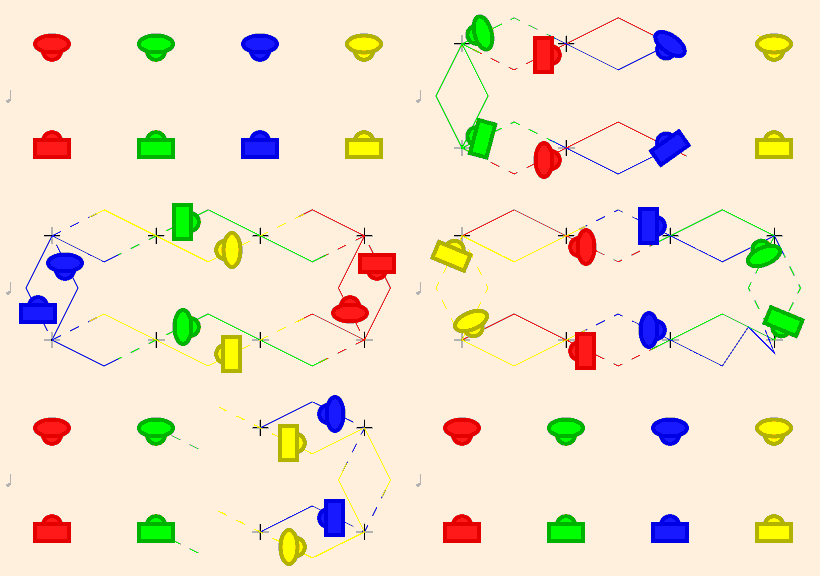 In a normal hey, everyone starts dancing at once. In a progressive hey two dancers will start, and pass each other, and then they and the dancers they face will pass by the other shoulder, and then the next dancers by the original shoulder. Each dancer waits until the one of the first pair reaches them, and then continues in their own right. The hey ends the opposite way: when the first two dancers reach their original places they stop, but the other dancers continue, only stopping when they reach their original places.
(Note that this is very similar to the old style of starting a country dance: where only the 1s and 2s were initially active, then the 1s+3s, then the 2s+3s and 1s+4s...
History
The earliest description of a hey that I've found is a progressive hey. In Thoinot Arbeau's (Jehan Tabourot) Orchésographie, 1589, a book about French dancing, he describes a dance called "Branle de la Haye" (page 90 (his numbering is unexpected, he only numbers every other page, most would call this page 180) where he gives a very clear definition.
Les danceurs seuls, & l'vn apre l'aultre, premierement dancent l'air en façon de Courante, & sur la fin s'entrelacent, & font la haye les vns parmy les aultres: ....Capriol.Ie ne leulx pas bien conprendre ce que dictes de cette haye.Arbeau.Vous l'entendrez bien facilement ansi: Posez le cas qu'ilz foient trois dáceurs (cest le moindre nombre qui y peult estre) & ymaginez qu'ils soient comme voiez ces lettres A B C.A B CE's premiers quatre pas de l'air de la haye, A & B changent de place en passant a leurs gaulches, puis és quatre secódes mesures A & C change de place, en passant a leurs main droictes, tellement qu'ils se treuueront placez ainsi que voiez icy.B C ACe fait, B & C changeront comme dessus, puis B & A, tellement qui'ils se treuueront disposez ainsi que voiez étroifiemes quatre pas de l'air de la haye.C A BE's quatre pas suyuants, C changera auec A, puis ledit C auec B, & ainsi se retreuueront comme au commencement.A B C
The dancers alone, one after another, first dance an air in the style of the Courante and, after that, interlace themselves, making a hay, each among the others....Capriol.I don't understand what you mean by this "hay".Arbeau.You will understand it easily thus: suppose that you have three dancers (that's the smallest number there can be) and imagine they are arranged as the letters A B C.A B CDuring the first four steps of the air of the hay, A & B change places by passing to their left, then the next four beats A & C change places passing by their right hands, now they are ordered thusly:B C AThis done, B & C change places as before, then B & A, and now they are disposed:C A BIn the next four steps, C changes with A, then the same C with B, and thus everyone finds themselves where they started.A B C
Playford, too, used progressive heys as early as 1651 in his dance À la Mode de France: then the 1. man take his wo. by the hand, his left hand to the 2. wo. the right to the 3. wo. and so forward, his wo. doing the like on the other side until you all meet again in your places.
Some dances which (probably) use this figure
See Also
Promenade
Bars: however long is needed.
Promenading consists of dancing beside your partner, holding hands. There are various hand positions. The most common one has both hands in front, right hand in partner's right, left in partner's left.
History
Sharp uses a promenade in his interpretation of Adson's Saraband, Playford, 1651. But I'm not sure he is right to do so. Playford says:
First cu. lead down between the rest, come with a compass to your places, the rest following
Which sounds rather different to me.
The concept of "promenading" came over from France with Cotillions.
Thomas Hurst, in his The Cotillons Made PLAIN and EASY, 1769, (page 9), defines promenading:
TWELFTH CHANGE, The Promenade, or Walk.Every Gentleman takes his Partner by the Left-Hand; and putting his Right-Hand round her Waist; in this Manner they follow each other all round in a great Ring, and finish in their proper Places.
Note, this is not the modern skaters' hold promenade
I think Wilson may be the first to suggest joining hands in front, in his The Quadrille and Cotillion Panorama:
6.—PROMENADE, THE GREATAll the four couples cross hands with their partners, and move round in a circle to places.
Some dances which (probably) use this figure
See Also
Promenade Progression
Bars: 8.
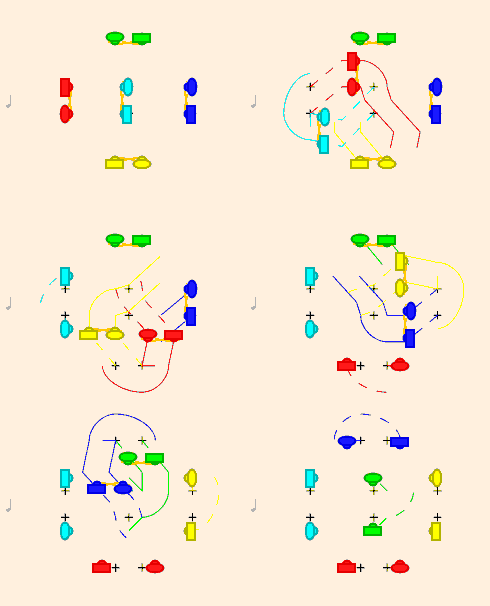 Promenade Progression is a progression pattern for 5 couples in a square set with one couple in the middle. It starts with all couples in promenade hold, all outer couples facing in, the the middle couple facing up. The progression can go either clockwise or counter-clockwise, the instructions below are for counter-clockwise.
The middle couple pass the top couple right, each taking the other's place, the middle couple end facing in, the top couple end in the middle facing the next couple counter-clockwise.
The process continues three more times.
History
The first example of this figure that I can find is in Wendy Crouch's Winter Solstice from 1988.
Some dances which (probably) use this figure
Three Couple Promenade Round
Bars: 8.
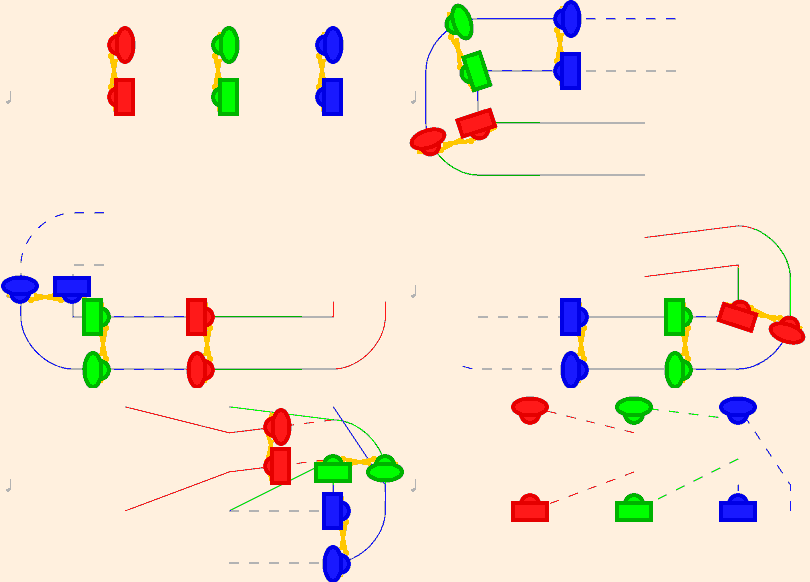 In Scottish Country dance the dancers start the figure in the center of the set, in promenade hold with partner, facing up. While in English dance you tend to start from the sidelines and quickly move into that position. Dancers move up, pivot round to face the men's line, move across, pivot to face down, move down to the bottom, pivot to face the women's line, move into the center, pivot to face up, and dance up to original places, and retire to the sidelines.
Variants
The (R)SCDS introduced both two and four couple longways promenades in Book 18. Leith Country Dance, and Longwise Eightsome Reel.
History
Sharp uses a three couple promenade in his interpretation of Adson's Saraband, Playford, 1651. But I'm not sure he is right to do so. Playford says:
First cu. lead down between the rest, come with a compass to your places, the rest following
Which sounds rather different to me.
The concept of "promenading" came over from France with Cotillions.
Thomas Hurst, in his The Cotillons Made PLAIN and EASY, 1769, (page 9), defines promenading:
TWELFTH CHANGE, The Promenade, or Walk.Every Gentleman takes his Partner by the Left-Hand; and putting his Right-Hand round her Waist; in this Manner they follow each other all round in a great Ring, and finish in their proper Places.
Note, this is not the modern skaters' hold promenade
I think Wilson may be the first to suggest joining hands in front, in his The Quadrille and Cotillion Panorama:
6.—PROMENADE, THE GREATAll the four couples cross hands with their partners, and move round in a circle to places.
But these are all in a square set. The first examples (that I can find) in a longways set occurred in 1776, and both Thompson and Skillern published dances which used this figure.
In the US, Saltator, 1802, specifies a three couple promenade in his dance College Hornpipe: each promenade their own partners round. While Howe, 1862, uses a 2 couple promenade in Whipple's Hornpipe.
In (R)SCDS Book 11, both the source descriptions of Glasgow Flourish (one by Anderson, and one by Wallace) contain three couple promenades, but the (R)SCDS replaced it with a lead down and up. However the next time the figure occurred (in Fidget, Book 16) it is translated unchanged.
Some dances which (probably) use this figure
Right And Left
Also known as: Rights and Lefts, Right Hand and Left, Circular Hey, Square Thru, Right and Left 4, Chaîne Anglaise, Chain Figure of Four.
An online definition may be found here.
Bars: 8.
 Right and left is a figure for 4 people. You pass the person you are facing by the right hand, and then turn ninety degrees toward the center of the minor set. You are facing someone new, and you pass them by the left hand, and again turn ninety degrees toward the center of the set. You are now facing the person you were originally, and you repeat the same movements until you have returned to where you started.
This figure can be fractionalized.
Variants
Less common is "left and right" where you do essentially the same figure but start with the left hand instead of the right.
In Scottish Country Dance the dancers in M1+W2's positions do a polite turn on the last change to face in to the set.
Square Dancing's "Square Thru" has the dancers continue in the direction they were facing at in the last pass; they do not turn to face in.
History
Nicholas Dukes defines right and left on page 23 of his A Concise & Easy Method of Learning the Figuring part of Country Dances using Feuillet diagrams.
This is the first definition I know of, but the figure was used much earlier. Playford used it in 1657 in the dance Abergenny (I cannot find any examples in the Lovelace MS, nor in the first two editions of the Dancing Master).
Sometimes Playford says "right and left", sometimes "right hands and left", and sometimes "right and left hands".
In 1752 Johnson uses the term "Right and Left 6" (in the dance Lord Anson for Ever). I presume he means what would later be called a "grand chain".
French dances often called this the La Chaîne Anglaise, or even more simply La Chaîne (see Pierre Trappeniers's La Belle Anglaise).
Thomas Wilson becomes rather vehement that "Right and Left" actually means something completely different.
N.B. This Figure is very different from the "Quadrille Right and Left," which is the "Chain Figure of four."
He does later define his Chain Figure of four, which is, indeed, what everyone else means by right and left.
Cecil Sharp also decided to change the name of the figure. In 1911 he called it a "circular hey". I've no idea why. In the US, at least since the publication of The Playford Ball in 1994, the term "circular hey" means going through the pattern of right and left without taking hands, while "rights and lefts" means doing it with hands.
In the US, Elias Howe, 1858 uses "Right and Left 4". This is probably the same as "Right and Left", but it may not be because 60 years later Burchenal (1918) defines it as something related, but different, Ricky Holden also uses this definition in 1956, and Smukler & Millstone in 2008.
In Square Dancing: Henry Ford (Benjamin Lovett) gives the conventional definition of right and left in 1925, but Lloyd Shaw, in Cowboy Dances, 1939, talks about Right and Left Through and gives a close to modern definition of it.
Shaw's definition is still over and back, but by the time CallerLab came around Right and Left Through meant only half of what it originally did, and Bill Hanson in 1957 came up with the figure "Square Thru" which is the original "Right and Left".
Some dances which (probably) use this figure
See Also
Right And Left 4
An online definition may be found here.
Bars: 8.
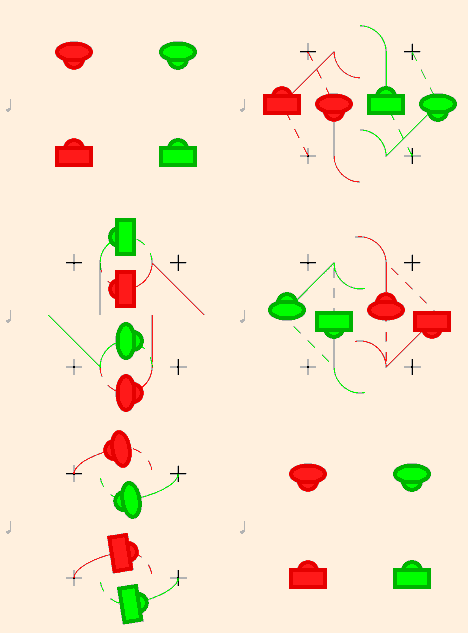 Right and left 4 is a figure for two couples, usually from a proper formation. Pass through by the right, taking right hands and dropping them. Then standing next to the same person you were next to originally (but on the other side of the set), the person on the left walks backward while the person on the right forward and you wheel around to face in. It's like a right and left through but without taking hands in the courtesy turn.
Then you repeat the above to return home.
History
Elias Howe in the 1850s+60s uses the term "Right and Left 4" and "Right and Left" interchangeably, but he defines neither, and I suspect he probably has the traditional definition of Right and Left in mind.
Elizabeth Burchenal, in American Country Dances defines right and left as:
Right and Left
This is executed either by two opposite couples (as in The Circle), or by two women with two opposite men (as in Hull's Victory, Old Zip Coon, etc. It consists of two dancers' exchanging places with the opposite dancers in the following manner:The two couples advance toward each other, and "pass through," the one on the right in each couple going between the opposite two (Diagram 9.)Then, keeping side by side as if their inside hands were joined, each couple continue to the opposite side, wheeling half around (to do this, the one on the left makes a left-about-face and walks backward, keeping the right shoulder toward the other's left shoulder), thus finishing on the opposite side with the right one still on the right and the left one still on the left. (Diagram 10.) All this is done in eight steps (4 measures).The then return in the same manner to their original position (4 measures).
In 1956 Rickey Holden says much the same thing on page 44 of his The Contra Dance Book.
Finally Smukler & Millstone define it on page 14 of Cracking Chestnuts, 2008. But they were reviving old traditions, not specifying current behavior.
Some dances which (probably) use this figure
See Also
Right And Left Through
An online definition may be found here.
Bars: 4.
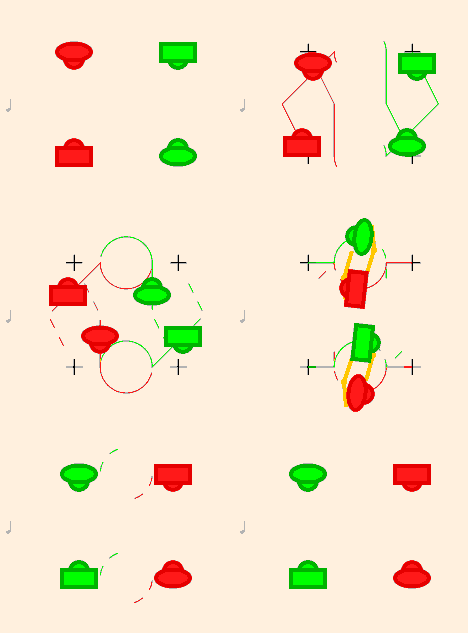 Right and Left Through is a figure for two facing couples. You pull-by right hands with the person you face, then give left hand to the person beside you (in front), and right hand behind the back, and then turn half to face in, with the man backing up, and the woman going forward.
Variants
In Becket Reel, 1957 there is a diagonal right and left through.
History
The first definition of Right and Left Through that I can find is in Lloyd Shaw's Cowboy Dances, first published 1939. He does not claim to be the author of this figure, saying that it comes form the New England Square Dance tradition, however, Henry Ford's (Benjamin Lovett's) Good Morning, 1925, does not define "right and left through", and does define the old right and left, and the same is true of Ralph Page's The Country Dance Book, 1937.
Lloyd says:
In the right and left through two couples advance to each other, each lady, of course, being on the right of her gentleman. Each dancer gives his right hand to the opposite (who, of course, is of the opposite sex as well) and passes beyond — the two couples passing through each other. Each gentleman then takes his lady's left hand in his left, and putting his right hand behind her waist, turns her around him to the left while he stands as a pivot. The the two couples pass through each other again, giving opposites right hands as they do so. Then giving left hands to partners, the gentlemen again turn the ladies to place. Right hands to opposites and left hands to partners give it the name right and left through. Experts usually leave out the handshake, but beginners find it a help.
In Sept 1949 Sets in Order published a short list of standardized calls:
RIGHT AND LEFT THRU—Touch hands as you go. Do not return unless called.
So (at least in Southern California) Right and Left Thru had become half of the original figure from 10 years before.
CALLERLAB's definition from the 1970s, and unchanged since, is basically the same as the 1949 version.
But in the January 1950 issue there is another list of class (this time for Texas), and there "Right and left thru" is still over and back.
Some dances which (probably) use this figure
See Also
Wilson's Right and Left
An online definition may be found here.
Bars: 4.
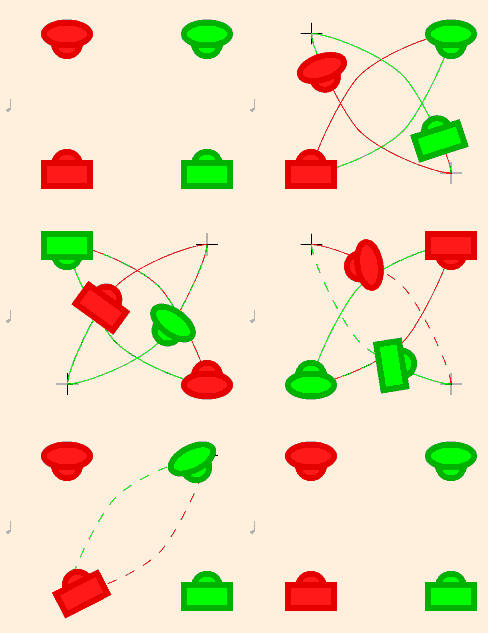 Thomas Wilson defined a different way of doing Right and Left. He said that the 2nd corners should change places by the left shoulder looking at each other with a slight inclination of the head, over the left shoulder. Then the 1st corners change by the right. Then the 2nd corners change back (by the left) and the 1st corners change back (by the right). All this in 4 bars.
(He defines the normal right and left figure, but calls it a Chain for four)
History
Wilson's definition is mostly in pictures so I shan't quote it.
Nicholas Dukes defined Right and Left in 1752 in the normal way.
I haven't any other contemporary publisher who used Wilson's definition.
Keller & Sweet in A Choice Selection of American Country Dances of the Revolutionary Era interpret a variety of Country Dances and use Wilson's definition of Right and Left. I'm not sure if this was a good choice (as this is not the figure that has come down to us in Contra Dancing), but they may know more than I do. Sadly Saltator, a US author who in 1802 defined a few figures, did not define "Right and Left", though he did use the term.
Some dances which (probably) use this figure
See Also
Rondel
An online definition may be found here.
Bars: 8.
 The Rondel is a figure for two couples who may start from the sidelines, or from the centerline.
The 1s lead down between the 2s and cross over to opposite sides about half a place below 2nd place, while the 2s make an arch (near hands) go above 1s, and cross to opposite sides about half a place above the top. The 2s now cast down to 1st place, as the 1s cast up to 2nd. The men make an arch, and the women lead through it going to their normal sides, and then crossing (both of the 1s go in front of their respective 2s).
Everyone is now where they started, but the 1s are facing up, and the 2s down. They loop round to face in the opposite direction beside the center line. Then the 1s lead through an arch made by the 2s, and all finish progressed on their own sides (no crossing to opposite sides this time).
History
The earliest source I can find for the Rondel is John Drewry's The Silver Tassie, 1966, followed by many dances in The Rondel Book of Scottish Country Dances, published 1967.
Some dances which (probably) use this figure
Rose Progression
An online definition may be found here.
Bars: 8.
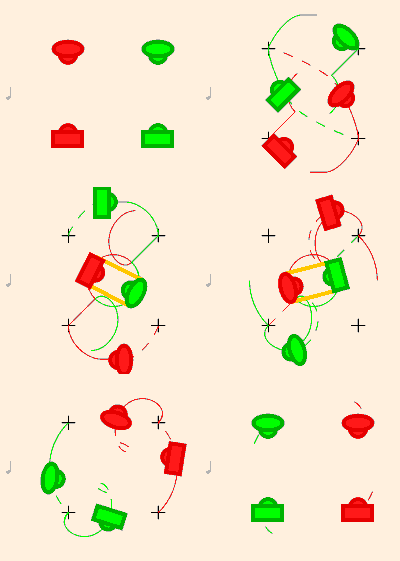 The Rose Progression is a progressive figure for two couples.
M1+W2 set for the first two bars while the others cross by right hand.
M1+W2 two hand turn half in two bars, while the other two cast up or down into the positions M1,W2 originally occupied.
M1+W2 turn over their right shoulders and loop into each others place, while the other two dancers come in and two hand turn have (navigating this can be a bit tricky, you have to curve out to places).
Finally M1+W2 cross the set while the others pull back their right shoulders and curve out to the place behind them.
History
The earliest dance with this figure that I can find is Ron Downey's Jenny Freeman's Strathspey from 1993.
Some dances which (probably) use this figure
Schiehallion Reel
An online definition may be found here.
Bars: 16.
 A Schiehallion Reel starts in a square formation with the women facing out. All couples do the same thing. In the first two bars the men move in toward the center and then out to the place where the woman to their right started, giving left shoulder to the man on their right. The women loop outside of the set and come in where their partner used to be.
In this figure the men follow the woman who starts to their right, while the women follow their partners. After every two bars each dancer should be where the person they are following was at the start of those two bars.
In bars 2-4 the men now loop outside the set, while the women move toward the center and then out to where their partner was.
After 4 bars all dancers in the set will have rotated 90 degrees counter-clockwise.
This process continues, after 8 bars they are diametrically opposite where they started, and after 16 bars they are back home.
History
The Scottish Country Dance Database has a long note about the dance Schiehallion, saying that a version of the dance was originally devised in the 1950s, containing the eponymous reel, but the dance itself was much changed in the final version published in 1971.
They also note that although Thurston thought the figure original, it is very similar to an Axum reel.
While they may be topologically equivalent they look quite different to me.
Some dances which (probably) use this figure
Set
Also known as: Balance, Foot It, Dance Address.
Bars: 2.
 Setting describes a general class of movements which usually end with the dancer going nowhere, and often involving a display of footwork.
At it's simplest a set is a step to the right¹ and a close followed by a step to the left and a close. That is step out with the right foot, close with the left, then step with the left foot and close with the right. You end where you started.
Often you will be facing someone and it can be confusing to see them move to your left; do not be taken in by this. Move to your right.
Set became balancé when it moved to France, and just balance when it moved back across the channel. Various other names have been given which I think of as variants of "set": "foot it", "rigadoon", etc. Perhaps even Playford's "backs and faces".
In the March, 1955 edition of Northern Junket, Ralph Piper gives 50 variations of the balance (setting) step); while the Fletts in Traditional Dancing in Scotland give a similarly large number of setting steps, with different kinds of steps depending on the music.
Occasionally the term "set advancing" will be used. In this case you do not end where you started but move slightly forward while setting.
Variants
In modern Scottish Country Dancing there are several standard forms of setting. The most common for jigs and reels is pas-de-basque. While strathspey dances use a setting step which involves: stepping out to the right, closing with the left, stepping right again, and hopping the left foot to behind the right. Finally there is Highland Schottishe setting.
History
The term "sett" appears in the Lovelace MS (1621~1649), and in Playford.
Nathaniel Dukes, 1752 appears to define setting as a movement to the left first, but Cecil Sharp says it should start with a movement to the right. I can't figure out from Wilson's diagrams whether he intends setting to start out to the right or left.
Both https://archive.org/details/bim_eighteenth-century_a-concise-easy-method-_dukes-nicholas_1752/page/n43/mode/2up">Dukes, 1752, and Wilson, 1815 say that "foot it" and "set" mean the same thing.
¹ Cecil Sharp actually defines setting:
This is a movement of courtesy, addressed by one dancer to another, or more frequently by two dancers to each other simultaneously. It consists of a single to the right sideways, followed by a single to the left back to position (two bars).
Note: this differs from Arbeau's definition of "two singles" which starts to the left. But in the English speaking world people follow Sharp.
Some dances which (probably) use this figure
Set and Honour
Also known as: Step and Honour.
An online definition may be found here.
Bars: 4.
Cecil Sharp says:
This is a lengthened form of the Set occupying four instead of two bars. On the first beat of the fist bar the right foot is placed on the ground sideways to the right; on the first beat of the second bar the left foot is brought up beside it and the honour paid in the manner already explained (two bars). These movements are then repeated in the reverse direction, the left foot being moved to the side, the right foot brought up beside it, and the honour paid (two bars, i.e., four bars in all).
History
As far as I know this is an invention of Cecil Sharp's and I can find nothing in Playford to justify it. Other interpreters have used it after Sharp.
Some dances which (probably) use this figure
See Also
Set And Link
An online definition may be found here.
Bars: 4.
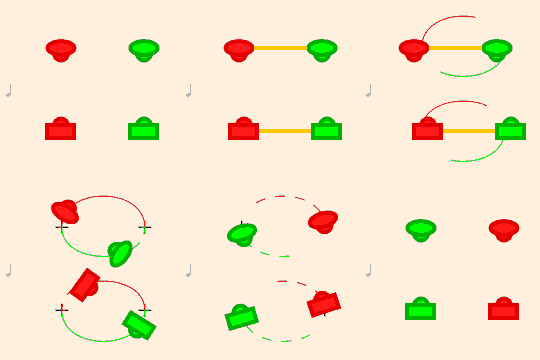
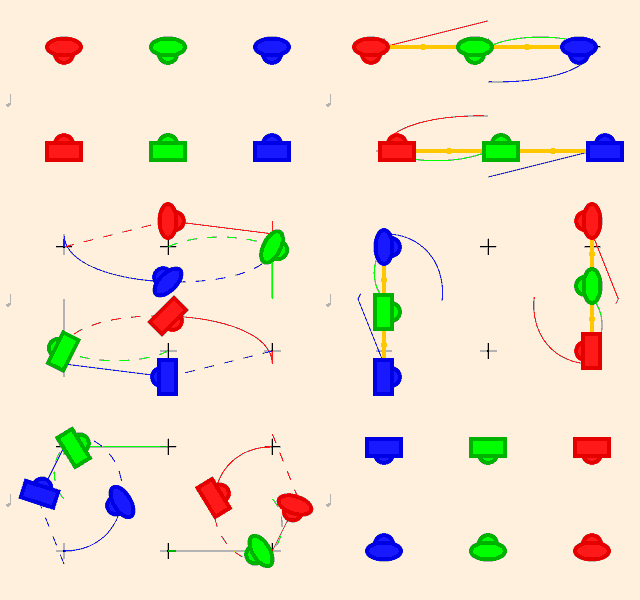 In a set and link, everyone takes hands on the side and sets to partner, the all drop hands. In a two couple set and link the people on the right end of their lines cast right to the other end of their line, while the people on the left end of the lines spin up or down through the center to the other end of the line.
In a three couple set and link life is more complicated, and the dancers switch orientations as well as positions. The person on the left end of the line still twirls through the center to the other end of her/his line and then faces up or down (back the way they came from). The people in the middle cast right and chase a quarter round the set, ending at top or bottom, on the center line, facing in to the set. The people on the right end of the line also cast right, and move to the other end of their sideline.
A 3 couple set and link is often done twice (to get everyone back in the normal orientation, albeit diametrically opposite where they started.
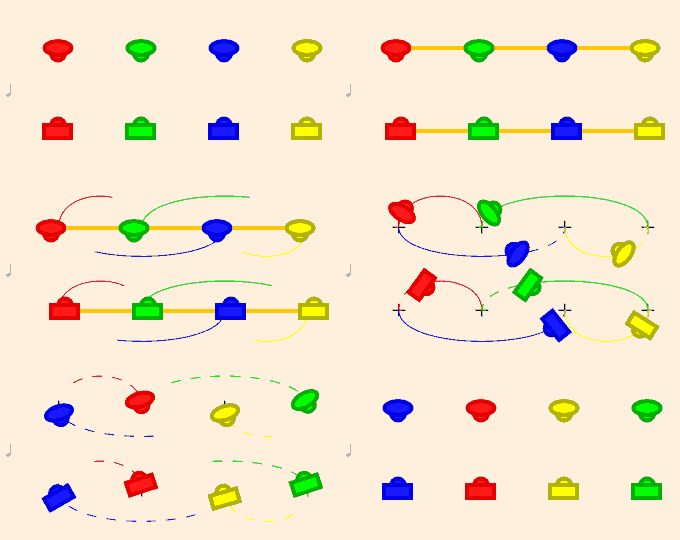 A four couple set and link is like the 2 couple in that it retains the same orientation. Here the people at the ends of the sidelines cast or twirl one place, while the people in the middle positions cast or twirl two places (so ends become new middles, and middles become new ends).
History
According to the SCDDB John Drewry claims that "set and link" was invented by Alec Hay.
Note. 1 These dances were devised between Spring 1991 and June 1992 i.e. they come after the printing of the Donside Book. Many of them were for use during a visit to New Zealand and California in October-November 1991. The New Zealand connection is emphasised by the inclusion of "set and link" which was devised by Alec Hay of Auckland. Alec said, when I met him, that he prefers dancers NOT TO HOLD HANDS when linking.— The Bankhead Book Part 2, John Drewry, 1991-1992
Looking at Alan Hay's dances, the first use I have found is Australian Ladies, 1966. The first example I have found in an RSCDS Book is in Book 23, 1967, again by Alec Hay, The Dean Bridge of Edinburgh. In both of these the two couple form is used.
The earliest 3 couple Set and Link I've found is in Gang the Same Gate, in RSCDS Book 36 (1990).
The only 4 couple set and link I know of is in The Library of Birmingham, devised 2015.
This figure makes an occasional appearance in English Country Dance, Andrew Shaw's interpretation of Kynaston's Well Done Jack (2002) is the first use I know of it, followed by Brooke Friendly & Chris Sackett's Home Again in 2005.
In his dance Fine Companion Waltz (2008) Gary Roodman describes the figure without naming it. When I asked him if he were using the Scottish figure, he said he hadn't heard of it when he wrote the dance. So I guess he developed it independently.
Some dances which (probably) use this figure
Set And Rotate
An online definition may be found here.
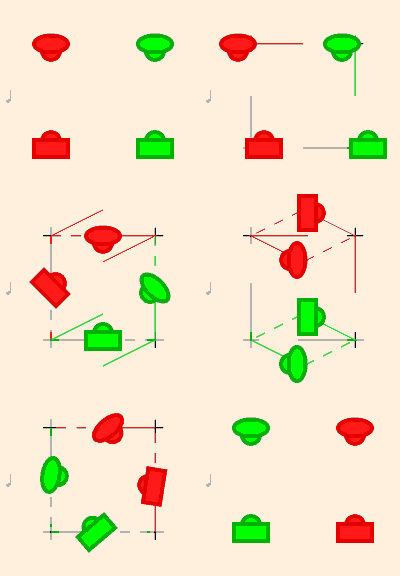
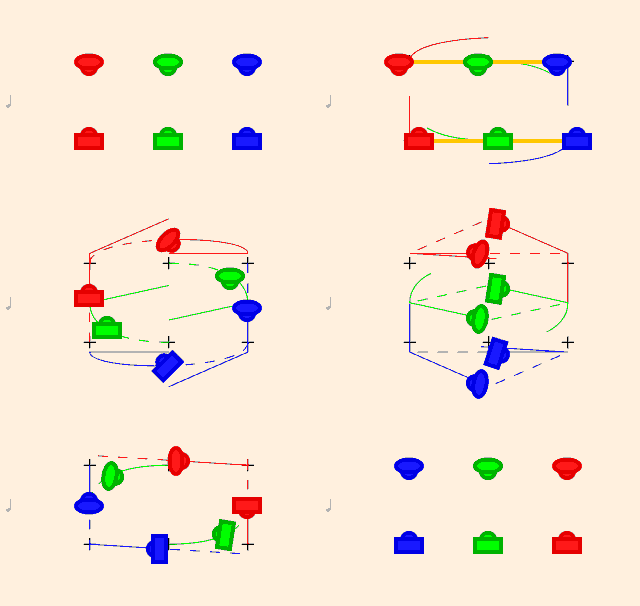 A set and rotate begins with everyone setting on the sidelines, but on the second bar everyone drops hands and pulls back their right shoulder, then they chase one place clockwise, and turn to face their partners, then cross with partner by the right hand, and chase one more place.
I'm not aware of a four couple variant of this figure.
History
A note on the Scottish Country Dance database for the dance Brimmond (by John Drewrey, 1986) claims that it was the first dance with this figure. The first use in an RSCDS Book was the dance The Gilly Flower in Book 36.
The first uses of a three couple version that I've found was devised by Ian Barbour in 1992: The Newholme Jig.
Some dances which (probably) use this figure
Set and Turn Single
Bars: 4.
A dancer first sets for two bars, and then turns single (usually to the right) for two more bars.
History
This was a common idiom in Playford's day (though I do not find it in the Lovelace MS who said "sett twice" instead). Almost every dance in the first two editions of the dancing master contained it, but none in the 5th, 6th, or 7th. The Neals were still using it in Ireland in 1726 (though they called it "dance and turn single")
Some dances which (probably) use this figure
See Also
Sheepskin Hey
Bars: 24.
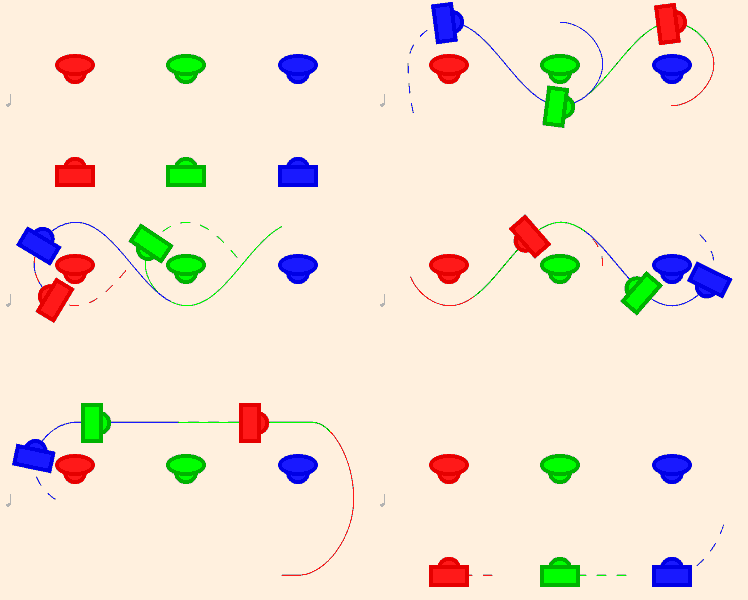 This is an unusual hey, since half the people in it are stationary, it has something of the feel of a figure eight.
There are two versions of the hey in the dance, first the men weave around the women, and then the women weave through the men. I only show the men weaving.
The men follow M1 as he dances across the set and outside W1, then between W1+2 and inside W2, then between W2+3 and outside W3 and loops around W3 to start up inside. M2 follows him. M3 starts to follow, but cuts it short and loops around W2 and heads up in front of M1 (and M2).
M3 dances between W1+2, inside W1 and loops around her to head down. M1 follows him, as does M2 until he reaches W2 when he cuts it short and loops around her. Now he is in the lead.
M2 cuts between W2+W3, outside W3 and loops around her to head up. M3 follows. M1 starts to follow, but cuts it short, and loops around W2 and outside her. Now he is in the lead again.
M1 dances between W1+2, around W1, and then dances down, outside all the women, across the set down at the bottom and then up his own side to his starting place. The other men follow him, each finishing in his own place.
History
As far as I know, the only dance to use a sheepskin hey is Picking of Sticks. Both the Playford version, and the Lovelace version seem to have this figure. (Lovelace reorders the figures) It was interpreted by Cecil Sharp in 1910.
Some dances which (probably) use this figure
See Also
Shoulder Round
Also known as: Gypsy.
Bars: 4.
 The shoulder round is pattern which can be either left or right, in fact it is almost exactly the same motion as the right/left hand turn — except you aren’t allowed to touch each other, instead you stare soulfully into each other’s eyes as you rotate around. You step in a little, turn either your right or left shoulder to your partner, look over your shoulder at them in as sexy a way as possible and turn around in a circle, usually returning to place.
As with hand turns, the figure may be fractionalized, with a half shoulder round meaning you trade places with the person you are going around.
In the example I have the 1st couple doing a right shoulder round and the 2nd couple doing a left. This combination actually occurs in dances and is called a “partner mirror shoulder round with the women in the middle at start”.
History
John Sweeney has a good article on the origins of this figure, as does Colin Hume.
First of all the term "shoulder round" is a modern invention, it is a replacement for the term "gypsy" which was felt to be offensive. "Gypsy" itself appears to be only slightly less of a modern invention. Cecil Sharp borrowed the term "Gyp" from Morris dancers and used it in some of his interpretations starting in 1911. I don't know who changed that to Gypsy.
But Sharp's "Gyp" is very different from the modern shoulder round (or from the gypsy of twenty years ago). Sharp describes two related figures: "Whole-gip facing centre" and "Whole-gip facing outward", the first of these is like a two hand turn with no hands, in other words you face your partner as you go round them in a circle, the second has you with your back to your partner as you go round them.
(I've never seen either of these figures actually danced).
Porter, Heffer, & Heffer may be the first to use the word "gypsy" rather than "gyp" in The Apted Book, 1931.
If Playford, or any subsequent publishers, ever intended to used any of these three figures, they did not make the fact clear in their dance descriptions.
Some dances which (probably) use this figure
Siding
Also known as: Side, Shoulder Siding, Inline Siding, Shaw Siding.
Bars: 4.
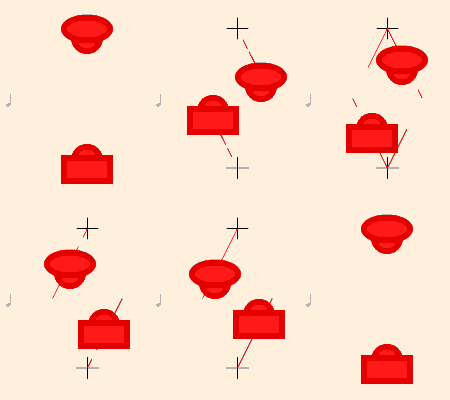 You can side either to right or to left. Often you first side to the right and then side to the left. When doing “right shoulder siding” you walk toward the center of the set and slightly to your left, stopping in the middle so that your right shoulder is near your partner’s right shoulder. In “left shoulder siding” you do essentially the same except mirror reversed.
Styling: Take a moment to acknowledge your partner in the center.
The example shows first right shoulder siding then left shoulder siding, as you would find in a up a double/siding/arming dance.
History
Siding appears in the Lovelace MS, and later in Playford's Dancing Master. It died out early in the 18th century.
When Cecil Sharp first started interpreting Playford's dances he did not know what it was, so he invented Swirly Siding. Later he changed his mind. Colin Hume provides a good explanation of why shoulder siding is the correct interpretation (based on Feuillet diagrams). John Sweeney also has a good page on siding, finishing with many modern variants on the basic move.
Some dances which (probably) use this figure
See Also
Snake Pass
Also known as: Serpentine, Spiral Exchange.
An online definition may be found here.
Bars: 4.
 In a snake pass you have two groups of dancers engaged in circular motion (circles or hands across most often) at either end of the set. The circles break and one dancer in each leads the others in a line which winds outside the other circle and into position.
History
Adrian Conrad devised several dances containing the snake pass in 1975, one of which is The Heights of Rechberg.
Some dances which (probably) use this figure
Spoke
An online definition may be found here.
Bars: 8.
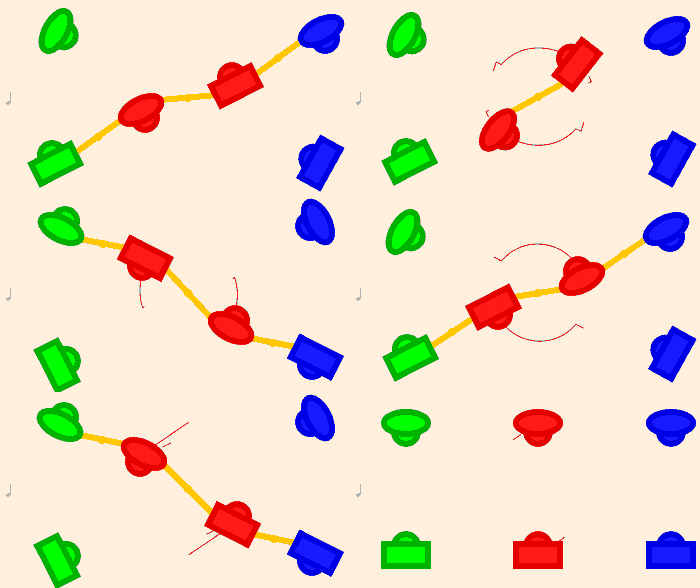 This figure begins in a balance in line position along the 1st diagonal. The active couple is in the middle with right hands to 1st corners and left hands to partner.
1st corners balance in line, 2nd corners set to each other, actives do 1 bar of balance in line and drop hands with corners, then left hand turn to 2nd corners.
2nd corners balance in line, 1st corners set to each other, actives do 1 bar of balance in line and drop hands with corners, then left hand turn to 3rd corners.
3rd corners balance in line, 2nd corners set to each other, actives do 1 bar of balance in line and drop hands with corners, then left hand turn to 4th corners.
4th corners balance in line, 1st corners set to each other, actives do 1 bar of balance in line and drop hands with everyone and return to places.
History
The first dance I can find containing this figure is The Maple Leaf Rant, the author of which is unknown, and the date is estimated by be 1952~1953.
Some dances which (probably) use this figure
Spurtle
An online definition may be found here.
Bars: 12.
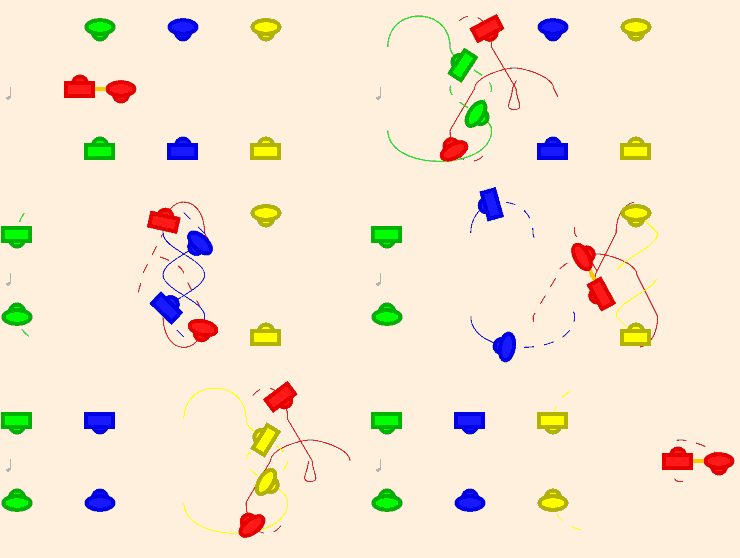 The Spurtle provides a means of progressing in a 4 couple set. It consists of three consecutive half reels of four. The first man faces 2nd lady, and 1st lady second man, then pass right to start half a reel, after two bars the 1s meet and right turn half, moving down slightly as the 2s finish the half reel and move up.
The 1s are now in position to do the same thing with the 3s, and then the 4s. Everyone ends on the wrong sides, in order: 2 3 4 1.
History
The first use of this figure appears to be in the dance The Blue Mess Jacket from Douglas Henderson's Kinclaven Pocket Book of Six Scottish Country Dances, published in ~1960.
Some dances which (probably) use this figure
Star Promenade
Also known as: Double Hands Across, Wagon Wheel.
Bars: 4.
In this figure there is a group of dancers in the center doing a hands across, or hand turn (if there are only two dancers in the middle), each holding their partner in their other hand, and all turning.
History
Lady Banbury's Hornpipe, Playford, 1657 appears to have a star promenade for two couples.
Then Thomas Hurst's Le Moulinet, a Cotillion from 1769: The four Ladies right hands across in the middle once round Ladies still keeping the right hands across each takes her partner with her left hand and turn once more round in a large cross.
In J.P. Boulogne's Petronelle ~ Quadrille, 1827:
Bars 1. The first Gentleman and third Lady perform the figure of a diamond, to their right, in the centre, setting at the four corners 16 2. Double hands across and back again, 8
Some dances which (probably) use this figure
See Also
Swat The Flea
Also known as: Box The Flea.
An online definition may be found here.
Bars: 2.
 This figure involves a facing couple, they join left hands and raise them, then they trade places. The woman turning right 180° as she passes under the raised hands, the man turning left 180° as he walks around her. The left hands remain joined afterward.
History
In March of 1951 Sets in Order published how box the gnat was danced in California, and in Texas. The California version also contains a swat the flea:
Now you box the gnatGive right to corner and exchange places, walking past each other, the lady turning with a left-face turn under the man's right arm.Box the fleaPertains to the left hand with the same person, girl walking forward does a right-face turn, back to original position.
But life isn't simple, and the distinction that box the gnat was with the right hand, not the left wasn't final yet. There's a dance from June of 1951 where the words "box the gnat" are used to describe what I'd call a "swat the flea".
By 1959 the term "swat the flea" has appeared and the destinction between it and "box the gnat" appears clear.
Box the Gnat: Used to reverse direction and exchange places. Partners face and join right hands. The lady makes a left face turn under the man's raised right arm as the man walks forward making a half right face turn. They finish facing each other. Hands have been held easily enough so that the man's hand may turn over the lady's figures (Count: 4 steps)Swat the Flea — Box the Flea: Used to reverse direction and exchange places. Partners join left hands and the lady makes a right face turn under the man's raised left arm as the man walks forward and does a half left face turn. They finish facing each other. (4 steps).— Bob Osgood, ed.
Sets in Order, Dec, 1959
Some dances which (probably) use this figure
See Also
Swing
Bars: 2,4,6 or 8.
A couple stands in ballroom position and turns clockwise about their center, using either a walking step or a buzz step.
History
The partner swing is an essential part of a modern Contra Dance or Square Dance. A dance without a swing is greeted with dismay in our local contra group.
But the swing did not exist in Playford's day, nor in the early Regency period.
I assume the swing is a simplified offshoot of the waltz, a waltz without steps as it were. As far as I know people did not stand in what is now called "Ballroom Position" before the waltz, I'm sure that would have been quite shocking (as indeed the waltz was).
But when did the swing evolve?
Well, it is NOT in Wilson's list of country dance figures from 1808. And as I mentioned earlier there's nothing like it in Playford.
The Regency Dance site says that a dance from 1807 called The Russian Ambassador's Waltz was the first country dance where couples waltz briefly as part of the dance.
There was a style of quadrilles called "Waltz Quadrilles" where waltzing was treated as a figure of the quadrille, Chivers describes Les Valse Quadrilles as early as 1821 in "The Dancer's Guide".
The Complete Ball-Room Hand-Book, Elias Howe, Boston, 1858 includes a category called "Waltz Contra Dances" (page 97) where waltzing is an integral part of the dance, but the waltzing usually seems to involve going somewhere rather than the stationary partner swing.
Cinderrela Waltz
Form as for common Contra dance First lady and second gentleman balance and turn First gentleman and second lady balance and turn two couples waltz down the centre and back right and left four.
Wilson's list does define "Swing Corners" (page 33), this is not a "Swing" in the modern sense, just a turn. Swing is often used in the sense of a hand turn, David Wall's The Russian Dance from 1775 is the earliest example I've found so far.
Hillgrove, in The scholars' companion and ball-room vade mecum, New York, 1857, also uses uses "swing" to mean a hand turn in his descriptions of Contra Dances (page 78):
First couple give the right hand, and swing once and a half round;
Howe, in The Complete Ball-Room Hand-Book, Boston, 1858, uses "swing" in a number of senses:
The term "swing" was still being used in the sense of a hand turn in Cowboy Dances, Lloyd Shaw, 1939 (page 50) when he discusses teaching allemande left to square dancers:
The caller will explain that the complete call is usually given in some such form as:Allemande left with your left hand,
Then right hand partner and right and left grand,but that until they get more used to the call and the idea he will use a simpler form which goes:
Swing your left hand lady with your left hand,
Then right hand partner and right and left grand,
And even today Square Dance uses "Swing through" to describe a series of pull-bies.
The first clear record I have of "swing" in the modern sense comes from Cecil Sharp's The Country Dance Book, part 1, 1909 where it is used in every single one of the dances in that work. He defines it as:
Partners meet, engage in waltz fashion, and dance round in a small circle between the lines of the General Set. At the beginning of the last bar they disengage, return to places, and bow to each other.The step varies with the rhythm of the music, and may take any one of the three following forms: (1) The waltz step: (2) the polka step or a modification of it: (3) step and hop on alternate feet.
Country dancers sometimes, though very rarely, substitute for the Swing the more conventional Set or Set-to-partners, a figure which is familiar to all quadrille dancers. This was the invariable custom in the ball-room where the Swing, as described above, was quite unknown.
There was, however, a figure known to fashionable dancers as the Swing, but this was performed in quite another manner: Partners met, joined right hands, turned slowly round from right to left and returned to places.
Emma Burchenal in American Country Dances, 1918, defines Partner Swing (and Balance and Swing) on page xii.
The most usual way of executing the "Balance and Swing" to-day, is for partners to meet, take "ordinary dance position" (the usual way of holding partner for waltzing), and swing around vigorously with the buzz-step. Originally the "Balance" was executed before the swing, but for some reason this has been almost universally abandoned, so that the expression "Balance and Swing" now means nothing more that "Swing Partners".
If you look up Burchenal's dances in Howe you will find that many of the places where she has a "Balance and Swing" Howe has a simple "Balance" (Circassian Circle, The Merry Haymakers, etc.). Burchenal defines five different ways to "Balance" and perhaps this flexibility allowed it to become a swing?
In the square dance world the picture is mixed. Cecil Sharp does not describe it as part of The Kentucky Running Set (an early square dance) in 1918. Henry Ford/Lovett defines it in Good Morning (a collection of dances, including squares and contras) in 1925, and uses it in both squares and contras.
TURN PARTNERS—(4) Lady and gentlemen join both hands (shoulder high) and turn once around. To swing partner in waltz position, weight of body should rest on half of right foot, turning with toe of left foot.
Ida Levin does not use it in Kentucky Square Dances in 1928. Lloyd Shaw uses it in Cowboy Dances in 1939.
In summary
The word swing was not used (or very rarely) in the modern sense in the 1850s on either side of the Atlantic, but was used that way around 1910 on both sides. Swinging was an integral part of the English Country Dance tradition that Cecil Sharp found still extant, but after his revival that figure seems to have died away. It is almost never used in modern ECDs, though waltzing does occasionally get a look in. The Contra and Square Dance traditions of the US have continued to count swinging as an integral part of their repertory.
Mary McNab Dart in Contra Dance Choreography, a Reflection of Social Change, 1995, has an interesting discussion of how the swing continued to grow in popularity between 1950 and 1990.
Petronella Turn
The dance Petronella was devised by Nathaniel Gow in about 1820, and involved a signature movement which became known as the Petronella Turn. This has become integral to both modern Scottish and American Contra dancing (and is occasionally seen in English).
In modern Scottish a Petronella turn involves a pas-de-basque step to the right (ending facing out), followed by another pas-de-basque step which turns round 180 in place to face back in.
In modern Contra, the figure involves moving right while spinning approximately 360.
But if you look at the Lowes, who published in Edinburgh in 1831 they describe the figure as First couple chassé round to the right.
By ~1868 in Glasgow Wilcock says: First couple turn round to the right which might be a description of the modern contra way of doing it.
The first description I know of from the US is in The Pianist's Matinee: A Collection of Music for the Piano-Forte, Howe, Boston, 1868, where it is described as First couple turn round to the right, and set in centre of dance.
Some dances which (probably) use this figure
See Also
Swing Through
An online definition may be found here.
Bars: 4.
 A swing through starts from a wavy line of four dancers (each dancer facing the opposite way from those adjacent) holding hands. Those holding left hands drop them, and those who can turn right half. Then drop right hands and take left hands where possible, and turn half left.
History
In the 19th century the term "swing" had many meanings, but it did not mean a partner swing. It most frequently meant a hand turn, a right hand turn if nothing else was specified.
The earliest use I can find of "Swing Thru" is from a list of Square Dance calls from Sets in Order, March, 1963. I assume this call has the modern meaning but it's impossible to tell from this list of names.
The next use is from the May 1963 issue, where Willard Orlich deviser who is first mentioned in a list of breaks. This issue also contains a definition of the call, written by Del Coolman (who wrote more of the above breaks than anyone else):
SWING THRUBy Del Coolman, Flint, MichiganIf two facing couples were to start a Pass Thru and stop at that point when they were in a line of four with individuals facing alternately they would be in a position to do a Swing Thru. On the command the line would break in the center and the outside two couples would turn a halfway around in a right hand swing. At this point hands would be released and the two on the outside would remain facing as they are while the two in the center would take left hands, turn halfway around, moving forward, and join hands in a line of four facing alternately with the person on the outside.
Some dances which (probably) use this figure
The Swirl
An online definition may be found here.
Bars: 8.
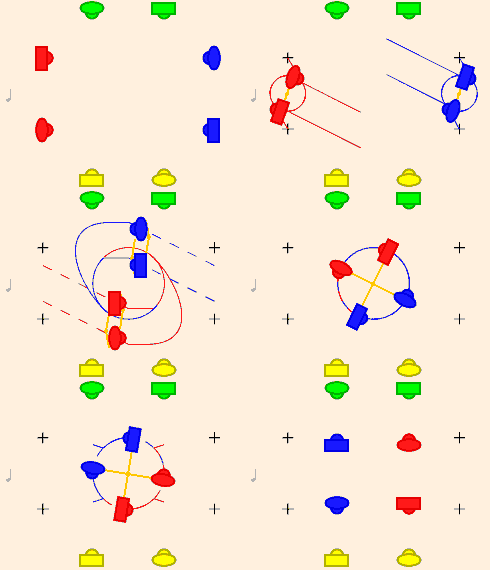 The Swirl is danced by two facing couples (woman on man's right). Men turn their partners right once around into allemande hold facing in. Then promenade half round each other, passing left shoulder, couples dropping right hands and pivoting to face each other again, but on the other side. Then all left hands across once around, and turn to face in the direction needed by the next figure.
History
The first example I can find is in Alex Gray's Edina's Pride, 1984
Some dances which (probably) use this figure
Swirly Siding
Also known as: Sharp Siding, Banana Siding.
An online definition may be found here.
Bars: 4.
 The best description I know of for swirly siding comes from Chris Page who says (something like):
Face your partner and left hand turn half, face them again and right hand turn half back to your original places. Now do it without hands.
Variants
Some modern dances include a mirror image of Sharp's figure: doing a right shoulder round half, and a left shoulder round half back.
History
This form of siding is an invention of Cecil Sharp, who did not know what siding was when he first encountered it. He defines it:
This is performed by two dancers, usually partners, but not necessarily so. They face each other, and move forward a double obliquely to the right, i.e., passing by the left. On the third step they make a half-turn counter-clockwise, completing the turn on the fourth step as they face one another (two bars). This completes the first half of the movement, and it is called side to the right. In the second half of the movement, side to the left, the dancers retrace their steps along the same tracks, moving obliquely to the left (passing by the right), turn clockwise, and face each other on the fourth step. The whole movement occupies four bars of the music.The dancers must remember to face each other at the beginning and close of each movement, to pass close to each other, shoulder to shoulder, and always to face in the direction in which they are moving.
Later he decided he was wrong and suggested using shoulder siding instead, but by then his original mistake had become a new figure in its own right.
Some dances which (probably) use this figure
See Also
Tandem Reel
Also known as: Shadow Hey, Shetland Hey.
An online definition may be found here.
Bars: 8.
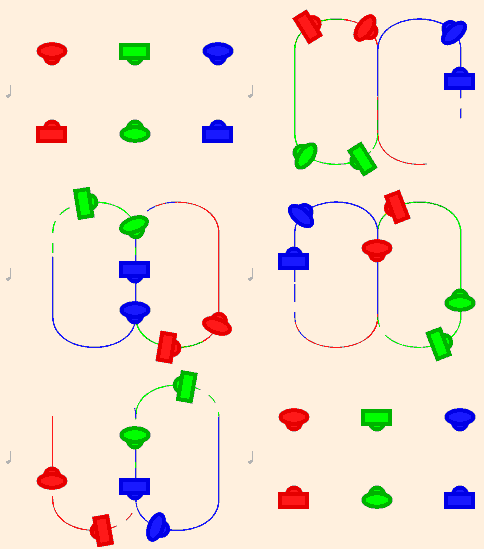
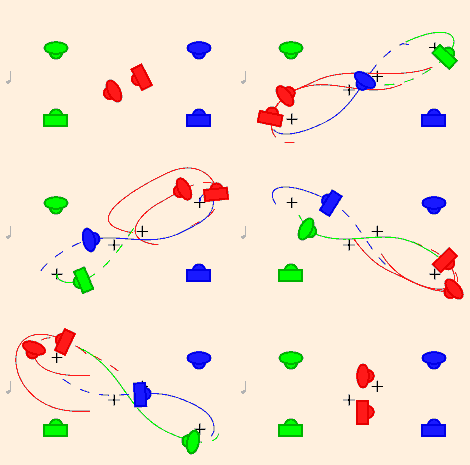 The Fletts give several different versions of Shetland Reels, I'm only showing one. In all the 3 couple reels, each couple acts as a unit with the woman leading her partner. They follow the normal figure eight pattern of three person reels, except that each unit in the dance is a woman followed by her man.
History
The Fletts, in their Traditional Dancing in Scotland, 1964, say that this Shetland Reel seems to have been current as far back as living memory extends in the Sandwick and Cunningsburgh districts, which would be about the 1880s?.
Pat Shaw devised a few dances containing Shetland Reels in 1977 (see The American Husband).
John Drewry is the first I know of who only had one couple in tandem during the reels, see his dance Ferla Mor, 1981
Some dances which (probably) use this figure
See Also
Tandem Reel Switching Leads
Also known as: Dolphin Hey, Dolphin Reel.
Bars: 8.
 In a dolphin reel two people act as one unit of the reel, they move across the set together, one behind the other, and when at the end of they reel they switch leads. In the example at left the first couple forms one unit with the woman in front, they pass the second woman by the right shoulder and turn around in such a way that the man is now in front, they go back across the set passing the second man by the right, second woman by the left, turn around at the bottom so that the woman is again in the lead and pass the second man by the left.
History
As far as I know the origin of the term "Dolphin Reel", and the first dance to use the figure are the same: Pelorus Jack, 1993. Pelorus Jack was a dolphin from New Zealand who liked to guide ships.
Some dances which (probably) use this figure
See Also
Targe
An online definition may be found here.
Bars: 8.
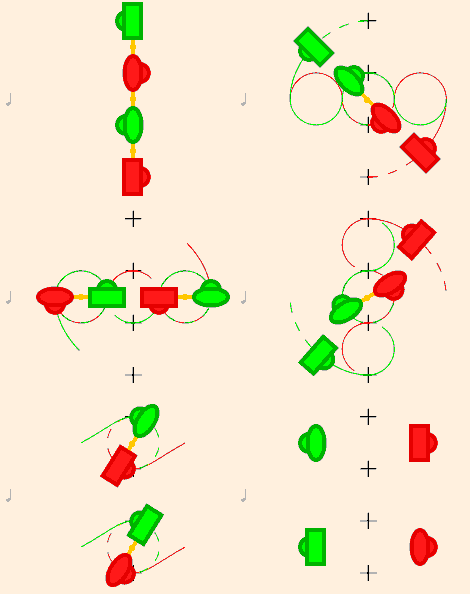 The targe is a two couple figure which starts in a line across the dance, with men on the outsides of the line, women on the insides. Men hold left hands with the woman who is not their partner (M1 facing down outside men's line, M2 facing up outside women's), while women hold right hands together, and left hands with person not their partners (W1 facing down, W2 up).
All drop left hands, women turn right three quarters, while men chase counter-clockwise a quarter.
Women drop right hands, and take left with their shadow, and turn once round to the left.
All drop left hands, women take right, women turn right three quarters, as men chase counter-clockwise a quarter.
Take left hand with shadow and turn left three quarters, ending with 2s above 1s on their own sides, and 1s on opposite sides.
History
The earliest dances I've found using this figure are The Clansman by Derek Haynes, 1981, and The Smith at his Anvil by Iain Boyd, also 1981. Not sure which came first, or if there's one even earlier.
Some dances which (probably) use this figure
Three Couple Rights And Lefts
An online definition may be found here.
Bars: 12.
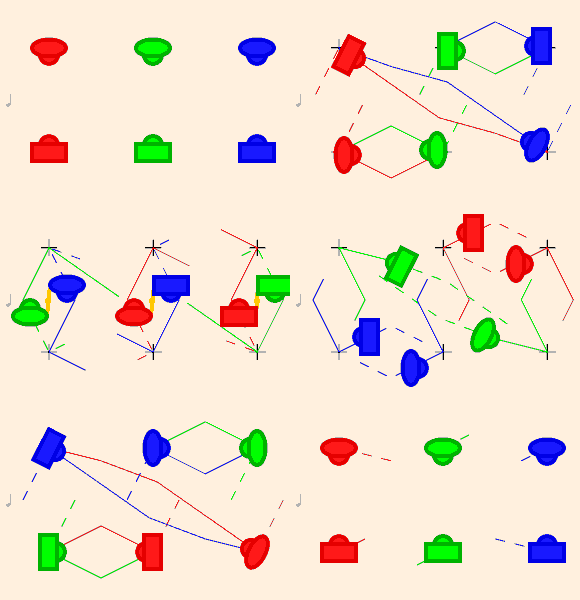 In a three couple right and left, all three couples cross by the right hand with partner. Then those in 2nd corner positions cross left on the diagonal while others cross left with neighbor on the sides. This repeats twice more returning everyone to their original places.
History
The earliest dance I can find with this figure on the SCDDB is Sterling of Caulder said to have been devised by Ron Wallace in 1978.
The next use is in Johnnie's Welcome Hame, by Neil Grant, 1982.
Some dances which (probably) use this figure
See Also
Tourbillon
An online definition may be found here.
Bars: 8.
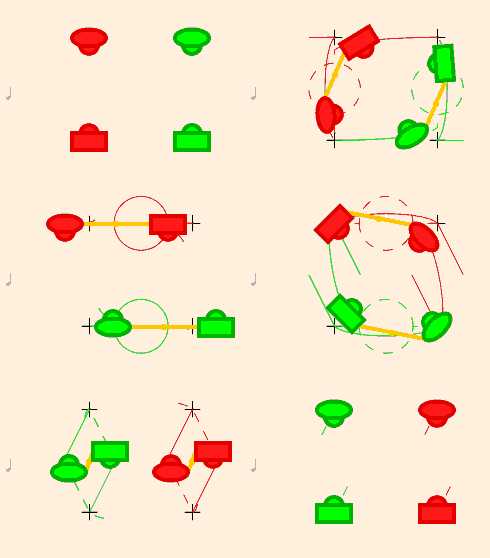 The Tourbillon is a progressive figure for two couples. They two hand turn their partners half, and then release hands closest to the center of the set. M1,W2 draw their partners one place clockwise (with one hand joined, still facing the center of the set). 1s on the Women's side, 2s on the men's set across. Taking both hands with partner, turn half way, and release the innermost hands. W1,M2 draw their partners clockwise one place across the set. Cross with partner by the right hand.
History
Barry Priddey published at least three dances in 1984 which contain the Tourbillon (The Burn of Sorrow, for one). Most of his dances and publications are undated, so these may not be the earliest ones, but they are the earliest I can date.
Some dances which (probably) use this figure
Tournée
An online definition may be found here.
Bars: 8.
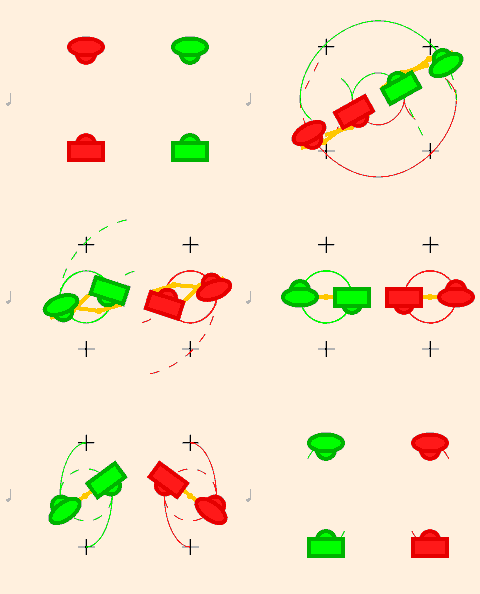 Tournée is a progressive figure for two couples. All advance to the centerline, the men inside the women, M1 turning over his left shoulder, and W2 over her right so that the 1s are facing the men's line (woman on the right), and the 2s are facing the women's line (woman again on the right), all in promenade hold. Promenade half around the set, then the men turn their partners across in front of them, 1s with the left hand 2s the right, finishing on the center line, women in the middle.
Mirror turn partner once and a half, 1s left, 2s right, and dance out to own sides.
History
The earliest use of this figure that I can find comes from a dance by Robert Campbell, From Scotia's Shores We're Noo Awa' which was published in "Two Traditional Scottish Dances - 8th set", 1964.
Some dances which (probably) use this figure
Turn Corner, Partner, Corner, Partner
Also known as: Swing Corners.
An online definition may be found here.
Bars: 8.
 Turn 1st corner right, turn partner left (once and a half times in Scottish), turn 2nd corner right, cross with partner by left.
History
Early examples of this figure are not very explicit, and it is not always clear which hand you use to turn whom, thus in modern dancing styles we have two different versions of what is basically the same figure.
In US Contra Dancing you turn your partner right, your 1st corner left, your partner right again, and your second corner left. The first description I can find that explicitly says to do this is in Thomas Wilson's An Analysis of Country Dancing from 1808.
Most other styles have settled on: turn your first corner right, partner left, 2nd corner right, partner left.
In Iantha the Lovely, Walsh, 1718 said: the 1st Man turn the 3d Wo. and the 1s Wo. the 2d. Man, then he turns his own Partner; then 1st Man turn the 2d. Wo. and the 1st. Wo. the 3d Man, and turn his own Partner again. We know whom to turn, and the order, but not whether to use right or left (or both) hands.
In Bullock's Hornpipe, John Young, 1726, says: And then cross over quite round all the 4 corners. which is even less specific.
Walsh, in 1731 does a little better in the dance Prince William saying: The 1st Man turns the 3d Wo. with his Right Hand, his Partner does the same with the 2d Man at the same Time and then turn your Partners Do the same at the other Corner.
Nathanial Dukes, 1752, in his A Consise & Easy Method of Learning the Figuring Part of Country Dances also defines it as right hands to corner, left to partner, right to corner, and left to partner.
Usually 8 bars are allocated for this figure, but occasionally 16.
Porter, Heffer, & Heffer suggest using a two hand turn (instead of right or left) for a 16 bar version in Fandango when Thompson said: turn corners & turn your Part: the same at the other corners.
Some dances which (probably) use this figure
See Also
Turn Single
Bars: 2.
 A turn single is turning in a small circle (about the size of a pizza) by yourself. You end up where you started. A turn single left means that you start the small circle by turning over your left shoulder. A turn single right involves turning over your right shoulder.
A turn single up means that you start turning up the set, while a turn single down means you start turning down.
A turn single cloverleaf means turning in such a way as to trace the pattern of a four leaf clover. You start by turning away from the center of the minor set. The way you turn will depend on where you are in dance and what direction you are facing. When facing your partner, the top couple will turn up and the bottom couple will turn down. The example on the right shows a cloverleaf turn.
Often no direction will be specified. Turn which ever way feels natural (given the flow of the dance).
Sometimes you will be expected to travel at the same time as turning, this will be explained in the choreography and you may find you simply spin as you move.
History
This figure is commonly used in the Lovelace Manuscript (1620~1649) as well as in Playford's Dancing Master, but it became less common over the 18th century, and the last use I've found so far is in Thompson's The Spaniard. of 1777.
Some dances which (probably) use this figure
See Also
Turn Single Cloverleaf
Bars: 2.
 A turn single is turning in a small circle (about the size of a pizza) by yourself. You end up where you started. In a turn single cloverleaf you turn away from the center of your duple minor set.
Playford mostly just says "turn single", modern interpreters have chosen to interpret this sometimes as a cloverleaf.
Some dances which (probably) use this figure
See Also
Up a Double, Siding, Arming
Also known as: USA.
Bars: 8 each.
 This is more a frame work than a figure as such, it names three figures often used in succession in early multi-part country dances, each one being the introduction to a new part of the dance. See Cuckolds All A Row for an example of this type of dance.
Each of these standard figures will be followed by the rest of the part. Occasionally all parts will have the same chorus, but more often each has a unique sequence.
This style of dance was quite common in the dances of the Lovelace MS, and the early Playford dances, but almost none was published after 1670.
Variants
In a square, or circle dance the "up a double" often becomes an "in a double" or circle left a double, followed by a circle right. Occasionally the second "up a double" will be a "down a double" (away from the presence).
History
Dances using this structure appear in the Lovelace Manuscript and in many early Playford dances. The 4th edition of the Dancing Master (1670) is almost the last to print any new dances of this format. The one exception is Fairy Queen published by John Young in 1726.
Marjorie Heffer & William Porter revived the style in Maggot Pie, published 1932. Pat Shaw's Monica's Delight is another such dance from the early 1930s. Since then a number of modern authors have used it.
Some dances which (probably) use this figure
See Also
Waltz
Bars: 8,16.
The Regency Dance Site has a good paper on the history of the waltz in England and how it interacted with Country Dance.
Starting in the 1790 you started seeing dances set to waltz music (and which contained "waltz" in their names, like The New German Waltz published by Longman & Broderip in 1796). But people did not waltz in these dances.
According to the Regency Dance's paper, the first country dance to describe a ballroom position hold and waltzing within the dance was William Campbell's The Russian Ambassador Waltz from ~1807.
Elias Howe published 12 country dances which contain waltzing as one of their figures in The American Dancing Master, 1862.
Some dances which (probably) use this figure
See Also
Weasel Reel
An online definition may be found here.
Bars: 8.
 This is a reel for three couples, it starts with four dancers on the center line ready for a reel of four, and two other dancers out on the side lines about midway up or down the set. The one on the men's line is facing up, the one on the woman's line is facing down.
It finishes when everyone is back where they started.
Those on the center line pass right to start the reel, while those on the outsides chase clockwise. When someone reaches the end of the reel they start chasing clockwise. When someone reaches the end of the chase, they give way before the person exiting the reel, and then pass the next person in the reel by the right.
History
According to a note on the SCD dictionary this reel was invented by Barry Skelton in 1990.
Some dances which (probably) use this figure
See Also
Sources
Here are a list of books which contain some descriptions of figures. Sometimes an entire book is devoted just to dance figures, sometimes it's a glossary or some such thing, in the case of cotillions the "changes" are often well described while the figures used in the dances are not. Mostly the descriptions are in words, but some also contain images showing the motions of the dancers. And, of course, the modern website Taminations contains both written definitions and animations of the figures.
Sadly, it is often the case that the descriptions are so vague that they only make sense if you already know what the phrase means, this is why the images are so useful.
Some books of French contredanses are described entirely in images with no words. I do not include such books in the list below since they usually don't help associate the name of a figure (since there are no figure names) with its movements. Still, if such things appeal to you look at Feuillet's Recüeil de contredances mises en chorégraphie, Paris, 1706.
| 1589 |  | Thoinot Arbeau, Orchésographie A book mostly concerned with steps, which occasionally spells out figures too. |
| 1752 |  | Nicholas Dukes, A Consise & Easy Method of Learning the Figuring Part of Country Dances A book describing figures with images. |
| ~1757 | | d'Aubat de St. Flour, Cent Contredanses en Rond Contains a list of figures and how long they take, no real descriptions, but Feuillet diagrams of some figures scattered randomly in the text. |
| 1768 | | J. Longman, XXIV New Cotillons or French Dances Contains a list of the cotillion changes, but no figure descriptions. |
| 1769 | | Thomas Hurst, The Cotillons Made Plain and Easy, Contains a list of the cotillion changes, but no figure descriptions. |
| 1770 | | Siret, A set of Cotillons, or French Dances Contains a list of cotillion changes, each dance is described in words, and pictures (but no list of figures as such) |
| 1772 | | Giovanni Andrea Gallini, A New Collection of Forty-four Cotillons, with Figures Properly Adapted Contains a list of cotillion changes, and a brief verbal description of many common figures and steps. |
| 1785 | | Malpied, Les Caracteres des Contre~Danses A French work with Feuillet diagrams of cotillion figures. |
| 1802 |  | Saltator, A Treatise on Dancing Contains a list of cotillion changes (pages 79-80), definitions of a few cotillion figures (pages 78-79), and definitions of (a rather limited set of) country dance figures (on pages 85-86) |
| 1808 | | Thomas Wilson, An Analysis of Country Dancing A book describing figures with images. |
| 1811 | | Thomas Wilson, An Analysis of Country Dancing, 3rd Ed. A book describing figures with images. |
| 1815 | | Thomas Wilson, The complete system of English country dancing A book describing figures with images. |
| 1822 |  | Thomas Wilson, The quadrille and cotillion panorama A book describing figures with images. |
| 1822 | | G. M. S. Chivers, The Dancer's Guide Contains a description of a few French figures with French names (pages 6-7), and an even shorter list of figures with English names (page 8). Another short list of figures on page 46. |
| 1822 | | G. M. S. Chivers, The Modern Dancing Master Description of about 20 country dance figures on pages 42-44, a few Ecossoise figures on page 70, a few Spanish figures on pages 78-79, a few Swedish figures (for trios) on page 98, and a few Mescolanzes figures on page 102. There are some Quadrille figures defined on pages 113-116. |
| 1820~1830 |  | Anon, NLS MS 3860 Description of about 20 country dance figures including the turning poussette. Also some Quadrille figures. |
| 1824 | | G. M. S. Chivers, The Quadrille Preceptor Contains a description of a few French figures with French names (page 5) |
| 1827 | | C. S. Van Winkle, Le Maître de Danse, Or, The Art of Dancing Cotillons Entire book devoted to explaining steps and figure with written descriptions and images for the figures. (The title says "Cotillons" but he is describing what I call Quadrilles) |
| 1828 | | J. S. Pollock, La Terpischore Moderne Contains a description of a few French figures with French names (pages 7-8) |
| 1838 | | F. Lowe, The Select Quadrille Preceptor for 1838 Contains a description of a French figures with French names (pages 7-10) |
| 1841 | | Huestis & Craft, The Ball-Room Instructer Contains a description of figures with English names starting page 13, and French names on page 42 |
| 1852 | | Thomas Wilson, The Art of Dancing Contains a description of Quadrille figures (pages 14-18) |
| ~1890 | | John M. Schell, Prompting How to do it, Contains a list of terms (containing figures) and their definitions, pages 4-8 |
| 1909-1926 | | Cecil Sharp The Country Dance Book Parts 1-4,6 Sharp produced a glossary of figures and definitions which grew longer with each new part. |
| 1918 | | Elizabeth Burchenal American Country-Dances, Vol. 1 Contains a list of steps (page xii), and figures (on pages xii-xiv) |
| 1918 |  | Cecil Sharp Country Dance Book, Part 5 Contains a description of the structure, and list of figures for an early type of Appalachian square dance. |
| 1925 | | Henry Ford/Benjamin Lovett, Good Morning. Contains a list of calls and figures on pages 117-119 |
| 1932 | | Neva Boyd/Tressie Dunlavy, Old Square Dances of America. Contains a short list of calls with definitions on pages 7-9 |
| 1937 | | Beth Tolman&Ralph Page, The Country Dance Book Contains a glossary of calls with definitions on pages 32-41 |
| 1949 | | Sets in Order. An early attempt to standardize square dance calls, at least in southern California, defines 26 calls, and five useful terms like "Partner, Corner, Home, Hand positions, Steps". |
| 1950 | | Sets in Order. A list of calls, and terms for Texas square dances. |
| 1953 | | Clarke Kugler Easy Key Handbook of Square Dance Fundamentals. A list of calls (or fundamentals) for Southern California. |
| 1956 |  | Rickey Holden, The Contra Dance Book Contains a glossary of contra terms with definitions on pages 33-46 |
| 1957 | | Sets in Order, May Sets in Order, June Sets in Order, July A list of about 110 square dance terms, spread over 3 issues. |
| 1968 | | Sets in Order, Dec, 1968 Sets in Order, Jan, 1969 Gold Ribbon Report, Basic+Extended Programs |
| 1976 | | Keller&Sweet, A Choice Selection of American Country Dances of the Revolutionary Era Contains a glossary of figures with definitions on pages 46-52 |
| 1983 | | Larry Jennings, Zesty Contras Contains a glossary of contra terms with definitions on pages 9-14 |
| 1991 | | Douglas Kennedy/Tony Parkes, Comunity Dances Manual 1-7 The 1991 combined edition contains a glossary of contra terms with definitions on pages 119-123 |
| 2004 | | Larry Jennings, Give and Take Contains a glossary of contra terms with definitions on pages 3-6 |
| Current | | Tamitwirlers/Callerlab Taminations Contains all MWS calls with animations and CallerLab definitions. |
| Current |  | Scottish Country Dance Dictionary/RSCDS Figures Dictionary Contains the standard Scottish Country Dance figures described bar by bar often with figures. |
There are far more descriptions of Quadrille figures and Cotillion changes than there are of anything that precedes them. Perhaps this is because Quadrilles and Cotillions were often described in French terms. There are also a lot of Square/Contra dance descriptions. Perhaps because people had forgotten how to dance by then.
I find it interesting that the Glossary in the Community Dances Manual contains Contra Dance and English Country Dance terms (Yet it does not contain a description of "Right and left" or "Circular Hey"). It was published by the EDFSS, while the Glossary was written by Tony Parkes, from the US; but the series is half from the US and half the UK.
This website is copyright © 2021-2026 by George W. Williams V My work is licensed under a Creative Commons Attribution 4.0 International License. Most of the dances have more restrictive licensing, see my notes on copyright, the individual dance pages should mention when some rights are waived.